What Is a Chief Revenue Officer? The B2B Founder’s Complete Guide to the CRO Role
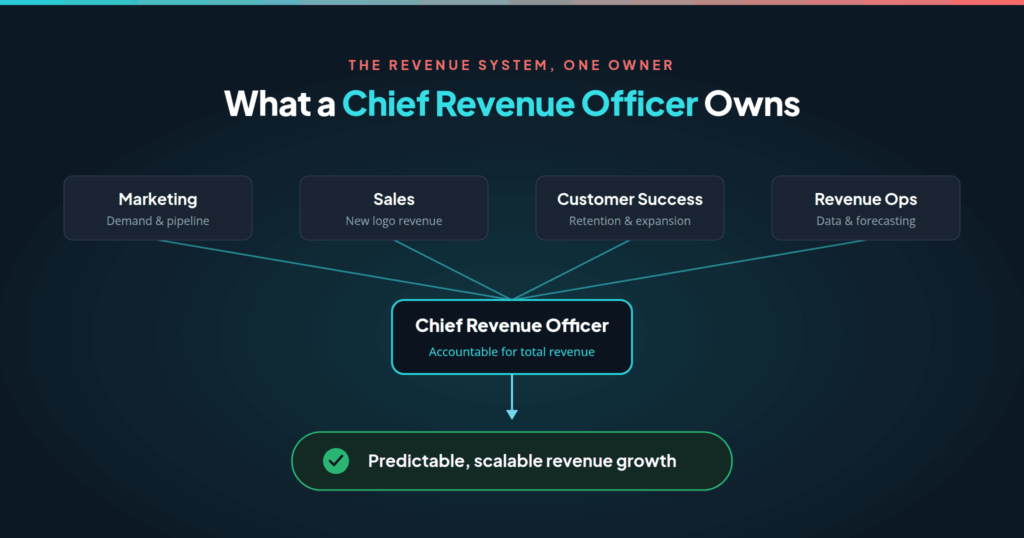
A chief revenue officer (CRO) is the executive accountable for every function that generates, retains, and grows revenue across a B2B company. Sales, marketing, customer success, and revenue operations all report to or align under the CRO. A VP of Sales owns one motion and its number; the CRO owns the entire revenue system and the number that comes out of it.
I get this question a lot from founders and CEOs, and it usually shows up at a predictable moment: growth has plateaued, the go-to-market teams are pointing fingers, or the pipeline looks healthy on the dashboard and keeps missing the number anyway. When that’s the situation, the CRO conversation starts fast. This guide answers it directly, from the operator’s chair rather than the org-chart theory.
A chief revenue officer owns the full revenue lifecycle, not just sales. They design the go-to-market operating model, align sales, marketing, customer success, and RevOps, and carry accountability for predictable revenue growth. Whether you need a full-time CRO, a fractional CRO, or something else entirely depends on your stage, your budget, and the specific gaps in your revenue system.
What Is a Chief Revenue Officer?
The chief revenue officer role came out of a problem I’ve watched play out inside company after company: as B2B businesses scale, sales, marketing, and customer success drift into silos, and each function starts optimizing for its own scoreboard at the expense of the others. Marketing celebrates MQL volume while sales complains the leads are junk. Customer success guards retention while expansion revenue sits untouched. Revenue leaks at every handoff, and no single leader has the authority to close the gaps.
The CRO exists to own the whole system rather than one slice of it.
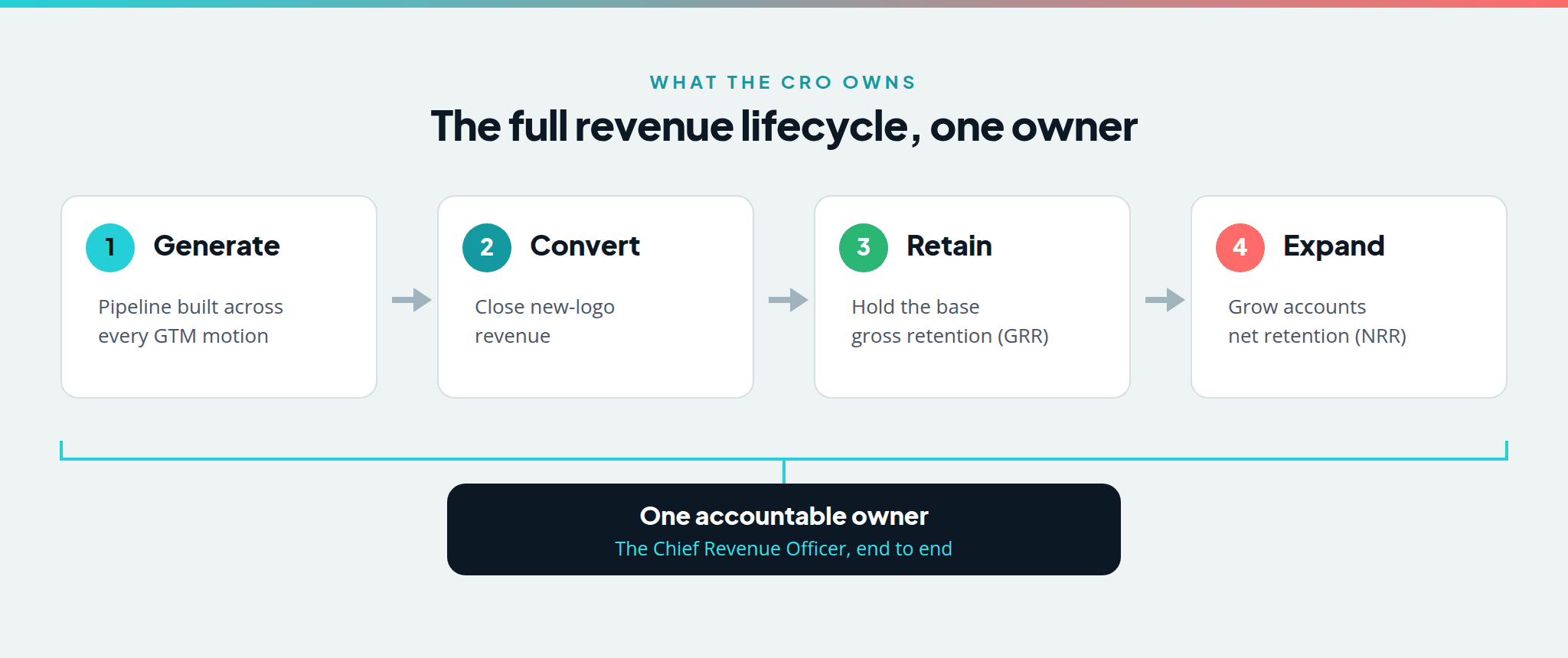
What makes a CRO different from other revenue leaders:
- Scope: A CRO owns all revenue-generating functions. A VP of Sales owns one team.
- Accountability: The CRO answers to the CEO and board for total revenue performance, not just a single team’s quota.
- Orientation: A CRO thinks in systems. They design the operating model that connects pipeline generation to closed revenue to retained and expanded accounts.
- Strategic authority: A CRO carries the organizational authority to make cross-functional calls that a VP of Sales or CMO simply can’t.
The chief revenue officer job description shifts with company stage, but the core mandate holds steady: build a predictable, scalable revenue engine and stand behind its output.
The CRO role is not a glorified VP of Sales title. Companies that treat it that way under-invest in the cross-functional infrastructure the role actually requires — and end up disappointed with a hire that never had a fair shot.
What Does a Chief Revenue Officer Do?
The day-to-day work spans strategy, execution oversight, and organizational alignment. Strip it down and a CRO does three things: they set the revenue strategy, they build the systems to execute it, and they hold the teams accountable for what those systems produce.
CRO Responsibilities by Function
Revenue strategy. The CRO defines the go-to-market strategy: which segments to target, which motions to run (inbound, outbound, channel, PLG), and how to sequence growth so it survives contact with the field. They translate the company’s growth goals into a concrete operating plan with headcount, budget, and pipeline coverage behind it.
Sales leadership. The CRO owns sales performance. They set quota structures, define territory models, establish the sales methodology (MEDDPICC, SPICED, Challenger, and the like), and make sure the team has the enablement and coaching to actually execute it. They run or oversee pipeline reviews and forecast calls.
Marketing alignment. A CRO doesn’t run marketing in the traditional sense, but they are on the hook for marketing’s contribution to pipeline. They set demand generation targets, hold marketing and sales to a shared ICP, and close the MQL-to-opportunity conversion gaps that quietly wreck pipeline quality.
Customer success and expansion. New logo revenue is only half the equation. A CRO owns net revenue retention, which puts churn, expansion, and upsell squarely on their desk. This is where I see companies leave the most money on the table, because nobody senior owns the back half of the customer lifecycle.
Revenue operations. The CRO leans on RevOps to instrument the system. CRM hygiene, pipeline visibility, forecasting accuracy, and tech stack rationalization all sit under the CRO’s purview, even when a Head of RevOps runs the day-to-day.
Core CRO Responsibilities at a Glance
| Responsibility | What it involves |
|---|---|
| Revenue strategy | GTM model, segment prioritization, motion design |
| Sales performance | Quota, methodology, pipeline reviews, forecasting |
| Demand generation | Pipeline targets, ICP alignment, marketing attribution |
| Customer retention | NRR, churn reduction, expansion playbooks |
| Revenue operations | CRM, forecasting infrastructure, data integrity |
| Board reporting | Revenue KPIs, growth trajectory, hiring plans |
The bottom line: if you need someone to run sales calls and manage a quota-carrying team, hire a VP of Sales. If you need someone to architect the entire revenue system and answer for the number, that’s a CRO.
CRO vs. VP of Sales vs. CMO vs. RevOps
One of the most common points of confusion I run into with founders is how the CRO relates to the other senior revenue leaders. These roles are not interchangeable, and blurring the lines between them is one of the fastest ways to manufacture organizational dysfunction.
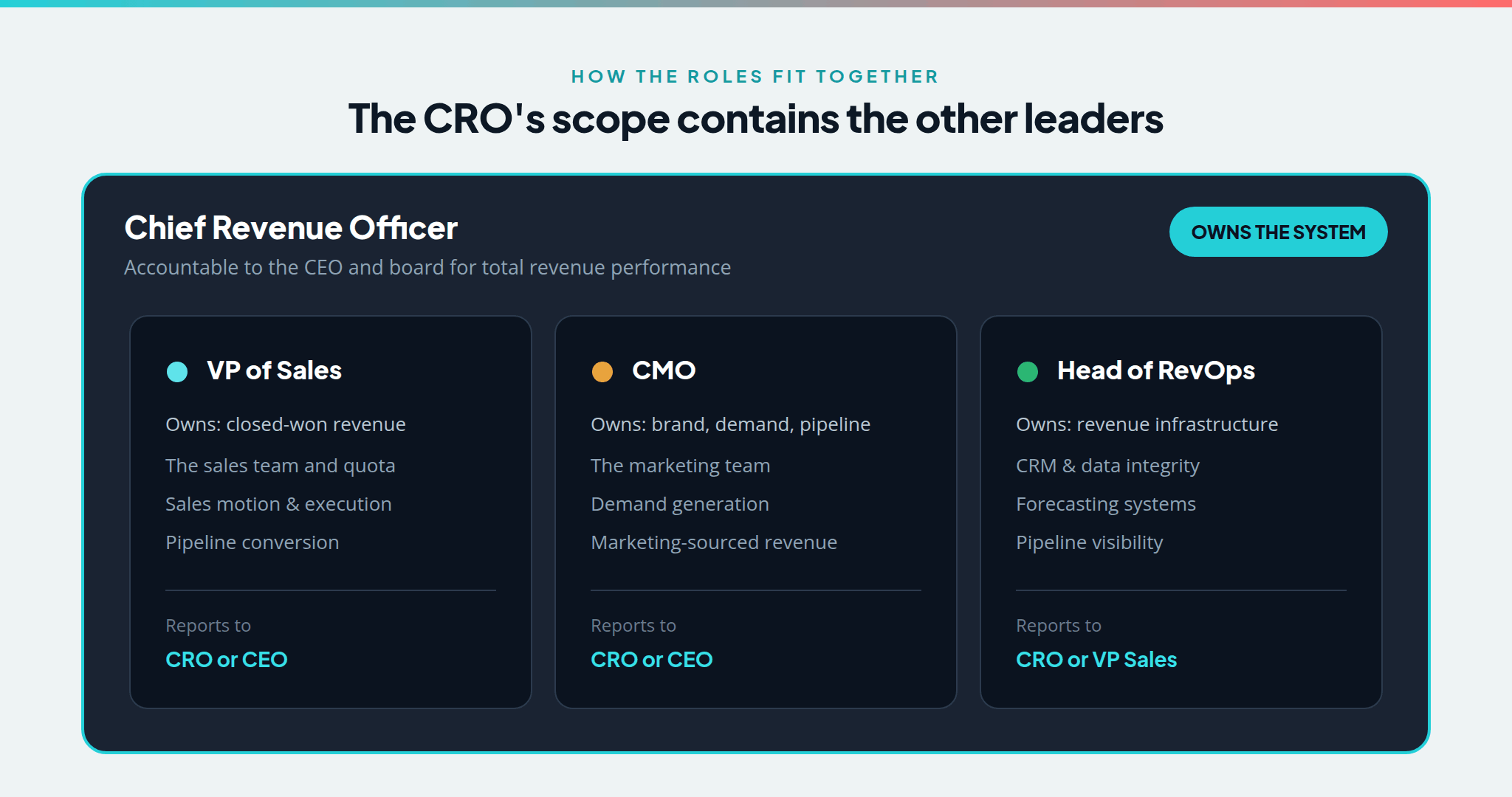
How the Roles Compare
| Role | Primary accountability | Scope | Reports to |
|---|---|---|---|
| Chief Revenue Officer | Total revenue performance | Sales, marketing, CS, RevOps | CEO / Board |
| VP of Sales | Closed-won revenue | Sales team and quota | CRO or CEO |
| CMO | Brand, demand, pipeline | Marketing team | CRO or CEO |
| Head of RevOps | Revenue infrastructure | CRM, data, forecasting systems | CRO or VP Sales |
CRO vs. VP of Sales
The VP of Sales is a function leader. They manage the sales team, own quota attainment, and optimize the sales motion. They’re not typically responsible for how marketing generates pipeline, how customer success retains accounts, or how pricing strategy moves deal velocity.
The CRO is accountable for all of it. They set the conditions under which the VP of Sales can win, and then they hold that leader to results.
When companies confuse these roles: a founder promotes a strong VP of Sales into a CRO title without expanding the mandate or handing over real authority across marketing and CS. The new “CRO” keeps doing VP of Sales work, and the dysfunction that prompted the hire in the first place is still sitting there six months later.
CRO vs. CMO
The CMO owns brand, content, and demand generation, and gets measured on pipeline contribution, brand equity, and marketing-sourced revenue. The CRO sets the pipeline targets the CMO is building toward and holds the marketing org accountable for ICP alignment and conversion quality.
In companies without a CRO, the CMO and VP of Sales end up in a standing turf war, because no single executive owns the full funnel. A CRO settles that fight by owning both sides of the handoff. For a deeper look at how these roles interact, see the Fractional Chief Revenue Officer vs. CMO comparison.
CRO vs. RevOps
Revenue operations is a function, not a leadership seat in the same sense. RevOps exists to instrument and optimize the revenue system the CRO designs. A strong RevOps team without a CRO tends to build a lot of impressive infrastructure with no strategic direction pulling it together, and a CRO without RevOps is flying the plane with the instruments taped over. The two are complementary, not competing.
When Does a Company Need a CRO?
Not every B2B company needs a CRO. The role earns its keep at a specific inflection point: the revenue system has gotten complex enough that no single functional leader can optimize the whole thing, but the company hasn’t yet reached the scale where a full-time C-suite hire is an obvious call.
Signals That a CRO Is the Right Next Hire
- Pipeline is inconsistent despite a functioning sales team. That’s rarely an effort problem; it’s a design problem.
- Sales and marketing are misaligned. Leads aren’t converting, attribution is disputed, and nobody owns the handoff.
- Net revenue retention is declining. Churn and contraction are quietly eating your new logo growth.
- Forecasting is unreliable. The CEO keeps getting surprised at the end of the quarter, in both directions.
- The founder is still the de facto CRO. Revenue strategy lives in the CEO’s head, which puts a hard ceiling on growth.
- You’re entering a new market or motion. Launching outbound, moving upmarket, or standing up a channel calls for a systems thinker, not another sales manager.
Stage Fit
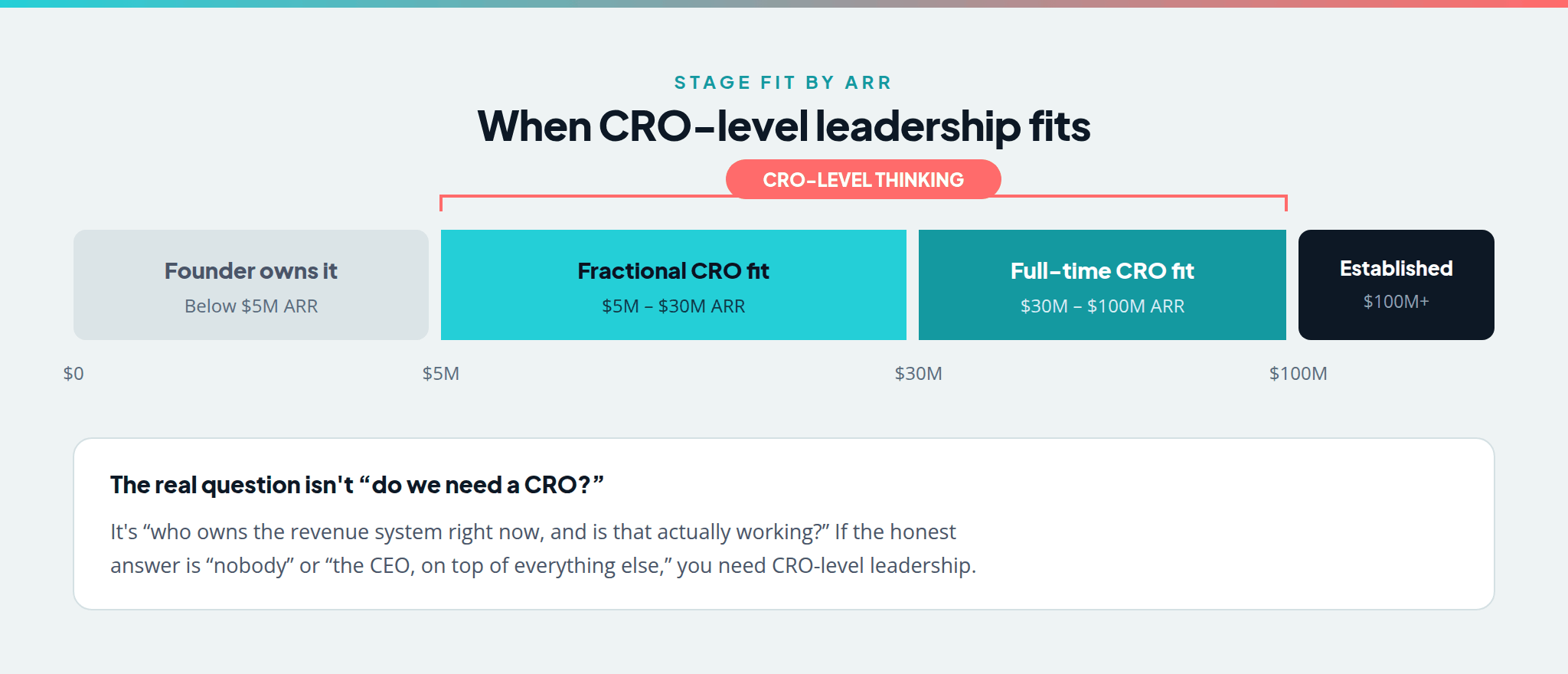
Most companies get the most out of CRO-level thinking somewhere between $5M and $100M in ARR. Below $5M, the founder usually owns revenue strategy directly and should. Above $100M, the CRO role is typically well-established, and the conversation is about optimization rather than activation.
The real question isn’t “do we need a CRO?” It’s “who owns the revenue system right now, and is that actually working?” If the honest answer is “nobody” or “the CEO, on top of everything else,” you need CRO-level leadership — whether that comes full-time or fractional.
Fractional CRO vs. Full-Time CRO: Which One Do You Need?
Once a company decides it needs CRO-level leadership, the next question is how to get it. A full-time CRO hire is the traditional answer, but for a lot of mid-market B2B companies, a fractional CRO is a faster and far more capital-efficient path to the same outcome.
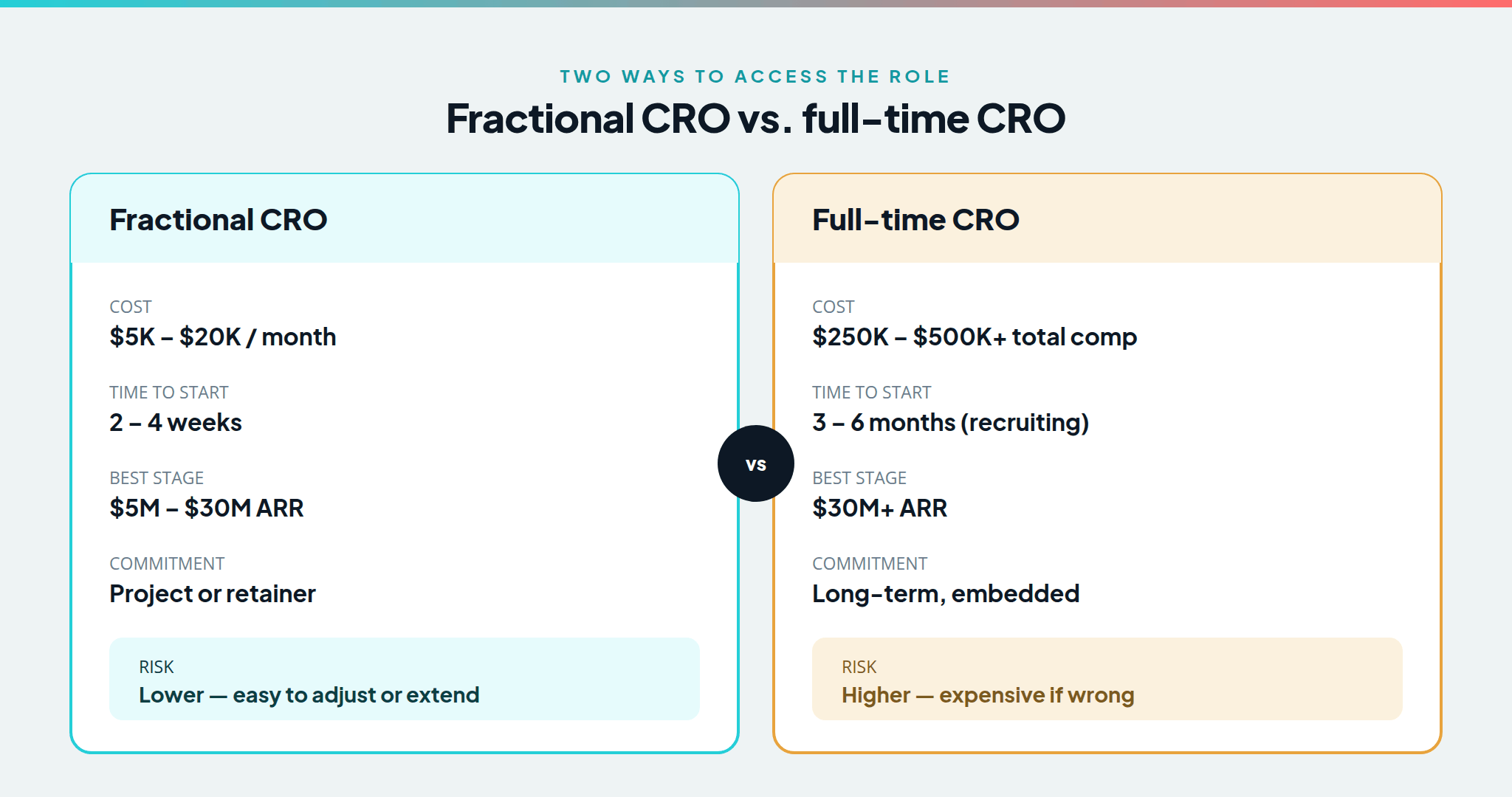
Full-Time CRO
A full-time chief revenue officer is embedded in the organization, owns the P&L for the revenue functions, and typically commands total compensation of $250,000 to $500,000 or more once you add base, bonus, and equity. The upside is full bandwidth and long-term ownership. The risk is that a bad hire at this level is expensive to carry and slow to unwind, and you often don’t know for two or three quarters.
Best fit for: companies at $30M+ ARR with a stable revenue team, a clear go-to-market motion, and the infrastructure to support a C-suite hire.
Fractional CRO
A fractional CRO brings CRO-level strategy and execution on a part-time or project basis. Because they work across several companies at once, they’ve pattern-matched across a much wider range of revenue problems than almost any single full-time hire will have seen, and they can put that pattern recognition to work in weeks rather than quarters.
Best fit for: companies between $5M and $30M ARR, or companies at any stage that need to diagnose and fix a specific revenue problem before they commit to a permanent hire.
Side-by-Side Comparison
| Factor | Fractional CRO | Full-Time CRO |
|---|---|---|
| Cost | $5K–$20K/month typically | $250K–$500K+ total comp |
| Time to start | 2–4 weeks | 3–6 months (recruiting) |
| Bandwidth | Part-time, focused | Full-time, dedicated |
| Commitment | Project or retainer basis | Long-term |
| Best stage | $5M–$30M ARR | $30M+ ARR |
| Risk | Lower (easier to adjust) | Higher (expensive if wrong) |
When to Hire a Fractional CRO
A fractional CRO tends to be the right call when:
- You need CRO-level thinking but can’t justify a full-time executive salary yet
- You’re at an inflection point (new market, new motion, post-raise) and need strategic clarity fast
- You want to audit and fix the revenue system before you hire a permanent leader
- Your current VP of Sales is strong but needs strategic support above their level
For a lot of B2B companies, the fractional engagement doubles as a de facto audition. It surfaces what the company actually needs in a full-time hire before anyone commits to a $400K search and the year it takes to know whether it worked. See how this plays out in practice in the TheSchuck.Agency case studies.
CRO Metrics: How to Measure Revenue Leadership Performance
A CRO should be measured on outcomes that span the full revenue lifecycle, not just closed-won deals. If your CRO is only being graded on new logo quota attainment, you’re measuring a fraction of the job and you’ll get a fraction of the value.
The Core CRO Metrics Dashboard
Pipeline and growth: total pipeline coverage (target: 3x to 4x quota), pipeline generation by motion (inbound, outbound, partner), new logo ARR vs. target, and average deal size and deal velocity trends.
Retention and expansion: net revenue retention (NRR) — the single most important metric for SaaS and recurring revenue businesses — gross revenue retention (GRR), expansion ARR as a percentage of total ARR, and churn rate by segment.
Efficiency: customer acquisition cost (CAC) by motion, CAC payback period, sales cycle length by segment and deal size, and win rate by stage and competitor.
Forecast accuracy: forecast accuracy within 10% of actual is a reasonable benchmark for a mature revenue system, and a consistent miss in either direction — over or under — points to a data or process problem, not just a sales problem.
In recurring revenue businesses, net revenue retention is the metric your board watches most closely. NRR above 110% means your existing customer base is growing faster than it churns — and that single fact rewrites the economics of everything you do to grow.
Common CRO Hiring Mistakes
Most CRO hiring failures are predictable. They fall into a short list of patterns that founders repeat because the role is so poorly understood at the moment the hire gets made. I’ve been called in to clean up most of them.
The Most Expensive Mistakes
1. Hiring a VP of Sales and calling them CRO. This is the one I see most. The candidate has a strong sales track record, gets the CRO title, and the mandate never grows past the sales team. Marketing and CS stay siloed, the revenue system never changes, and the hire never delivers what the company actually needed.
2. Hiring before diagnosing the problem. A CRO can’t fix a broken revenue system they don’t understand yet, and companies that skip the diagnostic tend to hire the wrong profile entirely. A demand generation problem calls for a very different CRO than a sales execution problem or a retention problem. Hire without clarity on the root cause and you’re rolling the dice on the match.
3. Hiring too early. A CRO with no team to lead and no system to optimize is an expensive strategist with nothing to execute against. Below roughly $5M ARR, most companies are better served by a strong VP of Sales or a fractional advisor than a full-time CRO.
4. Giving the CRO authority without infrastructure. A CRO runs on data. If the CRM is a mess, the pipeline is unstructured, and there’s no RevOps function, your new hire spends their first six months doing cleanup instead of strategy — and then looks like they’re underperforming when the real culprit is the operating environment you dropped them into.
5. Not aligning the board on what success looks like. If the board expects revenue to double in twelve months and the CRO believes the mandate is a durable system built over twenty-four, that gap won’t stay hidden. It surfaces at the worst possible moment, usually in a board meeting.
Before you make a CRO hire, a structured B2B sales audit can surface the real gaps in your revenue system and define the exact profile you need. It’s a far cheaper mistake to catch before the hire than after.
What Is a Revenue Operating Model?
The revenue operating model is the system the CRO builds and runs. It isn’t a strategy deck and it isn’t a sales playbook. It’s the operating infrastructure that ties every revenue-generating function into a single, measurable system.
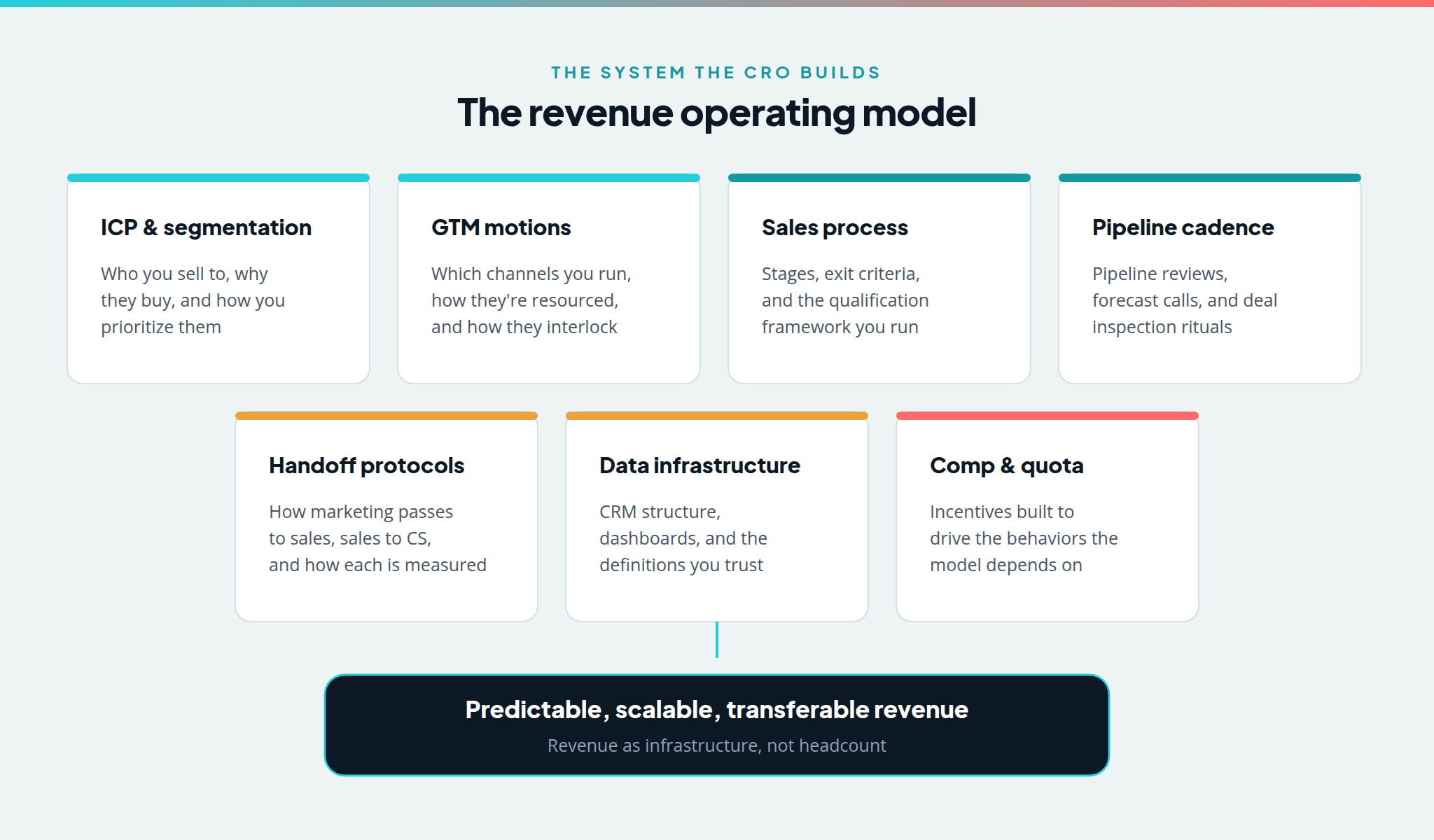
A mature revenue operating model includes:
- ICP definition and segmentation — who you sell to, why they buy, and how you prioritize them
- Go-to-market motions — which acquisition channels you run, how they’re resourced, and how they interlock
- Sales process and methodology — the defined stages, exit criteria, and qualification framework the team executes against
- Pipeline management cadence — weekly pipeline reviews, forecast calls, and deal inspection rituals
- Handoff protocols — how marketing passes to sales, how sales passes to CS, and how each handoff gets measured
- Revenue data infrastructure — CRM structure, dashboards, and the data definitions that make a forecast worth trusting
- Compensation and quota design — how incentives are built to drive the behaviors the model depends on
Why the Operating Model Matters More Than the Hire
A CRO without a clear operating model is improvising, and improvisation doesn’t scale. The companies that get the most out of CRO-level leadership are the ones that treat the revenue system as infrastructure rather than headcount. A real operating model is what makes revenue predictable, scalable, and transferable when leadership eventually changes hands.
The audit-first principle: before you build or rebuild a revenue operating model, start with a structured diagnostic. Understanding what’s genuinely broken before you prescribe a fix is the difference between a CRO who delivers results and one who installs a generic playbook and hopes. Diagnose first, then build. Learn more about how Heather Schuck approaches this work.
Does Every B2B Company Need a CRO?
No. And treating “we need a CRO” as a synonym for “we need better revenue leadership” is how founders end up with expensive mismatches. Here’s a more useful way to think about it.
You probably don’t need a CRO yet if:
- You’re below $5M ARR and the founder is still the primary seller
- Your sales motion is simple and single-threaded (one product, one segment, one motion)
- You have one revenue leader who can reasonably own the whole system
- Your primary constraint is product-market fit, not revenue execution
You likely need CRO-level leadership if:
- Revenue is growing but you can’t predict it
- You’re running multiple GTM motions that aren’t coordinated
- Your VP of Sales and CMO are in a standing fight over pipeline quality
- You’re heading into a fundraise or acquisition and need clean, credible revenue metrics
You need a full-time CRO specifically if:
- You’re at $30M+ ARR with multiple revenue teams and complex GTM motions
- Your board or investors are requiring C-suite revenue leadership
- You already have the infrastructure (RevOps, CS, marketing) to give a CRO something real to lead
The honest answer for most mid-market B2B companies is that they need CRO-level thinking well before they need a CRO title on a full-time org chart. A fractional engagement, a structured audit, or an advisory relationship often delivers the bulk of the value at a fraction of the cost and commitment. B2B revenue leadership comes down to the quality of thinking and execution you apply to the revenue system, not the title printed on the business card.
Do You Need a CRO? Readiness Check
Check every signal that’s true of your revenue org right now. The more that apply, the more your revenue system has outgrown single-function ownership — and the closer you are to needing CRO-level leadership.
signals your revenue system has outgrown single-function ownership
Stable for now
A quick gut check, not a diagnosis. The signals you checked are exactly what a structured revenue audit is built to pull apart. Talk it through on a discovery call →
Frequently Asked Questions
What is the difference between a CRO and a VP of Sales?
A VP of Sales answers for the sales team’s quota attainment. A chief revenue officer answers for total revenue performance across sales, marketing, customer success, and revenue operations, and sets the system the VP of Sales operates inside. One owns a function; the other owns the machine that function is part of.
What does a chief revenue officer do on a day-to-day basis?
A typical day mixes pipeline reviews, forecast calls, cross-functional alignment with marketing and CS leadership, hiring and performance management for revenue team leaders, board reporting, and forward planning for go-to-market initiatives. How the week splits between strategic and operational work depends heavily on company stage.
How much does a chief revenue officer earn?
Full-time CRO compensation swings widely with company size and stage. At mid-market B2B companies ($10M to $100M ARR), total comp usually lands between $250,000 and $450,000 across base, bonus, and equity. A fractional CRO typically runs $5,000 to $20,000 per month depending on scope and time commitment.
What is a fractional CRO?
A fractional CRO is a seasoned revenue executive who works with a company part-time or on a project basis, delivering CRO-level strategy and execution without the cost or long-term commitment of a full-time hire. It’s a particularly good fit for companies between $5M and $30M ARR that need senior revenue leadership but aren’t ready to carry a full-time C-suite seat.
When should a B2B company hire a CRO?
The right moment is when the revenue system has grown too complex for any single functional leader to optimize alone, and the company has enough team and infrastructure to give a CRO something substantial to run. The usual triggers are inconsistent pipeline, sales and marketing misalignment, slipping net revenue retention, and forecasts nobody can trust.
What is a revenue operating model?
A revenue operating model is the system that connects every revenue-generating function into one measurable, repeatable process. It covers ICP definition, go-to-market motion design, sales process and methodology, pipeline management cadences, cross-team handoff protocols, revenue data infrastructure, and compensation design. Building and running that model is the core work of a CRO.
Assess Your Revenue Leadership Gap
Most B2B companies don’t have a CRO problem — they have a revenue system problem a CRO would be responsible for solving. A 30-minute discovery call is enough to see which one you’re facing and what it would take to fix it. No pitch, no pressure. Just a straight read on what’s happening and where the gaps are.
Book a Discovery Call
Responds within 24 hours · No commitment required
