Go-to-Market Strategy Consulting for Enterprise Revenue Teams
Most go-to-market strategies do not fail because the thinking was wrong. They fail because the organization treats the strategy as a plan to be presented rather than an operating system to be run. The deck gets approval, the kickoff happens, and then the strategy quietly dissolves back into the daily habits it was supposed to replace. Reps go on qualifying deals their own way, managers go on inspecting activity instead of deal quality, and the forecast goes on reflecting how people feel rather than what the pipeline actually supports. A quarter or two later the number misses, and everyone reaches for a new plan instead of asking why the last one never made it into the field.
I have spent more than twenty years inside revenue organizations, and the pattern is remarkably consistent. The gap between a good GTM strategy and a good quarter is execution, and execution is a system you can diagnose, rebuild, inspect, and hold people to. That is what go-to-market strategy consulting should deliver, and it is the work TheSchuck.Agency does with enterprise revenue teams across sales, marketing, customer success, and leadership.
The short answer: Go-to-market strategy consulting helps revenue teams align sales, marketing, customer success, and leadership around a repeatable system for generating, qualifying, advancing, and forecasting revenue. TheSchuck.Agency focuses on execution, diagnosing where GTM systems break down and rebuilding the operating rhythm needed for predictable growth.
What Go-to-Market Strategy Means for Enterprise Revenue Teams
For an enterprise revenue team, go-to-market strategy is not a positioning deck or an annual planning offsite. It is the operating system that decides how you generate demand, qualify it, advance it, forecast it, and hold people accountable for the number. Defined in operational terms, GTM strategy is the concrete set of mechanics your team runs every week, and every one of those mechanics either reinforces the others or quietly works against them. When they reinforce each other, revenue becomes predictable enough to defend to a board. When they work against each other, you get pipeline that looks healthy on Monday and a forecast that collapses in the last two weeks of the quarter.
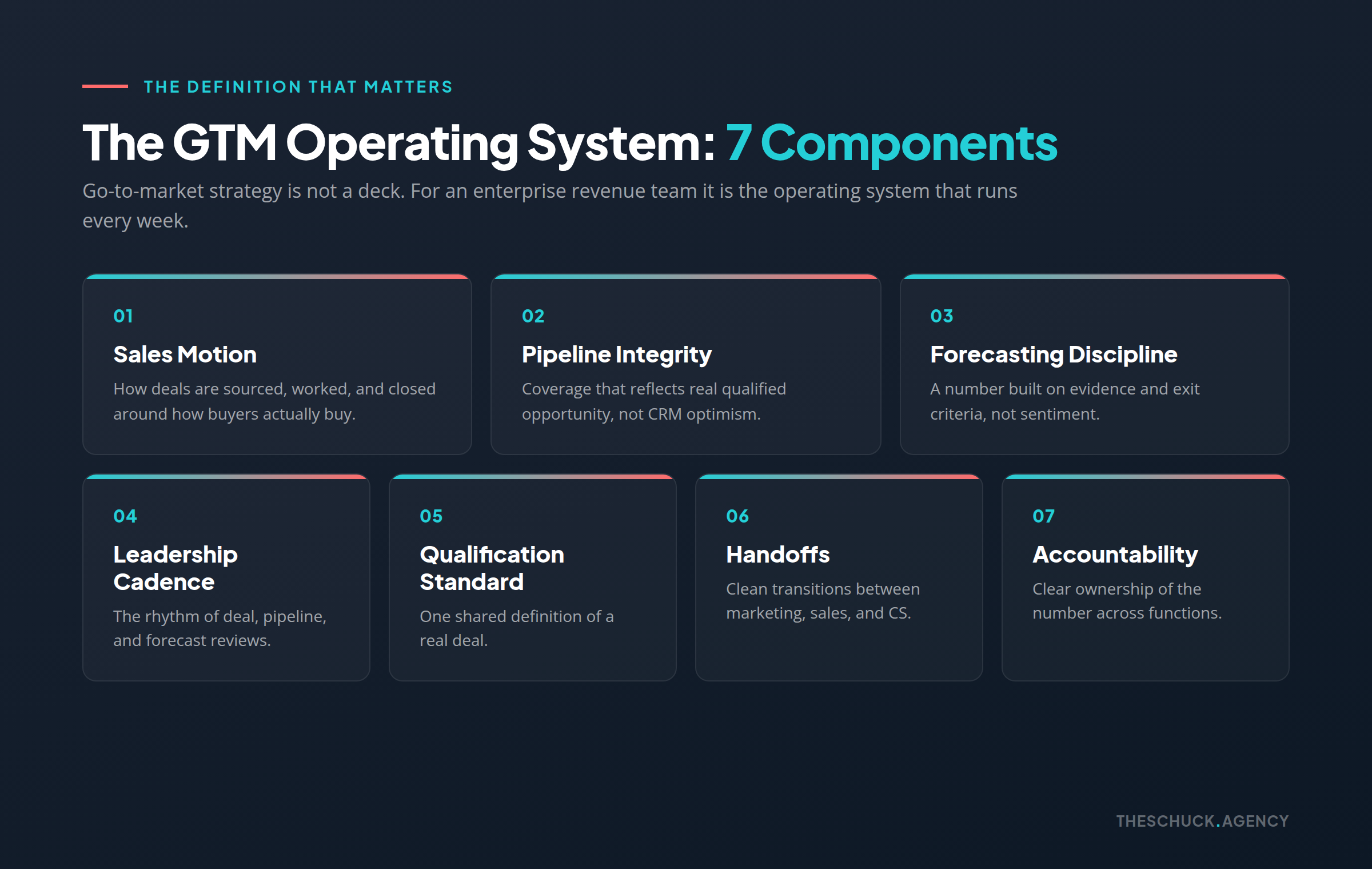
Seven components make up that system, and a real GTM strategy has to account for all of them rather than treating them as separate departmental concerns.
Sales motion
The sales motion is how deals are actually sourced, worked, and advanced to close. A GTM strategy has to define the motion around how your buyers really buy, including who is in the buying committee and what has to be true at each step, rather than around how the org chart happens to be drawn. When the documented motion and the real motion diverge, sellers default to the real one and your process becomes fiction.
Pipeline integrity
Pipeline integrity is the difference between coverage that reflects real, qualified opportunity and coverage that reflects a rep’s reluctance to show an empty column. It is the single most abused number in most revenue organizations, because pipeline is easy to inflate and inconvenient to scrub. A strategy that does not enforce pipeline integrity is measuring optimism, not opportunity.
Forecasting discipline
Forecasting discipline means the number is built on evidence and stage exit criteria, not on sentiment and the hope that a slow quarter turns around at the buzzer. A disciplined forecast is one you can defend to your CFO and board because it rests on what deals actually support. Guessing wrong here is expensive in a way that compounds, because a missed forecast does not just cost a quarter. It costs two to three quarters of recovery time and quietly erodes your credibility with leadership.
Leadership cadence
Leadership cadence is the recurring rhythm of deal reviews, pipeline reviews, and forecast calls that turns a strategy into ongoing inspection instead of a slide nobody revisits. Cadence is where a strategy either becomes real or becomes decoration. Without it, even a well-designed system decays within a quarter because there is no mechanism keeping the team honest to it.
Qualification standard
A qualification standard is one shared definition of a real deal, so that a Stage 3 opportunity means the same thing in every rep’s pipeline and every manager’s roll-up. Qualification is the connective tissue of the entire system, because forecasting, pipeline integrity, and manager inspection all depend on stages meaning something consistent. When qualification is private and inconsistent, nothing downstream can be trusted.
Handoffs and accountability
Finally, the system depends on clean handoffs between marketing, sales, and customer success, with clear ownership so nothing falls through the seams between teams. Handoffs are where alignment is tested. Accountability is what keeps each function owning its part of the number rather than pointing at the function upstream. A strategy you cannot execute on a Tuesday afternoon is not a strategy. It is a wish.
Why Go-to-Market Strategies Break Down
A GTM strategy rarely fails in the strategy. It fails in the space between the plan and the field, where good intentions meet inconsistent behavior and a forecast that reflects mood more than evidence. In almost every stalled revenue organization I audit, the breakdown traces back to the same five failure points. None of them are about the caliber of the people. They are about the system the people are operating inside.
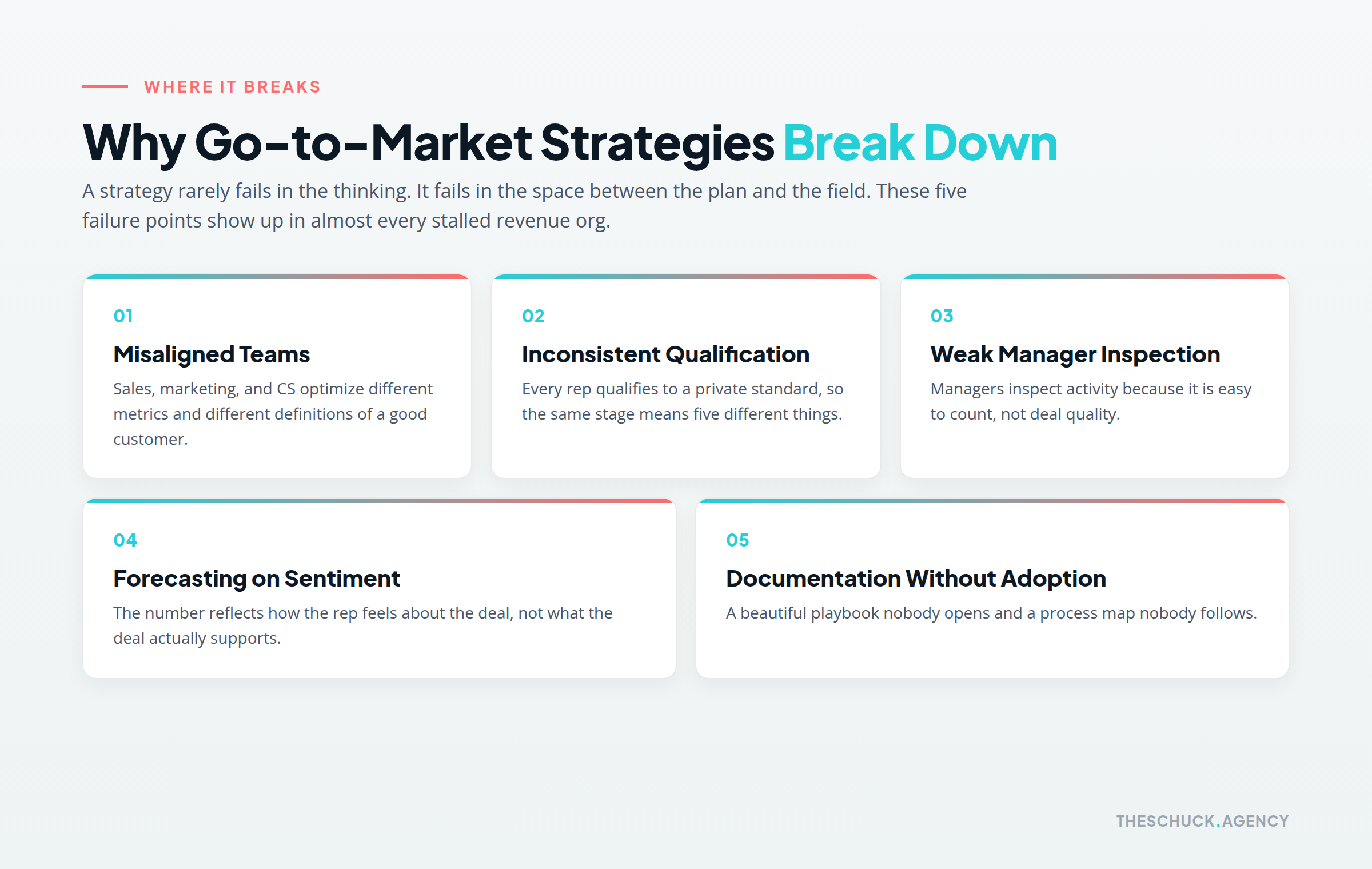
Misaligned teams
Sales, marketing, and customer success each optimize for their own metric and often work from different definitions of a good customer. Marketing is measured on lead volume, sales on closed revenue, and customer success on retention, so the three functions can each hit their target while the company still misses. When there is no shared definition of the ideal customer and no shared view of what a qualified opportunity looks like, effort scatters instead of compounding, and the seams between teams turn into places where revenue leaks.
Inconsistent qualification
When every rep qualifies to a private standard, the same stage means five different things across a team of five sellers. One rep’s Stage 3 is a genuine, evidence-backed opportunity, and another rep’s Stage 3 is a friendly conversation with someone who cannot sign. Once qualification is inconsistent, the pipeline stops being something a leader can reason about, and every number derived from it inherits the same unreliability.
Weak manager inspection
Frontline managers inspect activity because activity is easy to count. Calls made, meetings booked, and emails sent all show up cleanly in a dashboard. Deal quality does not, so it rarely gets pressure-tested. The result is that weak deals ride the pipeline unchallenged until they slip at the worst possible time, usually late in the quarter when there is no room left to recover. Inspection that never examines the assumptions inside a deal is not really inspection. It is attendance-taking.
Forecasting based on sentiment
In too many organizations the forecast reflects how the rep feels about a deal rather than what the deal actually supports. Sentiment-based forecasting feels reasonable in the moment because the rep is closest to the account, but feelings are not exit criteria, and optimism is not evidence. By the time reality asserts itself, the number has already been committed to the board, and the gap between commit and actual becomes a credibility problem long before it becomes a revenue problem.
Too much documentation, not enough adoption
The most common and most frustrating failure point is a beautiful playbook nobody opens and a process map nobody follows. Enormous effort goes into writing the system down, and almost none goes into getting the team to actually run it. Documentation is not adoption. A strategy only exists to the degree that it changes what people do on live deals, and a binder on a shelf changes nothing.
The hard truth most consultants will not tell you: the problem is almost never your people. It is the system your people are operating inside.
TheSchuck.Agency’s Audit-First, Build-Second Approach
I do not open an engagement with a framework. I open with a diagnosis, because most revenue problems are not what they look like on the surface, and prescribing before you understand the system is how good teams end up with the wrong fix. The engagement moves through five stages, and it is deliberately built to run without me once I leave. The point is capability, not dependency. If the system only holds while I am in the room, I have not actually fixed anything.
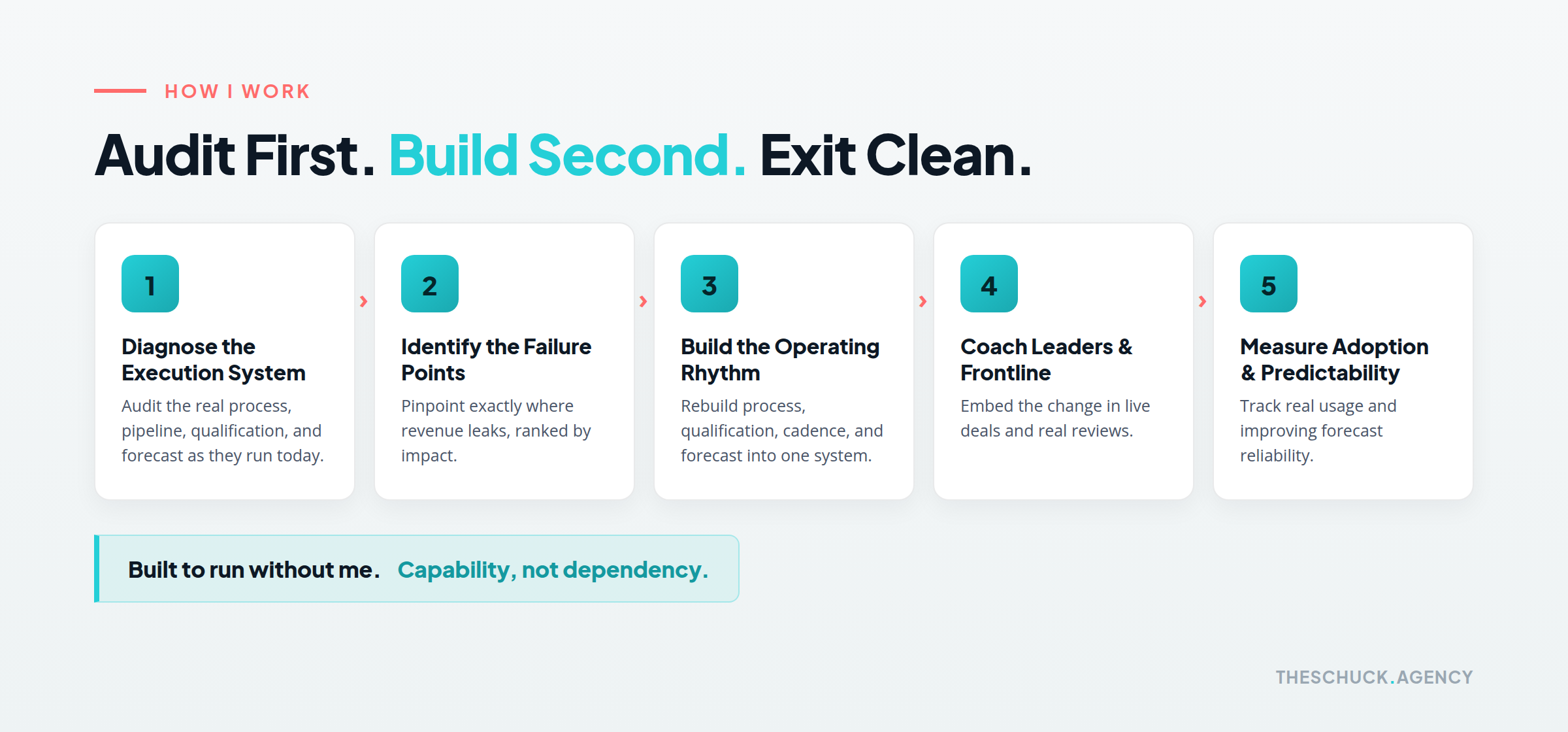
1. Diagnose the current execution system
The first stage is a full audit of how your revenue system actually runs today, not how it is supposed to run on paper. That means examining the real sales process, pipeline integrity, qualification discipline, the forecast method, manager inspection habits, and the handoffs between marketing, sales, and customer success. I go deep before I go wide, because the surface complaint and the underlying cause are rarely the same thing.
2. Identify the failure points
With the system mapped, the next stage is to pinpoint exactly where revenue is leaking. Which stage, which handoff, which inspection gap is quietly costing you deals and forecast accuracy. The output is not a list of everything that could be better. It is a ranked view of the few failure points that are actually moving your numbers, so you can prioritize by impact rather than fixing whatever happens to be loudest.
3. Build the operating rhythm
Once the failure points are clear, we rebuild the sales process, qualification standard, deal-review cadence, and forecast model into a single system the team runs every week. This is where strategy becomes operating rhythm. Stage definitions get exit criteria, qualification gets one shared standard, and reviews get a structure that inspects quality rather than counting activity. The system is designed around how your deals actually move, not around a textbook or whatever worked at someone else’s company.
4. Coach leaders and frontline teams
A system only changes revenue if people adopt it, so the fourth stage embeds the change in live deals and real reviews. I coach managers to inspect deal quality and to run reviews that develop their sellers, and I coach reps to qualify to one standard and to work deals against evidence. This is hands-on work inside your pipeline, not a training session followed by a hope that it sticks. Adoption is earned in the reviews, one real deal at a time.
5. Measure adoption and revenue predictability
The final stage measures two things: whether the system is actually being used, and whether forecast reliability and revenue predictability are improving as a result. Adoption without results is not the goal, and results without adoption do not last. Tracking both is how you know the change is real and durable rather than a temporary lift that fades the moment attention moves elsewhere.
Audit first. Build second. Exit clean. The system should hold on its own, without constant executive intervention.
Who This Is For
This work fits revenue organizations that are big enough to have real complexity and real stakes, but that are still carrying execution habits from an earlier stage. If you are also weighing whether you need an experienced leader in the seat to drive the change, my fractional CRO and growth strategy consulting covers the hands-on operating side of the same problem. Go-to-market strategy consulting is the right fit when the following describe you.
- Enterprise or scaling revenue teams. Organizations with enough motion and headcount that inconsistency compounds instead of self-correcting. At small scale a strong leader can hold the system together by force of will. Past a certain size, that stops working and the system has to hold on its own.
- $10M to $100M organizations. Companies past the founder-led scramble and operating under real board and forecast scrutiny, where a missed quarter is genuinely expensive and a shaky forecast costs credibility as much as it costs revenue.
- CROs, CEOs, revenue leaders, and sales executives. Owners who are accountable for the number and need the revenue system to hold up across the entire C-suite, from the CFO reviewing the forecast to the board reviewing the plan.
- Teams with pipeline, forecast, or process inconsistency. If coverage looks fine but revenue misses, if the forecast keeps surprising you, or if two reps describe the same stage in completely different terms, the execution system is where to look.
Common GTM Problems We Solve
These are the patterns I hear on almost every first call. Each one tends to get diagnosed as a people problem or a motivation problem, and it almost never is. Underneath, the GTM execution system is producing exactly the results it is built to produce.
Pipeline looks healthy but revenue misses
Coverage is more than enough on paper, yet the number still comes up short. This is the signature symptom of a pipeline-integrity and qualification problem. The pipeline is measuring motion rather than real opportunity, so it looks like plenty right up until the weak deals fail to convert.
Deals slip without a clear cause
Opportunities keep sliding a quarter, and nobody can say exactly why. The usual reason is that the deal was never qualified against evidence in the first place, so there was never a real basis for the close date. A deal built on optimism does not slip for a reason. It slips because it was never solid.
Reps qualify inconsistently
Every seller has a private bar for what counts as real, so the roll-up blends strong and weak deals into a single number you cannot fully trust. Inconsistent qualification does not just distort the pipeline. It makes coaching harder, because managers cannot compare deals that were never scored the same way.
Sales and marketing blame each other
The leads are bad, the follow-up is worse, and the two teams argue past each other because there is no shared definition of a qualified opportunity. When both functions are optimizing different metrics with no agreed handoff standard, the friction is structural. It will not be fixed by another meeting or a better attitude. That is the third of five collapse points I map in why sales transformations fail.
Managers inspect activity, not deal quality
Reviews count calls and meetings because those are easy to measure, while the actual risk inside each deal goes unexamined until it is too late to do anything about it. Activity inspection produces busy teams and surprising losses. Quality inspection produces fewer surprises and better sellers.
The forecast is a negotiation, not a number
Each cycle turns into a debate about commit versus best case, because the forecast rests on sentiment instead of consistent exit criteria. When the forecast is negotiable, it stops being a forecast and becomes a bargaining position, which is exactly the wrong thing to hand a board.
What Clients Leave With
You do not leave a TheSchuck.Agency engagement with a slide deck. You leave with a documented, operating GTM system your team owns and can run without me. The fastest way to see that system built and adopted is the 90-Day Growth Sprint. Every engagement produces the following six assets, each designed to work as part of the whole rather than as a standalone deliverable.
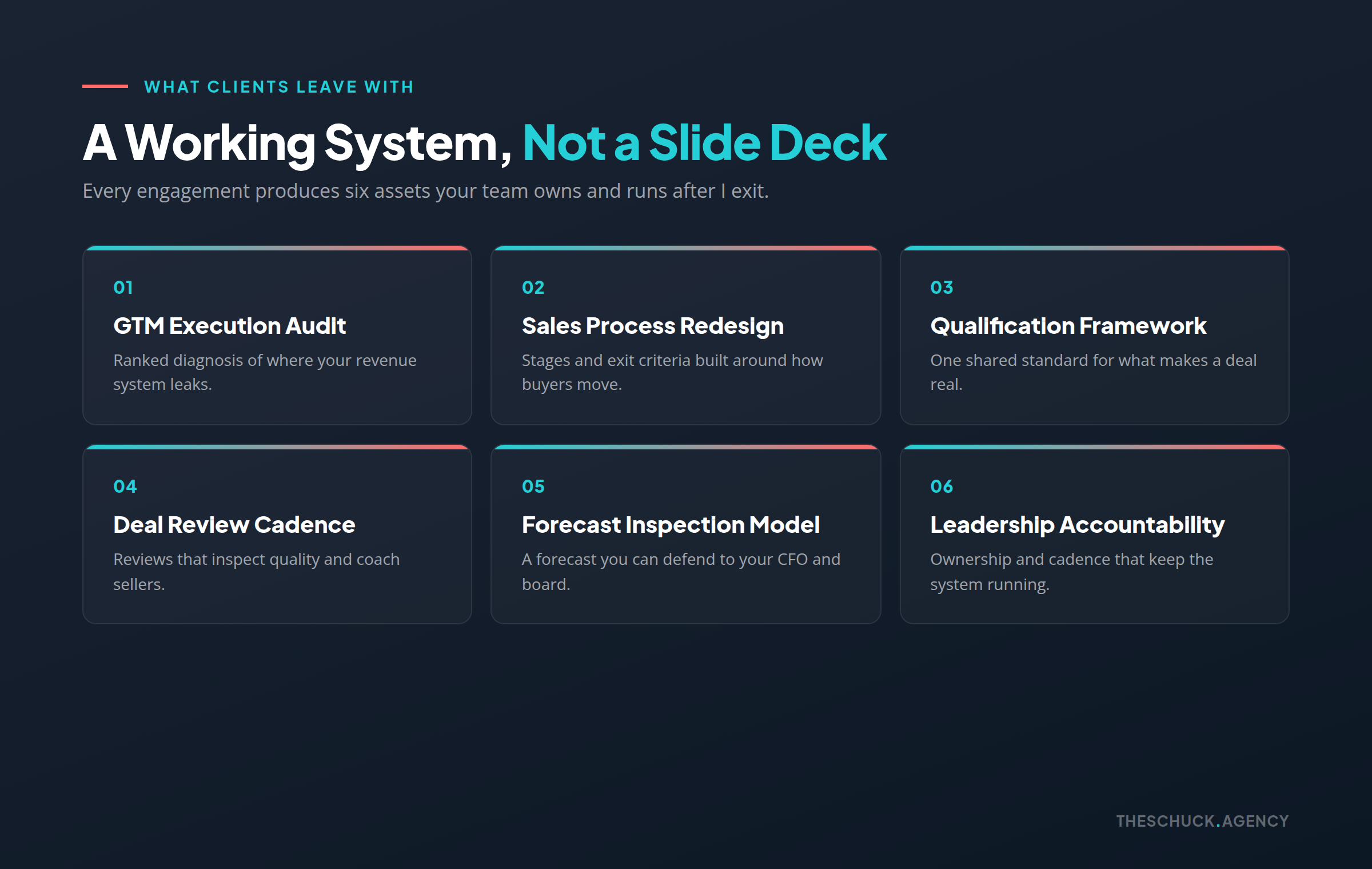
- GTM execution audit. A clear, ranked diagnosis of where your current go-to-market system leaks revenue, ordered by impact so you know exactly what to fix first and what to leave alone for now.
- Sales process redesign. Stage definitions and exit criteria rebuilt around how your buyers actually move through a decision, so the documented process and the real process are finally the same thing.
- Qualification framework. One shared standard for what makes a deal real, so a stage means the same thing in every rep’s pipeline and every manager’s roll-up, and every downstream number can be trusted.
- Deal review operating cadence. A recurring rhythm of reviews that inspects deal quality and coaches sellers, structured so it develops the team rather than just reporting status up the chain.
- Forecast inspection model. A forecast you can defend to your CFO and board, built on evidence and exit criteria instead of sentiment, so the number you commit is the number you can stand behind.
- Leadership accountability system. Clear ownership, the right metrics, and a cadence that keeps the whole system running without constant executive intervention, so it holds after the engagement ends.
Frequently Asked Questions
What is go-to-market strategy consulting?
Go-to-market strategy consulting helps a revenue team align sales, marketing, customer success, and leadership around a repeatable system for generating, qualifying, advancing, and forecasting revenue. The best engagements go past the strategy document and into execution, diagnosing where the current system breaks down and rebuilding the operating rhythm the team runs every week. The goal is not a smarter plan. It is predictable revenue that survives contact with a real pipeline.
What makes a GTM consultant with CRO experience different from a typical strategy consultant?
A traditional strategy consultant hands you a recommendation and leaves. A consultant who has actually carried a number as a Chief Revenue Officer has made the calls, lived with the consequences, and fixed what breaks afterward. That difference shows up in the details, from stage definitions that reflect how deals really move, to forecasts that hold up under board scrutiny, to coaching that lands with frontline managers because it comes from someone who has sat in their seat. I have led enterprise sales transformation and operated as a CRO across growth-stage and enterprise organizations, so the work is grounded in real operating reality rather than best-practice theory.
How is this different from a GTM agency or a marketing agency?
Most agencies own a channel or a campaign and optimize their slice of the funnel. This work owns the whole revenue execution system, from how demand is generated through how it is qualified, advanced, forecast, and inspected across sales, marketing, and customer success. It is a revenue owner’s vantage point rather than a vendor’s, which means the fix is the operating rhythm your team runs, not a deliverable you hand off and hope sticks.
What size company do you work with?
The sweet spot is enterprise and scaling revenue teams in the $10M to $100M range, though the approach applies wherever complexity has outgrown the original way of selling. These organizations are past the founder-led scramble and under real forecast and board scrutiny, which is exactly where inconsistent qualification and sentiment-based forecasting start to cost real money.
Our pipeline looks healthy but we keep missing the number. What is going on?
That gap is almost always a pipeline-integrity and qualification problem, not a volume problem. When every rep qualifies to a private standard and managers inspect activity instead of deal quality, the coverage in your CRM blends real opportunity with optimism, so it looks like plenty right up until deals slip. The fix is one shared qualification standard, exit criteria the team actually uses, and a deal-review cadence that pressure-tests quality before it hits the forecast.
How do you make a sales forecast more reliable?
By moving the forecast off sentiment and onto evidence. That means clear exit criteria for every stage, a qualification standard that means the same thing across the team, and an inspection cadence where managers test the assumptions inside each deal rather than accepting a rep’s gut feel. Once the forecast is built on what deals actually support, it becomes a number you can defend to your CFO and board instead of a negotiation you dread every quarter.
What does a GTM execution audit include?
The audit examines your revenue system as it actually runs, including the sales motion and process, pipeline integrity, qualification discipline, forecasting method, manager inspection habits, and the handoffs between marketing, sales, and customer success. The output is a ranked view of where revenue is leaking and which failure point to fix first, so you are prioritizing by impact rather than fixing whatever is loudest.
How long before we see results?
The diagnosis is fast, often within the first few weeks, because the failure points tend to be consistent once you know where to look. Rebuilding the operating rhythm and getting real adoption takes a focused engagement, which is why the 90-Day Growth Sprint exists. The point is durable change, so the system holds after the engagement ends rather than reverting the moment attention moves elsewhere.
GTM Decision Brief is my newsletter for revenue leaders who want to turn pipeline data into decisions they can stand behind. Signals, not noise. Read it here.