B2B Go-to-Market Strategy Framework: How to Build an 8-Step GTM Plan
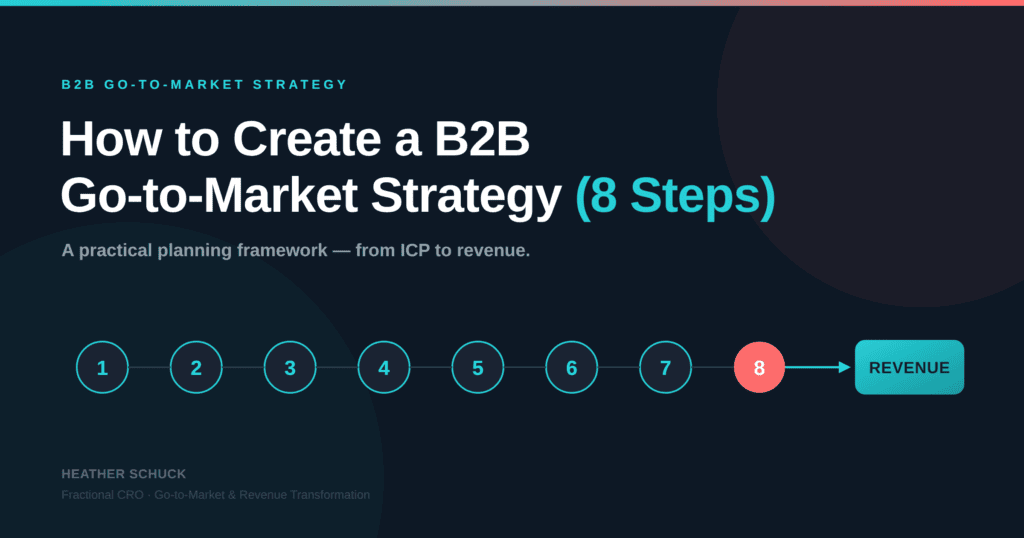
A B2B go-to-market strategy framework helps revenue teams define the right customer, position the offer, choose the right sales and marketing motion, and measure whether the plan is creating qualified pipeline. This 8-step GTM plan walks through the decisions that matter most: ICP, market diagnosis, value proposition, channel strategy, sales motion, enablement, metrics, and operating cadence.
A B2B go-to-market strategy is the operating plan a company uses to turn a specific market opportunity into measurable revenue. It defines the ideal customer, positioning, channels, sales motion, pricing, enablement, and the metrics that marketing, sales, customer success, product, and leadership all use to move in the same direction.
Most B2B GTM plans fail because they jump to tactics before the company agrees on the customer, the problem, the buying motion, and the revenue target. I have watched well-funded launches stall for exactly that reason, and I have rebuilt the motion afterward more times than I can count. This guide walks through the eight-step process I use to create a B2B go-to-market strategy that connects market insight to pipeline execution — one that survives contact with the field, not just the planning deck.
A B2B go-to-market strategy should define who you sell to, what problem you solve, how you position the offer, which channels create demand, how sales converts that demand, and which metrics prove the motion is working. Get those six decisions aligned before you spend on tactics, and the rest of the plan has something solid to stand on.
- B2B go-to-market strategy framework
- What a B2B go-to-market strategy is
- GTM strategy vs. marketing strategy
- When you actually need one
- The 8-step B2B GTM framework
- Choosing your GTM motion
- How to measure GTM performance
- B2B go-to-market strategy template
- B2B GTM strategy examples
- Common GTM mistakes
- How I approach GTM transformation
- FAQ
- Sources & further reading
B2B Go-to-Market Strategy Framework
The B2B go-to-market strategy framework turns a market opportunity into revenue in eight steps, each one a decision that sales, marketing, RevOps, and leadership make together:
- Define the business objective
- Identify the ICP
- Diagnose the market and competitors
- Clarify the value proposition
- Choose the GTM motion
- Select primary channels
- Build conversion assets
- Define metrics and operating rhythm
What Is a B2B Go-to-Market Strategy?
A B2B go-to-market strategy is the coordinated plan for reaching business buyers, positioning an offer against their alternatives, choosing the channels that create demand, running the sales motion that converts it, and measuring whether any of it is producing revenue. If you want the fuller definition — GTM versus marketing versus sales, the components, the benefits and trade-offs — start with what a GTM strategy means. This page is the companion to that one: less about the definition, more about how you actually build the plan.
The distinction I hold onto after twenty years inside revenue organizations is that a GTM strategy is not a launch checklist and it is not a marketing campaign. It is the operating system that tells marketing, sales, customer success, and leadership which customer they are building around and how revenue will be created. When that operating system is missing, every team optimizes its own slice and the numbers still miss.
A B2B GTM strategy is not a launch checklist. It is the operating system that tells marketing, sales, customer success, and leadership which customer they are building around and how revenue will be created.— Heather Schuck, Fractional CRO
B2B GTM Strategy vs. Marketing Strategy
These two get used interchangeably, and the confusion is expensive because it lets a company believe it has a go-to-market plan when all it really has is a demand plan. A marketing strategy answers how you create awareness and interest. A go-to-market strategy is broader: it also owns the sales motion, pricing and packaging, distribution, customer success, and the revenue math that ties them together.
| Strategy | Purpose | Owner | Main question | Core metrics | Common failure mode |
|---|---|---|---|---|---|
| Marketing strategy | Create awareness, demand, and engagement | Marketing / demand gen | How do we get the right buyers to pay attention? | Traffic, MQLs, pipeline sourced, CPL | Generating volume the sales motion can't convert |
| GTM strategy | Turn a market opportunity into measurable revenue | CRO / revenue leadership | Who do we sell to, how do we convert them, and how do we prove it works? | Qualified pipeline, win rate, sales cycle, CAC, retention | Scaling channels before the customer, message, and motion are aligned |
The practical test: if the plan can be executed entirely by marketing, it is a marketing strategy. A real GTM strategy requires marketing, sales, and revenue operations to change what they do together.
When You Actually Need a GTM Strategy
You do not need a formal go-to-market strategy for every quarter of business as usual. You need one at the moments where getting the customer, motion, or message wrong costs you two to three quarters of recovery time and quietly erodes credibility with your board. In practice that's:
- Market entry — a new segment, industry, or geography where your existing assumptions don't transfer.
- A new offer or product launch — where the buyer, value story, and motion may all be different from your core.
- Pipeline quality problems — plenty of activity and leads, but the pipeline doesn't convert or forecast reliably.
- Expansion — moving up-market, adding a second motion, or opening a partner channel.
- Repositioning — when the category has shifted and the old message no longer earns attention.
How to Create a B2B Go-to-Market Strategy: The 8-Step Framework
This is the sequence I run, in order, because each step is the input to the next. Skipping ahead is the single most common reason a plan looks great on the slide and falls apart in the field. Diagnose before you prescribe; build second; and don't scale anything until you know it converts.
1. Define the business objective
Before anything else, get explicit about what this motion is supposed to accomplish: market entry, a new offer launch, better pipeline quality, expansion into a new segment, repositioning, or fixing a sales motion that has stopped converting. Every downstream choice — ICP, motion, channels, metrics — changes depending on this answer, and teams that skip it end up building a beautiful plan for the wrong goal.
2. Identify the ideal customer profile
Document the company traits, buyer roles, pain points, urgency triggers, typical deal size, sales cycle, and what "good fit" actually looks like once they're a customer. The discipline here is subtraction: a sharp ICP is as much about who you will not chase as who you will. The fastest way I have ever seen a team waste a quarter is generating demand from accounts that were never going to buy.
The fastest way to waste GTM budget is to scale channels before you know which customer, message, and motion actually converts.— Heather Schuck
3. Diagnose the market and competitors
Look at direct competitors, the "do nothing" alternative, the language customers actually use to describe the problem, their pricing expectations, and the category narrative they already believe. You are not doing this to copy anyone; you're doing it to find the position no one else is credibly holding.
4. Clarify the value proposition
Define the business problem in the buyer's terms, the cost of inaction, the measurable outcome you create, and why the buyer should choose you now rather than later. If the honest answer to "why now" is weak, the deal will slip no matter how good the product is — status quo is the competitor that wins most B2B deals.
5. Choose the GTM motion
Decide how you actually go to market: sales-led, product-led, partner-led, inbound-led, outbound-led, account-based, community-led, or a deliberate hybrid. The motion has to match the buyer and the deal economics — a high-consideration, multi-stakeholder enterprise deal will not close on a self-serve motion, and a low-ACV product will get strangled by an expensive field sales team.
| GTM motion | Best for | Typical ACV | Sales cycle | Required assets | Main risk |
|---|---|---|---|---|---|
| Sales-led | Complex, multi-stakeholder deals | $25K–$250K+ | 2–9 months | Reps, playbook, deal desk, enablement | Expensive if ACV is too low |
| Product-led | Fast time-to-value, easy adoption | <$15K (land) | Days–weeks | Free tier, onboarding, usage data | Weak expansion without a sales layer |
| Partner-led | Established channels own the buyer | Varies | Medium | Partner program, margins, co-sell | Less control of the customer relationship |
| Account-based | Narrow list of high-value accounts | $100K+ | 3–12 months | Named-account plans, tight sales+marketing | Doesn't scale to broad markets |
| Inbound-led | Buyers actively searching | Any | Varies | Content, SEO/AEO, nurture | Slow to build; demand you don't control |
| Outbound-led | Defined ICP not yet in-market | $15K+ | 1–6 months | Lists, sequences, SDRs, offers | Burns the list if targeting is loose |
6. Select the few channels that match the buyer
Pick two or three primary channels, not every tactic that exists. Focus is the whole point: a GTM plan spread thin across ten channels produces ten mediocre signals and nothing you can actually read. Choose where your buyer already spends attention, commit enough to learn something, and leave the rest for later.
7. Build the enablement and conversion assets
This is where strategy either becomes executable or stays theoretical. Build the landing pages, sales decks, buyer guides, objection handling, case studies, ROI tools, and nurture sequences the motion needs — the things that let a rep or a page convert interest into a next step. A motion without conversion assets is just a plan to generate traffic.
8. Define metrics and operating rhythm
Decide what you will measure and how often you will look at it, together, as a team. Track both leading and lagging indicators — qualified pipeline, conversion rates, sales cycle, win rate, CAC, retention, expansion, and forecast accuracy — and put them in front of leadership on a fixed cadence so the plan can survive execution, not just planning. Signals, not noise.
| Metric | What it tells you | Why it matters | Warning sign |
|---|---|---|---|
| ICP fit rate | How much pipeline matches your best customer | Everything downstream depends on it | Reps chasing anyone who replies |
| MQL → SQL conversion | Whether marketing demand is real demand | Exposes volume the motion can't use | High MQLs, low SQLs |
| Opportunity conversion | How well qualified deals advance | Where the motion actually leaks | Stalls at one stage repeatedly |
| Win rate | Whether you win the deals you pursue | Tests positioning and qualification | Falling win rate on "good fit" deals |
| Sales cycle length | Speed and friction in the motion | Drives capacity and forecast timing | Cycle creeping longer each quarter |
| CAC | Cost to acquire a customer | Tells you if the motion is efficient | CAC rising while ACV is flat |
| Retention | Whether you sold the right customer | Bad-fit wins churn and mask GTM flaws | Early churn in a specific segment |
| Expansion revenue | Whether accounts grow after the land | The real payoff of a good ICP | Flat net revenue retention |
B2B Go-to-Market Strategy Template
Use this B2B go-to-market strategy template to turn the framework into a working plan your revenue teams can actually run. Fill it in top to bottom — each line is the input to the next.
- Business objective — market entry, new offer, better pipeline quality, expansion, or repositioning, plus the revenue target.
- Ideal customer profile — firmographics, buyer roles, deal size, and the trigger events that mean "now."
- Buyer pain and urgency — the problem quantified and the cost of inaction that makes them act now.
- Positioning and value proposition — why you, why now, and the one sentence a champion repeats internally.
- GTM motion — sales-led, product-led, partner-led, or account-based, matched to ACV and sales cycle.
- Primary channels — the two or three channels that actually reach this buyer, not all of them.
- Sales and marketing assets — decks, buyer guides, objection handling, and enablement each stage needs to convert.
- Revenue metrics — the leading and lagging indicators that prove the motion is working.
- 90-day operating cadence — the review rhythm that keeps it honest, and who owns each number.
B2B Go-to-Market Strategy Examples
The motion changes with the business model, the buyer, and the stage. Here are four patterns I've either run or rebuilt, and when each one is the right call.
Example 1: Founder-led outbound for an early-stage company
Best when you need fast customer learning, narrow ICP validation, and unfiltered market feedback. When I built my first company from a kitchen table to more than 500 retail locations, the early motion was pure founder-led selling — direct conversations that told me exactly which buyer, message, and price actually worked before I spent a dollar scaling. Early-stage B2B is no different: the founder is the best qualification instrument you have.
Example 2: Sales-led GTM for a mid-market SaaS company
Best when the buyer needs education, several stakeholders touch the decision, and someone has to connect the pain to business impact. This is where qualification discipline earns its keep — a shared framework like MEDDPICC keeps reps inspecting real buyer evidence instead of forecasting on optimism. One mid-market motion I rebuilt this way moved from disconnected activity to a predictable, inspectable pipeline in a single quarter.
Example 3: Account-based GTM for enterprise buyers
Best when the target market is narrow, deal sizes are high, and marketing, sales, and customer success have to coordinate around named accounts. This is the motion I work in daily inside a global enterprise sales organization: territory and coverage design, tight segmentation, and executive deal reviews that hold every account to the same standard. It is powerful and it is expensive, which is exactly why the ICP has to be ruthless.
Example 4: Content-led GTM for a services or advisory business
Best when trust, point of view, and buyer education create demand before a sales conversation ever happens. When existing channels can't efficiently serve demand, the smartest move is sometimes to design a new route to market entirely — I once replaced a capital-heavy direct motion with a licensing model that added more than $12M in revenue. Content-led GTM is the advisory version of that instinct: earn the right to the conversation first.
Common B2B GTM Mistakes
Most GTM failures are not exotic. They're the same handful of alignment problems showing up as weak pipeline, long sales cycles, poor handoffs, or a forecast no one trusts.
- An ICP that's too broad — "everyone with a budget" is not a target, and it quietly poisons every metric downstream.
- Generic positioning — if your value story could run under a competitor's logo, it isn't positioning.
- Sales and marketing misalignment — different definitions of a good lead, no shared lifecycle stages, and a handoff that leaks.
- Launching too many channels at once — spreading spend so thin that nothing produces a readable signal.
- Dirty revenue data — you can't run a GTM motion on CRM optimism; without clean data you're measuring motion, not progress.
Most GTM problems are not channel problems. They're alignment problems that show up as weak pipeline, long sales cycles, poor handoffs, or unreliable forecasts.— Heather Schuck
How TheSchuck.Agency Approaches GTM Transformation
TheSchuck.Agency approaches GTM transformation as a revenue alignment problem first, not a campaign problem. The work starts by diagnosing where the motion is breaking — ICP clarity, positioning, pipeline quality, sales process, handoff friction, RevOps visibility, or leadership alignment. From there, the goal is a focused 90-day plan that turns GTM from a set of disconnected tactics into a measurable revenue operating system that runs without constant executive intervention.
- Diagnose the current motion — find where pipeline, conversion, sales cycle, or forecast reliability is actually breaking.
- Clarify the customer and offer — tighten ICP, buyer pain, positioning, and value proposition.
- Align sales, marketing, and RevOps — shared definitions, lifecycle stages, and reporting everyone trusts.
- Build the 90-day execution plan — prioritize the channels, assets, enablement, and operating cadence most likely to improve revenue quality.
If you want that diagnosis for your own motion, that's exactly what a 90-day GTM diagnosis is built to deliver, and it's the front door to my go-to-market strategy consulting work.
Frequently Asked Questions
What is a B2B go-to-market strategy?
A B2B go-to-market strategy is a plan for reaching the right business buyers, positioning an offer, choosing channels, aligning sales and marketing, and turning market demand into measurable revenue.
What should a B2B GTM strategy include?
It should include the ideal customer profile, positioning, value proposition, sales motion, marketing channels, pricing and packaging, enablement assets, revenue operations, and success metrics.
How is a GTM strategy different from a marketing strategy?
A marketing strategy focuses on awareness, demand, and engagement. A GTM strategy is broader because it also includes the sales motion, pricing, distribution, customer success, and revenue measurement.
How do you know if a GTM strategy is working?
A GTM strategy is working when it improves qualified pipeline, conversion rates, win rate, sales cycle length, forecast reliability, customer retention, and expansion revenue.
What causes B2B GTM strategies to fail?
They usually fail because the ICP is too broad, positioning is generic, sales and marketing are misaligned, too many channels are launched at once, or the company lacks clean revenue data.
What is a B2B go-to-market strategy framework?
A B2B go-to-market strategy framework is a structured plan for turning a market opportunity into revenue. It aligns ICP, positioning, channels, sales motion, enablement, metrics, and operating cadence so sales, marketing, RevOps, and leadership work from the same plan.
How do you build a B2B GTM plan?
Build a B2B GTM plan by defining the business objective, narrowing the ICP, diagnosing the market, clarifying the value proposition, choosing the motion, selecting channels, creating enablement assets, and measuring qualified pipeline, win rate, sales cycle, and retention.
Sources & Further Reading
- McKinsey & Company — research on go-to-market and commercial-growth optimization.
- Gartner — sales and marketing alignment and B2B buying-behavior research.
- HubSpot — benchmarks on GTM, demand generation, and RevOps metrics.
- Pavilion — practitioner benchmarks on B2B SaaS GTM motions and revenue leadership.
- TheSchuck.Agency: what a GTM strategy means, revenue operations, MEDDPICC, and sales forecast reliability.