B2B Sales Methodologies: How to Choose the Right Framework for Complex Sales
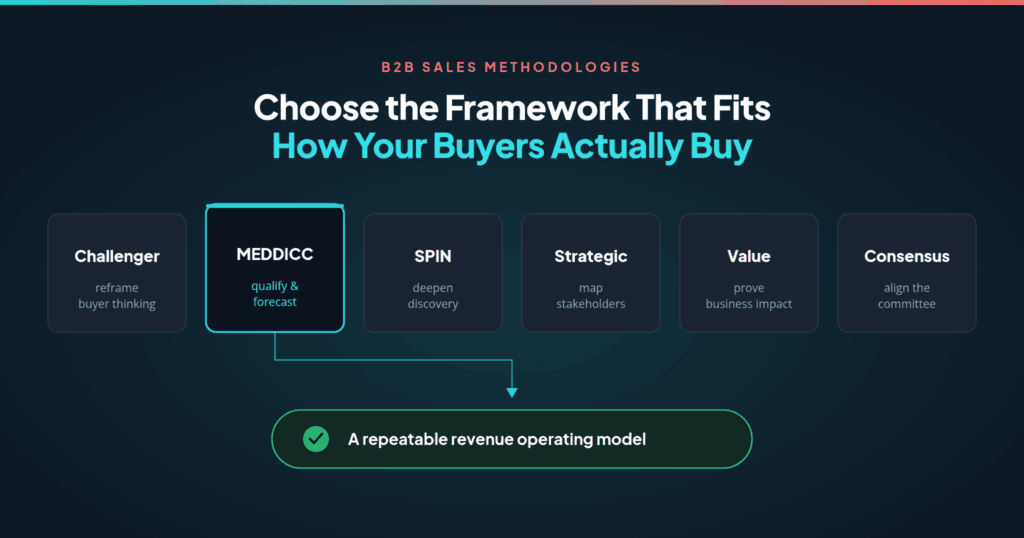
A sales methodology is the structured approach a company uses to qualify opportunities, run discovery, communicate value, manage stakeholders, build consensus, and move deals through the buying process. For mid-market and enterprise B2B companies, the right one depends on deal complexity, the size of the buying committee, the length of the sales cycle, pricing, implementation risk, and how much a buyer has to learn before they can decide.
Here’s the thing I tell founders and revenue leaders when the topic comes up: most companies don’t need a methodology because it’s trendy. They need one because their sales process is inconsistent, forecast calls are unreliable, deals stall without clear next steps, or every rep is quietly selling in a different way. If that sounds familiar, this guide is written for you.
The best B2B sales methodology depends on how your buyers make decisions. Challenger works when buyers need a new perspective. MEDDICC works when enterprise deals require qualification and forecast discipline. SPIN and Consultative Selling work when discovery is the gap. Strategic Selling and Account-Based Selling work when large accounts and buying committees drive the outcome. Value Selling works when you need to prove business impact. The real goal isn’t to pick a popular framework — it’s to build a repeatable revenue operating model your team will actually use.
- What is a sales methodology?
- Why you need more than a process
- How to choose the right methodology
- Challenger Sale
- MEDDICC and MEDDPICC
- SPIN Selling
- Miller Heiman Strategic Selling
- Target Account Selling
- Value Selling
- Consultative Selling
- Solution Selling
- Consensus Selling
- Which one is best for you?
- How to implement it
- FAQ
What Is a Sales Methodology?
A sales methodology is the framework your team uses to guide how it qualifies opportunities, uncovers needs, communicates value, manages stakeholders, handles risk, and moves deals toward a decision. It is not the same thing as a sales process, and that distinction matters far more than most companies realize.
Sales methodology vs. sales process
A sales process defines the stages of a deal — prospecting, discovery, proposal, negotiation, close. It tells you where an opportunity sits in the pipeline. A sales methodology defines how the seller should think, ask questions, create urgency, build consensus, and advance the opportunity inside those stages. It’s the operating logic behind the process.
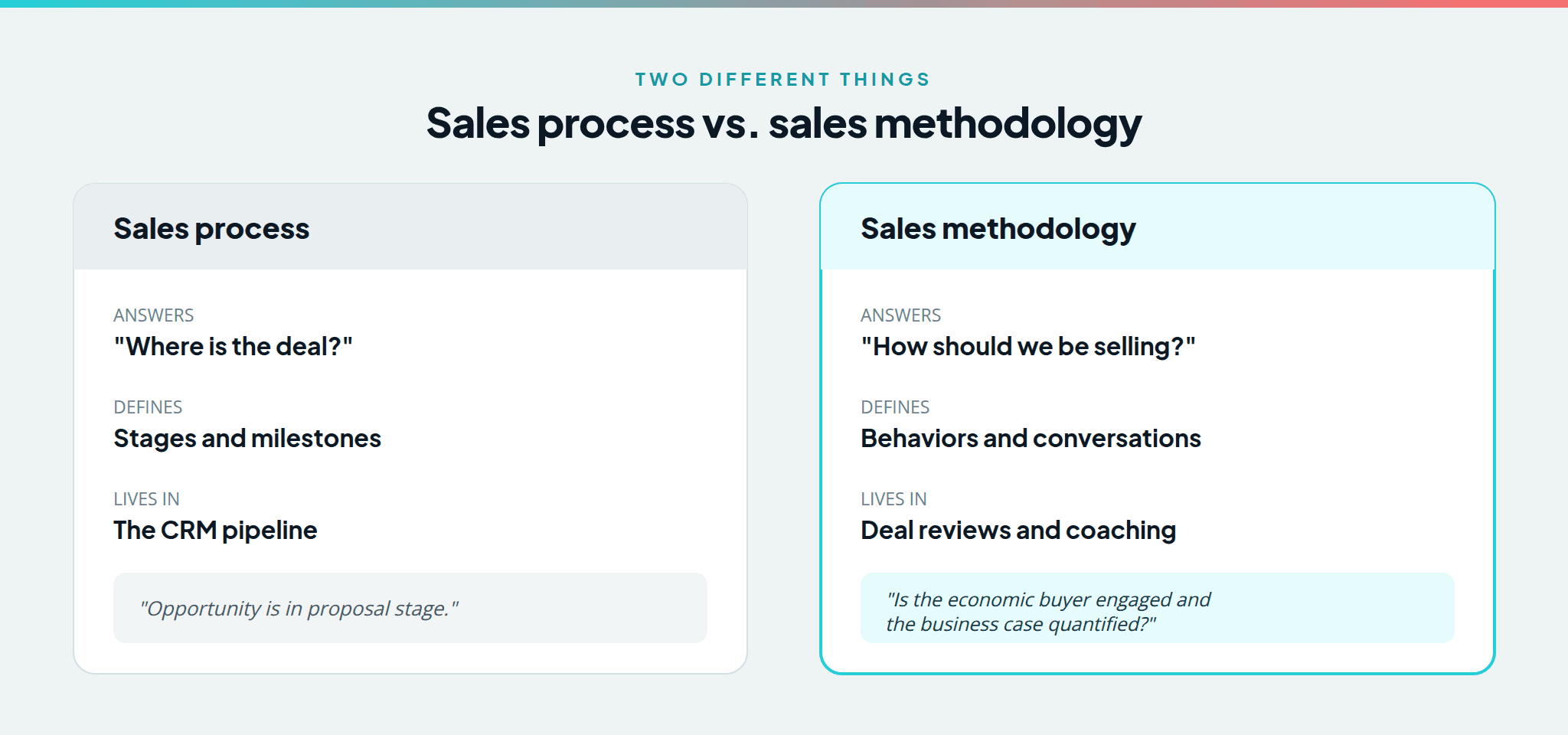
Here’s the practical difference:
| Sales process | Sales methodology | |
|---|---|---|
| Answers | Where is the deal? | How should we be selling? |
| Defines | Stages and milestones | Behaviors and conversations |
| Visible in | The CRM pipeline | Deal reviews and coaching |
| Example | “Opportunity is in proposal stage.” | “Have we identified the economic buyer and quantified the business case?” |
For mid-market and enterprise companies, that distinction is critical. A CRM stage alone doesn’t tell a rep how to navigate procurement, map stakeholders, quantify value, challenge assumptions, or judge whether a deal is real. A methodology gives the whole revenue team a shared operating language — a common standard for what “good” looks like at each stage of a complex sale.
Why B2B Companies Need More Than a Sales Process
A process can tell you an opportunity is in discovery, proposal, or negotiation. What it can’t tell you is whether the pain is real, whether the economic buyer is engaged, whether the business case holds up, or whether the buying committee even agrees on the problem. That’s the work a methodology does: it gives the team a consistent way to inspect deal quality, coach sellers, and forecast with more confidence.
The complexity a process alone can’t handle
Mid-market and enterprise deals rarely come down to a single buyer making a clean decision. The reality usually looks like this:
- Multiple stakeholders with different priorities, risk tolerances, and definitions of success
- Cross-functional decisions pulling in finance, IT, legal, procurement, and operations
- Buyers weighing not just the solution, but implementation risk, change management, and internal politics
- Sales cycles that run months or longer, with multiple evaluation phases and approval gates
- Forecast calls that lean on rep optimism rather than deal evidence
When every rep sells differently, pipeline reviews turn into guesswork, and deals slip — not because the product is wrong, but because the team has no shared standard for qualification, value, or stakeholder strategy. A methodology closes that gap. It connects the individual sales conversation to leadership’s ability to inspect pipeline quality, forecast accurately, and decide where to spend time and money.
A methodology isn’t a training program. It’s the operating layer between your CRM stages and your revenue cadence. Without it you have a pipeline; with it you have a revenue operating model.
How to Choose the Right Sales Methodology
There’s no universal answer here. The right methodology depends on how your buyers actually buy, not on what’s trending in the sales community this quarter. Before you pick one, look honestly at your situation across eight dimensions.
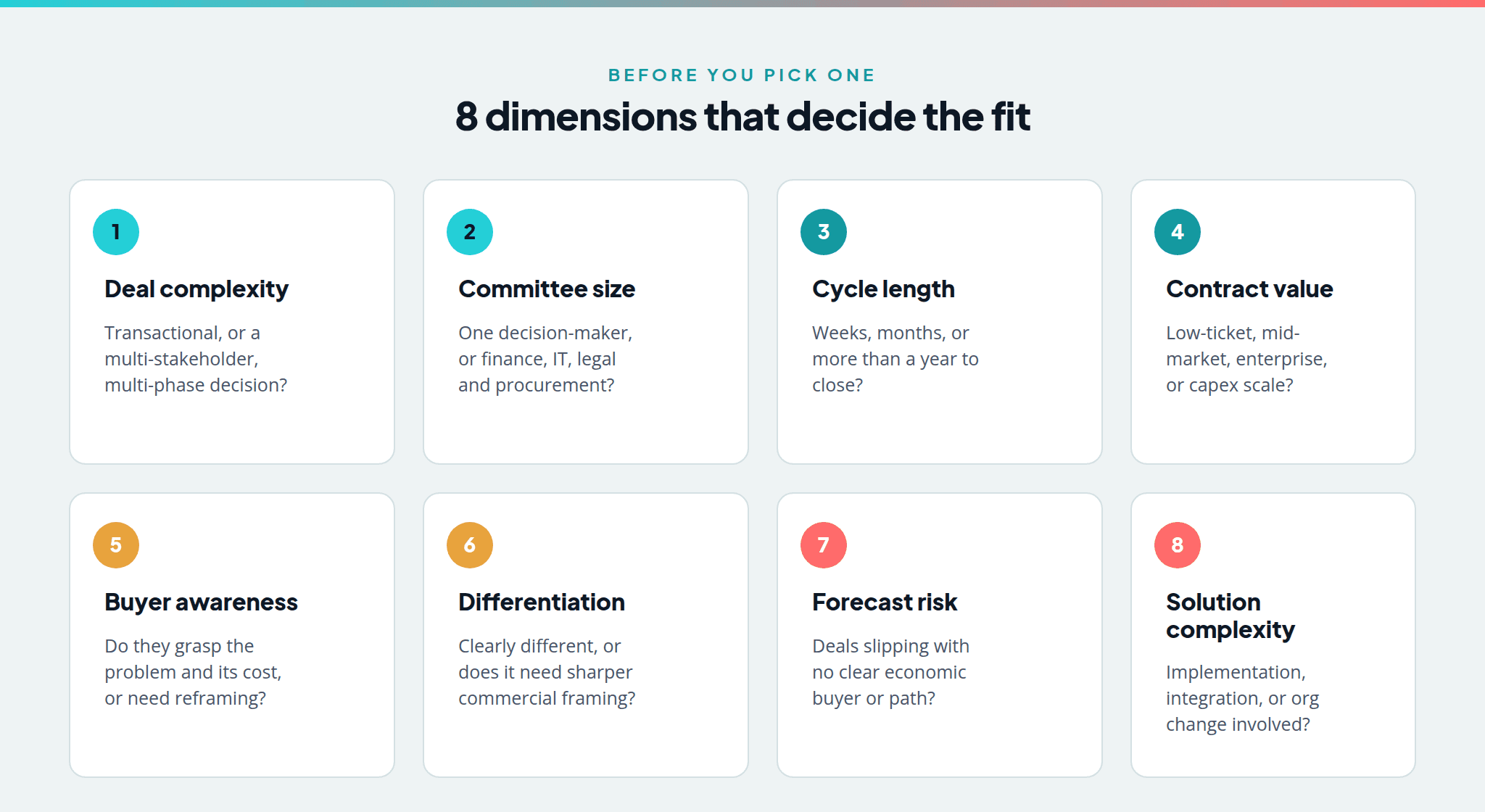
- Deal complexity — a transactional sale, or a multi-stakeholder, multi-phase decision?
- Buying committee size — one decision-maker, or a group that includes finance, IT, legal, and procurement?
- Sales cycle length — weeks, months, or more than a year from first conversation to close?
- Average contract value — low-ticket, mid-market, enterprise, or capital-expenditure scale?
- Buyer awareness — does the buyer already understand the problem and its cost, or does the seller need to reframe it?
- Differentiation — is the offering clearly distinct, or does the team need sharper commercial messaging to stand out?
- Forecast risk — are deals slipping because no one can identify decision criteria, economic buyers, or approval paths?
- Product or service complexity — does the sale involve implementation, integration, customization, or organizational change?
A quick diagnostic
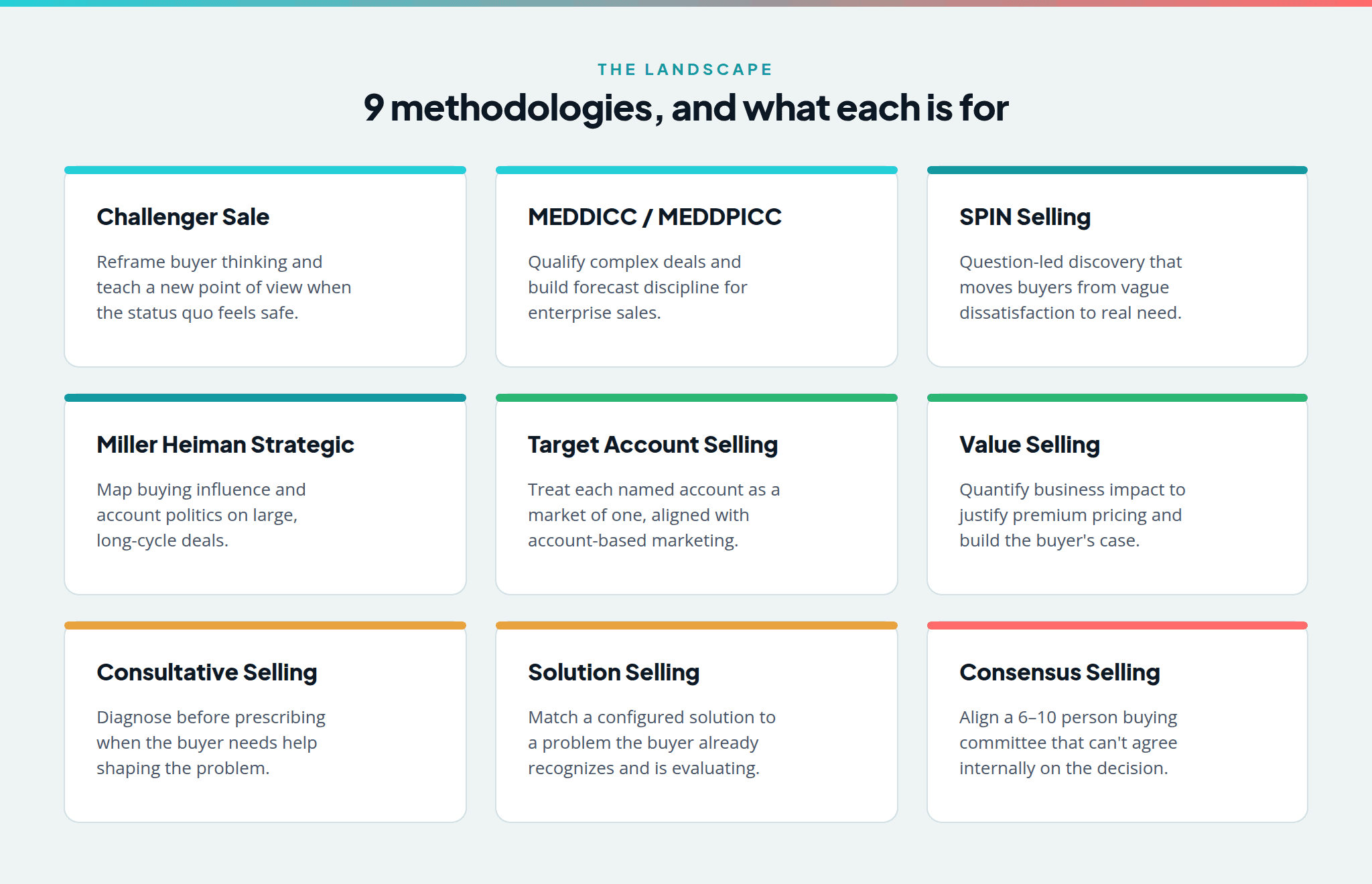
If deals are slipping late and no one can say why, the problem is usually qualification — look at MEDDICC. If buyers don’t feel any urgency and the status quo feels safe, the problem is framing — look at Challenger. If discovery is shallow and reps jump to pitching, the problem is conversation quality — look at SPIN. And if large accounts stall because no one has mapped the real decision-makers, the problem is stakeholder strategy — look at Miller Heiman or Target Account Selling.
The best methodology is the one that improves the quality of your sales conversations and the quality of your leadership decisions. Not the one with the most recent book deal.
Challenger Sale
Introduced by Matthew Dixon and Brent Adamson in The Challenger Sale, this methodology is built on a counterintuitive finding: the most effective B2B sellers aren’t the ones with the deepest relationships. They’re the ones who teach buyers something new, tailor the message to what each stakeholder cares about, and take control of the commercial conversation.
Core idea
- Teach — bring a commercially useful point of view the buyer hasn’t considered
- Tailor — connect that insight to the specific priorities of each stakeholder
- Take control — guide the buyer toward a decision instead of waiting for them to arrive on their own
Use it when
- Buyers are stuck in status-quo thinking and don’t see the cost of inaction
- The market is crowded and differentiation is strategic, not feature-based
- The buyer needs a new frame for the problem, not just a better answer to the one they already defined
- Your team needs to move from relationship-based selling to insight-led selling
Where it breaks down
Challenger fails when sellers challenge without credibility, real insight, or enough discovery. “Challenging” doesn’t mean being aggressive or contrarian — it means showing up with a commercially useful point of view grounded in the buyer’s actual business. Without that foundation, it reads as arrogance, not expertise.
MEDDICC and MEDDPICC
MEDDICC is, in my experience, the single most useful qualification framework for mid-market and enterprise B2B sales. It gives revenue teams a shared language for inspecting deal quality, not just deal activity.
What the acronym means
- M — Metrics: what measurable business impact does the buyer need — revenue growth, cost reduction, time savings, risk reduction?
- E — Economic buyer: who owns the budget and has final authority to approve the decision?
- D — Decision criteria: what standards will the buyer use to evaluate and compare options?
- D — Decision process: how will the decision actually get made, and who has to approve it at each step?
- I — Identify pain: what problem is creating urgency, and what happens if it goes unsolved?
- C — Champion: who inside the buying organization will advocate for you when you’re not in the room?
- C — Competition: what else is the buyer considering, including doing nothing?
MEDDPICC adds one more element — P — Paper process: the legal, procurement, security-review, and contracting steps that must happen before a deal can close. That addition matters enormously in enterprise deals, where legal and procurement can add weeks or months to a timeline that looked clean on the forecast.
Use it when
- Deals are slipping late in the quarter without a clear reason
- Forecast calls run on rep optimism instead of deal evidence
- Reps confuse activity — calls, meetings, demos — with actual progress
- Leadership can’t tell which pipeline opportunities are real
- Procurement or legal keeps slowing down late-stage deals
Where it breaks down
MEDDICC turns into busywork the moment leadership treats it as a CRM checklist instead of a coaching and deal-inspection framework. The point isn’t to fill in fields — it’s to see what’s missing and build a plan to get it. If reps are completing MEDDICC fields without changing how they sell, the implementation has already failed.
SPIN Selling
Developed by Neil Rackham and published in SPIN Selling after one of the largest studies of sales effectiveness ever run, this methodology is built around a sequence of question types that move a buyer from vague dissatisfaction to clearly articulated need.
The four question types
- S — Situation: understand the current environment. What’s in place, and how does it work today?
- P — Problem: identify what isn’t working — the difficulties, frustrations, and gaps
- I — Implication: explore the cost of leaving the problem unsolved for the business, the team, and the bottom line
- N — Need-payoff: help the buyer articulate the value of solving it
The implication questions are where SPIN earns its keep. Most reps spend too long on situation questions and skip implication entirely — which is exactly why deals stall. The buyer understands the problem but has never felt the weight of it.
Use it when
- Discovery quality is inconsistent across the team
- Reps present solutions before the buyer has defined the problem
- The sale requires diagnosis before recommendation
- The buyer knows something is wrong but hasn’t defined or quantified it
Where it breaks down
SPIN gets weak when reps ask too many basic situation questions and not enough implication questions. Situation questions gather information; implication questions create urgency. Without urgency, there’s no compelling reason to change.
Miller Heiman Strategic Selling
Miller Heiman Strategic Selling was built for exactly the deals where the org chart doesn’t tell you who actually makes the decision. It gives teams a framework for mapping buying influence, spotting risk, and building a plan to win complex opportunities across multiple stakeholders.
Stakeholder categories
- Economic buyer — holds final budget authority and cares about business outcomes
- Technical buyer — evaluates the solution against technical, operational, or compliance criteria
- User buyer — will use the solution day to day and cares about usability and workflow
- Coach or internal guide — has credibility inside the organization and helps you navigate politics and process
Understanding which stakeholder is which — and what each one actually cares about — is what separates account strategy from account activity.
Use it when
- Deals involve multiple departments with competing priorities
- Internal politics are shaping the decision as much as the solution itself
- Expansion revenue depends on account planning and relationship mapping
- The seller needs to understand influence, not just titles
Where it breaks down
Strategic Selling can get too heavy for smaller deals or teams that won’t maintain account plans. It takes real investment in account research and ongoing stakeholder mapping. Without that discipline, it becomes a documentation exercise rather than a sales strategy.
Target Account Selling and Account-Based Sales
Target Account Selling (TAS) shifts the focus from territory management to account strategy. Instead of working a broad list of prospects, the team identifies the accounts most likely to buy, maps the stakeholders inside them, and tailors outreach to each stakeholder’s specific priorities. Pair TAS with an account-based marketing motion and it becomes one of the most effective ways to break into large enterprise accounts and expand within existing ones.
Use it when
- A finite list of high-value accounts represents a disproportionate share of your revenue potential
- Expansion and multi-threading matter as much as new-logo acquisition
- Marketing and sales need better alignment on which accounts to pursue and how
- Different stakeholders in the same account need different messages and entry points
Where it breaks down
TAS fails when teams build target-account lists without doing the underlying work — real account research, stakeholder mapping, coordinated outreach, account-specific value propositions. A list of named accounts in a CRM field isn’t a strategy; it’s a filtered view. Teams that run TAS well treat each target account as a market of one and build a coordinated plan across sales and marketing before the first outreach goes out.
Value Selling
Value Selling connects the solution to measurable business outcomes rather than features or deliverables. The premise is simple: buyers don’t buy solutions, they buy results — and the seller’s job is to quantify what those results are worth in the buyer’s own terms.
What “value” actually means in B2B
Value isn’t a vague claim. It’s a specific, quantifiable outcome the buyer cares about: revenue growth or pipeline acceleration, cost reduction, risk or compliance improvement, time savings, margin improvement, retention gains, productivity, or better decisions through data and visibility.
Use it when
- The offering costs more than the alternatives and the buyer has to justify the premium
- Procurement will pressure pricing and you need to defend value rather than discount features
- The buyer needs an internal business case to get finance or the executive team on board
- The solution affects financial or operational outcomes that can be measured
Where it breaks down
Value Selling fails when sellers claim value without quantifying it. “Our solution will improve your team’s efficiency” is not a value proposition. “Based on your team size and current process, this typically cuts manual work by about 40% — roughly 12 hours per rep per week” is. The specificity is what makes it credible.
Consultative Selling
Consultative Selling positions the seller as a problem-solver and advisor rather than a product presenter. The job is to understand the buyer’s goals, constraints, risks, and internal context before recommending anything — the recommendation comes after the diagnosis, not before it. It’s especially relevant for services companies, advisory-led sales, and any situation where the right answer depends heavily on the buyer’s specific circumstances.
Use it when
- The buyer doesn’t have a fully defined solution in mind and needs help shaping the problem
- The offering requires customization, scoping, or advisory input before a proposal makes sense
- Trust and demonstrated expertise are central to the decision
- The conversation has to uncover root causes before you can credibly recommend anything
Where it breaks down
Consultative Selling gets too passive when sellers diagnose forever but never lead the buyer to a decision. Strong consultative sellers are advisors, not order-takers — they ask the hard questions, surface the uncomfortable truths, and then guide the buyer to a clear recommendation.
The failure mode is a seller so focused on being helpful and non-pushy that they never actually close. Consultative selling requires confidence in the recommendation, not just in the questions.
A note on SNAP Selling: for teams selling into busy executives with short attention spans, SNAP (Simple, iNvaluable, Aligned, Priority) is a useful lens for keeping messages concise and relevant. It isn’t a primary methodology for complex B2B sales, but its underlying principle — you have to earn attention before you can earn a conversation — applies across every framework here.
Solution Selling
Solution Selling, developed by Michael Bosworth, starts with the buyer’s pain point and builds the whole sale around how the solution addresses it. Unlike Consultative Selling, which shines when the problem isn’t yet fully defined, Solution Selling works best when the buyer already recognizes a problem and is actively evaluating ways to solve it. The seller’s job is to connect capabilities directly to the stated pain, show how implementation works, and help the buyer picture what adoption looks like inside their organization.
Use it when
- The buyer has a clear, recognized pain point and is in active evaluation mode
- The solution needs tailoring, configuration, or scoping to fit the environment
- The offering includes services, implementation, or change-management components
- The team needs a consistent way to connect product capabilities to customer outcomes
Where it breaks down
Solution Selling gets too reactive when sellers only respond to stated needs instead of helping buyers see the larger issue underneath. A buyer who says “we need a better reporting tool” may actually have a pipeline-visibility problem, a forecasting problem, or a coaching problem. Address only the stated need and you miss the larger opportunity — and close a smaller deal.
Consensus Selling
Research from Gartner consistently shows the average B2B buying group for a complex solution runs 6 to 10 stakeholders, each doing independent research and arriving with different priorities, risk tolerances, and sometimes different definitions of the problem. The deal doesn’t stall because the champion lost interest — it stalls because the group can’t align internally. Consensus Selling tackles that head-on: the seller’s job isn’t just to convince one champion, it’s to help the whole committee align on the problem, the decision criteria, the business case, and the path forward.
Use it when
- Multiple departments are involved and each has a vote or a veto
- No single buyer can approve the deal alone
- Internal alignment is slowing the deal more than external evaluation is
- Risk, change management, or implementation concerns are creating friction inside the buying organization
- The deal has a strong champion who can’t move it forward without broader support
Where it breaks down
Consensus Selling fails when sellers over-rely on one champion and never build support across the committee. A champion who can’t mobilize their colleagues isn’t a champion — they’re a fan. Your job is to equip that person with the materials, talking points, and business case to sell internally when you’re not in the room.
Why this matters now: as buying committees have grown and economic scrutiny has increased, Consensus Selling has shifted from a specialty approach to a baseline requirement for enterprise sales. If your team isn’t actively managing multi-threading and internal alignment, deals will keep stalling in ways that look mysterious from the outside.
Which Sales Methodology Is Best for Your Company?
The answer depends on your specific sales challenge, not on which methodology is loudest right now. Use this as a starting point:
| If your primary challenge is… | Start with |
|---|---|
| Enterprise deals slipping or hard to forecast | MEDDICC or MEDDPICC |
| Buyers don’t see the cost of inaction | Challenger Sale |
| Discovery is shallow or inconsistent across reps | SPIN Selling |
| Large accounts need stakeholder mapping and account politics | Miller Heiman Strategic Selling |
| You sell into named strategic accounts with expansion potential | Target Account Selling |
| You need to justify premium pricing or build a business case | Value Selling |
| You sell advisory, consulting, or custom services | Consultative Selling |
| Buyers know the problem but need the right configured solution | Solution Selling |
| Buying committees can’t align internally on the decision | Consensus Selling |
Sales Methodology Matcher
Pick the challenge that best describes where your deals actually break down. You’ll get the methodology to start with — and the one to pair it with.
A starting point, not a prescription. Which framework actually fits — and how you coach and forecast against it — is what a B2B sales audit is built to answer.
Most mid-market and enterprise teams need more than one
A common mistake is treating methodology selection as a binary choice. In practice, most complex B2B sales need more than one framework working together. A few combinations that hold up well:
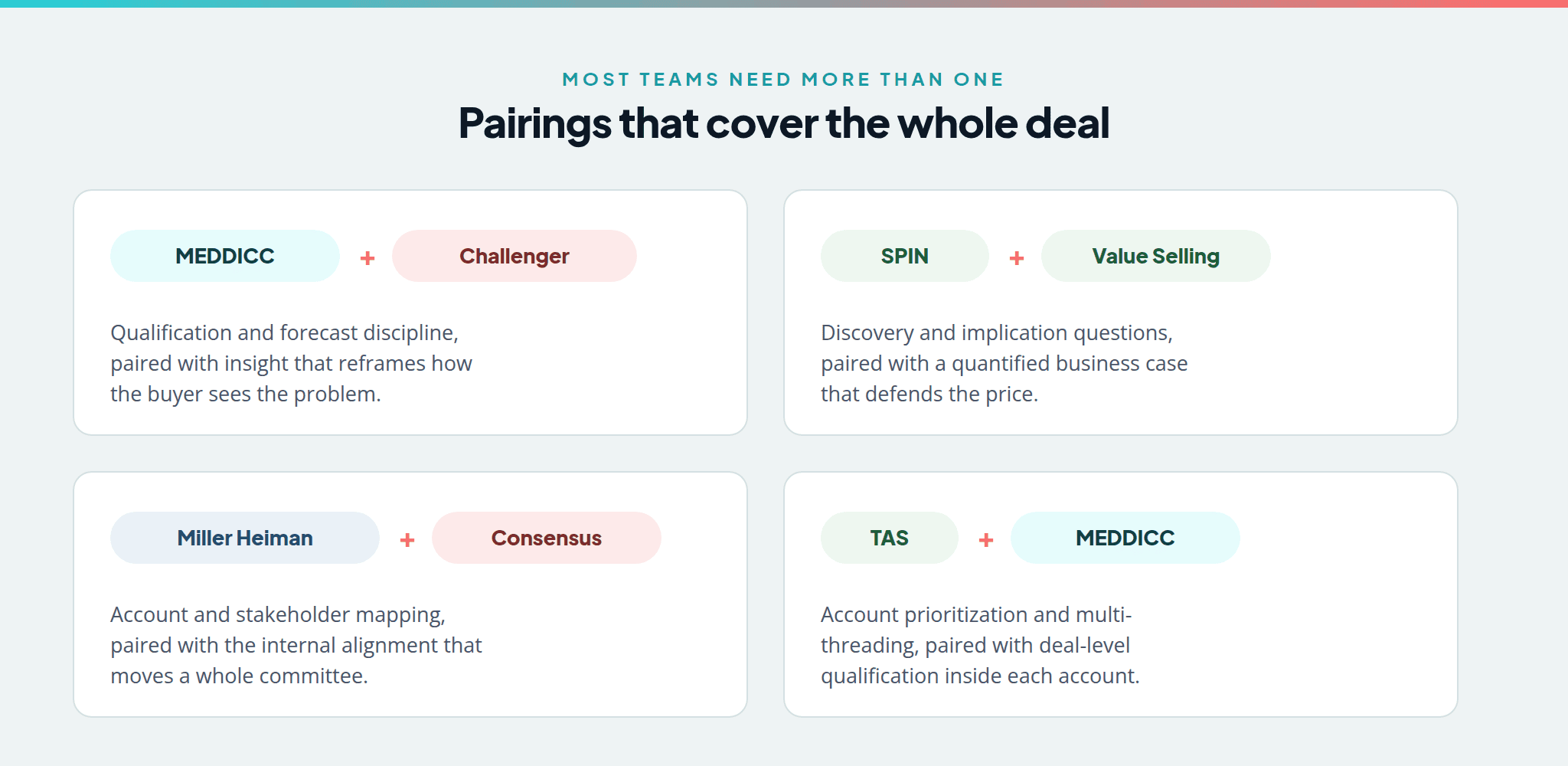
- MEDDICC + Challenger: MEDDICC for qualification and forecast discipline, Challenger for insight-led messaging that reframes buyer thinking
- SPIN + Value Selling: SPIN for discovery and implication, Value Selling for business-case development and pricing defense
- Miller Heiman + Consensus Selling: Strategic Selling for account mapping, Consensus Selling for internal alignment across the committee
- TAS + MEDDICC: Target Account Selling for prioritization and multi-threading, MEDDICC for qualification inside each account
The point isn’t comprehensiveness. It’s understanding which combination addresses how your team currently sells — and then building that into how you coach, inspect, and forecast.
How to Implement a Sales Methodology Without Creating Busywork
This is where most rollouts fall apart. The training happens, the slides look good, the reps nod along in the kickoff, and then nothing changes. Six months later leadership is wondering why the pipeline looks exactly the same. The problem is almost never the methodology — it’s the implementation.
Here’s how I approach it when I work with mid-market and enterprise teams on sales process and revenue operating model design.
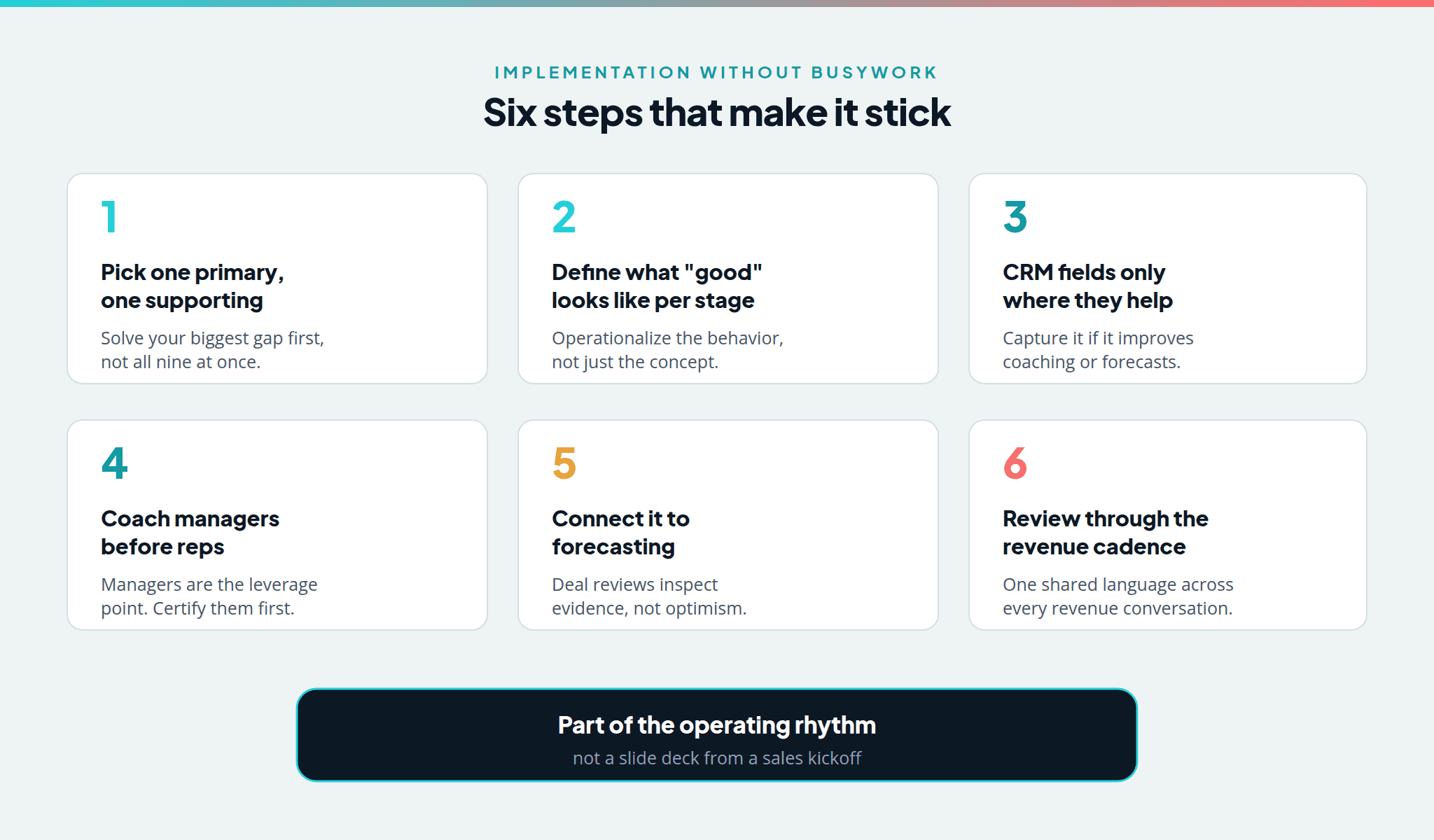
1. Pick one primary methodology and one supporting methodology
Don’t try to implement everything at once. Choose the methodology that addresses your biggest current gap and pair it with one supporting framework. A team with a forecast-accuracy problem and shallow discovery might run MEDDICC as the primary — for qualification and pipeline inspection — and SPIN as the support, for discovery quality. That’s a coherent combination. Rolling out all nine frameworks at once is not.
2. Define what “good” looks like at each sales stage
Don’t just train the team — operationalize the behavior. What does a strong discovery call look like under your chosen methodology? What evidence should exist in the CRM before an opportunity can move to proposal? What does a qualified deal actually look like, in specific, observable terms? Without those definitions, methodology training stays abstract and reps have no clear picture of what to do differently on Monday morning.
3. Build methodology into CRM fields only where it improves decisions
Every methodology concept that becomes a required CRM field is a potential source of admin burden. Be selective. Ask whether capturing it helps managers coach better or helps leadership forecast more accurately. If yes, add it. If it’s documentation for its own sake, skip it.
4. Coach managers before you train reps
Managers are the leverage point. If a manager can’t inspect a deal in the methodology’s language, ask the right coaching questions, and spot what’s missing from a rep’s assessment, the methodology won’t stick. Train and certify managers first, then let them reinforce it through weekly pipeline reviews and deal coaching — not through another training session.
5. Connect methodology to forecasting
Deal reviews should inspect evidence, not optimism. If a rep says a deal is 80% likely to close, the manager’s job is to ask: who’s the economic buyer and are they engaged? What’s the decision process and where are we in it? Who’s the competition and how do we know we’re winning? Those are methodology questions — and when they become the standard language of your forecast calls, the methodology is working.
6. Review adoption through your revenue cadence
Weekly pipeline meetings, monthly forecast reviews, and quarterly account planning should all speak the same methodology language. When the vocabulary is consistent across every revenue conversation, adoption becomes self-reinforcing.
A methodology only works when it becomes part of the operating rhythm — not a slide deck from a sales kickoff.
If your team has a sales process but deals still stall, forecasts feel unreliable, or every rep sells differently, a B2B sales audit can pinpoint whether the issue is methodology, messaging, qualification, pipeline integrity, or revenue cadence. You can also see how I work with teams as a fractional CRO and growth strategy consultant, or review client case studies to see how this plays out in practice.
FAQ About B2B Sales Methodologies
What is the best sales methodology for B2B companies?
It depends on your sales motion, deal complexity, buying committee, and revenue maturity. MEDDICC is strong for complex enterprise qualification and forecast discipline. Challenger helps when status-quo inertia is the main obstacle. SPIN improves discovery when reps jump to solutions too fast. Value Selling helps justify premium pricing and build internal business cases. Most mid-market and enterprise teams do best combining a qualification framework with a conversation or messaging framework.
What sales methodology is best for enterprise sales?
MEDDICC, MEDDPICC, Miller Heiman Strategic Selling, Target Account Selling, and Consensus Selling are especially strong for enterprise because they address the realities of complex deals — multiple stakeholders, long cycles, procurement involvement, account politics, and the need to align a buying committee that may run 6 to 10 people or more.
What is the difference between a sales process and a sales methodology?
A sales process defines the stages of a deal — discovery, proposal, negotiation — and tells you where an opportunity sits. A sales methodology defines how sellers should think, ask questions, qualify, communicate value, and move buyers through those stages. The process is the structure; the methodology is the operating logic inside it.
Is MEDDICC only for SaaS companies?
No. MEDDICC works for any complex B2B sale where qualification, stakeholder mapping, business impact, decision process, and forecast accuracy matter. It’s popular in SaaS because that’s where it was popularized, but it applies just as well to services, consulting, industrial products, implementation-heavy solutions, and enterprise offerings of any kind.
Which sales methodology works best for services companies?
Consultative Selling, SPIN, Value Selling, Challenger, and Consensus Selling are often strong fits for services firms because they support diagnosis before prescription, business-case development, trust-building, and stakeholder alignment. Services sales usually involve a longer trust-building phase and a more custom scoping process, which makes consultative and diagnostic approaches particularly effective.
Can a company use more than one sales methodology?
Yes — and most complex B2B teams should. Many run one primary methodology plus one or two supporting frameworks: MEDDICC for qualification, SPIN for discovery, Value Selling for the business case, for example. The key is choosing combinations that address specific gaps in how the team sells, not layering on frameworks for the sake of it.
How long does it take to implement a new sales methodology?
Meaningful adoption usually takes three to six months when it’s done well: managers trained first, behaviors defined at each stage, the methodology built into pipeline reviews and forecast calls, and adoption reinforced through the revenue cadence. Teams that treat methodology as a one-time training event rather than an ongoing operating standard rarely see lasting results.
Build a Methodology Your Team Will Actually Use
If deals are stalling, forecasts feel shaky, or every rep is selling differently, the fix usually isn’t another training session. A 30-minute discovery call is enough to see where the real gap is — qualification, messaging, pipeline integrity, or cadence — and what it would take to close it. No pitch, no pressure.
Book a Discovery Call
Responds within 24 hours · No commitment required
