Why B2B Growth Breaks Without Revenue Operations
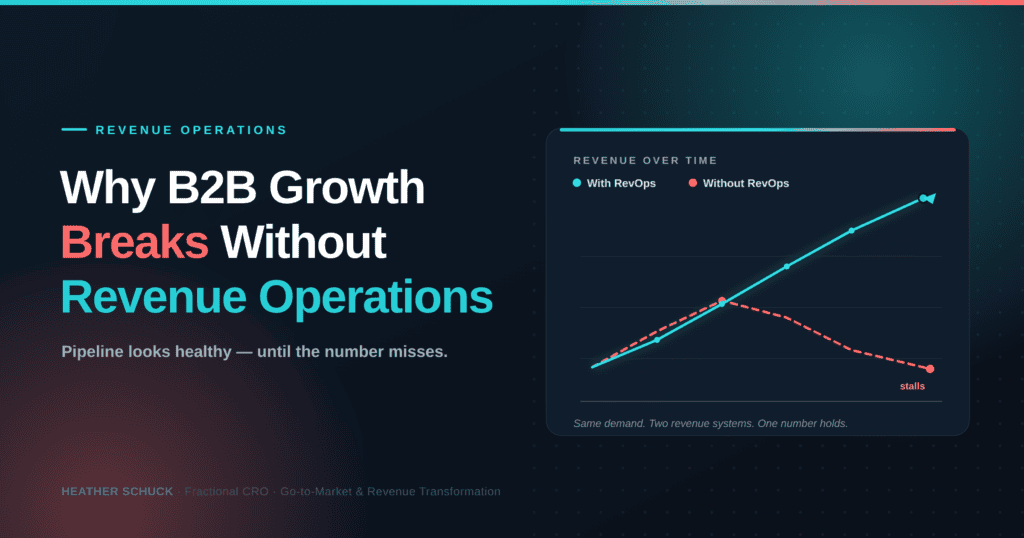
Most B2B companies do not have a growth problem first. They have a revenue system problem. Pipeline looks healthy until it misses. Forecasts sound confident until deals slip. Sales, marketing, and customer success each optimize their own work, but no one owns the full revenue motion. That is where revenue operations becomes a growth system, not a reporting function.
If you need the full definition first, read our guide to what revenue operations is. This article focuses on why RevOps has become essential for B2B growth — forecast confidence, CRM discipline, cross-functional alignment, and AI-ready revenue execution.
I have spent two decades inside these systems as a fractional CRO and, most recently, leading sales transformation for a global enterprise. The pattern is almost always the same: the demand is real, the people are good, and the system underneath them is quietly leaking growth.
RevOps matters for B2B growth because it turns three separate motions — marketing, sales, and customer success — into one accountable revenue system. That is what makes pipeline, forecasting, and expansion predictable instead of hopeful. Without it, growth depends on heroics; with it, growth depends on the system.
- Why traditional B2B growth models break down
- What RevOps actually fixes
- The warning signs your company needs RevOps
- Why RevOps matters for forecasting
- Why AI makes RevOps more important
- What good RevOps looks like in practice
- Common RevOps mistakes
- When to bring in outside RevOps help
- How RevOps connects to a 90-day audit
- Frequently asked questions
Why Traditional B2B Growth Models Break Down
Traditional B2B growth models break down when each revenue function optimizes its own metrics instead of the full customer journey. Marketing can hit lead goals while sales misses pipeline quality. Sales can advance deals that do not meet real exit criteria. Customer success can inherit accounts without full context. RevOps fixes this by creating shared definitions, shared data, and shared accountability across the revenue engine.
In practice, the breakdown shows up in five predictable places:
- Sales, marketing, and customer success operate from different definitions of success.
- CRM data becomes a reflection of rep behavior, not buyer reality.
- Forecasts rely on manager opinion instead of consistent deal inspection.
- Marketing celebrates volume while sales questions quality.
- Customer handoffs create friction that weakens expansion and retention.
What RevOps Actually Fixes
RevOps is not more dashboards. It fixes the operating system behind revenue: how opportunities enter the CRM, how deals move from stage to stage, how leaders inspect pipeline, how marketing and sales define qualified demand, how customer success receives new accounts, and how executives decide whether the forecast is real.
Revenue operations fixes the systems that make revenue predictable:
- Process — stage definitions, exit criteria, qualification, and handoff rules.
- Data — CRM governance and hygiene, so the numbers reflect reality.
- Technology — a stack that supports execution instead of adding sprawl.
- Accountability — one shared definition of success across teams.
- Leadership cadence — the rhythm of inspection and decision-making.
The Warning Signs Your Company Needs RevOps
A company needs RevOps when revenue leaders can no longer trust the system that produces the number. The most common signs are inconsistent CRM usage, weak stage discipline, unreliable forecasts, poor handoffs between teams, and pipeline reviews that depend more on opinion than evidence. Run down this checklist:
- Your forecast changes dramatically late in the quarter.
- Your pipeline looks full but does not convert.
- Reps use CRM stages inconsistently.
- Sales and marketing disagree on lead quality.
- Customer success receives incomplete handoffs.
- Leadership does not trust the dashboard data.
- Your team keeps buying tools instead of fixing process.
- AI initiatives stall because the underlying CRM data is not reliable.
If more than a couple of those sound familiar, the issue is rarely the people. Those unreliable forecasts and messy CRM signals are symptoms of a revenue system that needs a diagnosis, not another tool.
Why RevOps Matters for Forecasting
RevOps improves forecasting by making the inputs behind the forecast more consistent. If reps use stages differently, qualification is weak, and managers inspect deals inconsistently, the forecast becomes a collection of opinions. RevOps creates the definitions, CRM governance, deal-inspection rhythm, and KPI framework that make forecast confidence easier to defend — to your team, and to a board.
| Forecast problem | RevOps fix |
|---|---|
| Deals slip late in the quarter | Clear, buyer-verified exit criteria |
| Pipeline is inflated | Qualification discipline |
| Dashboards are not trusted | CRM governance and hygiene |
| Managers inspect deals differently | A standard deal-review cadence |
| The board narrative changes often | One consistent revenue signal |
A forecast is only as strong as the process behind it. Fix the system, and the number stops surprising you.— Heather Schuck, GTM Strategy Consultant
Why AI Makes RevOps More Important, Not Less
AI makes RevOps more important because AI tools depend on clean data, consistent process, and clear revenue definitions. If the CRM is messy, opportunity stages are inconsistent, and teams do not follow the same operating rhythm, AI will produce faster noise instead of better decisions. AI does not fix broken RevOps — it amplifies whatever system is already in place.
- AI forecasting depends on clean CRM data.
- AI sales coaching depends on consistent process adherence.
- AI reporting depends on field hygiene and shared definitions.
- AI automation depends on clean handoff rules.
- AI insights are only useful if the data layer is trustworthy.
This is why AI readiness starts with revenue readiness. A GTM tech stack and AI readiness review almost always finds the same thing: the models are fine; the data and process underneath them are not.
What Good RevOps Looks Like in Practice
Good RevOps is visible in the way the company operates. Leaders trust the pipeline because the CRM reflects reality. Managers inspect deals against clear criteria. Sales and marketing use the same definitions. Customer handoffs are documented and consistent. Board conversations become clearer because the revenue story is built from trustworthy pipeline signal, not last-minute explanation.
- Sales stages reflect real buyer behavior.
- Managers inspect deals against the same criteria.
- Marketing and sales use shared definitions of qualified demand.
- Customer success receives clean account context.
- Executives know which pipeline signals to trust.
- Forecast reviews become evidence-based, not opinion-based.
- Dashboards support decisions, not just reporting.
Common RevOps Mistakes That Slow Growth
The most common RevOps mistake is treating RevOps as a dashboard or technology project instead of an operating discipline. Tools can improve visibility, but they cannot fix unclear process, weak qualification, inconsistent handoffs, or poor CRM adoption on their own. The recurring traps:
- Buying tools before fixing process — automating a broken motion just makes it fail faster.
- Treating RevOps like reporting support instead of an execution function.
- Letting every department define success differently.
- Automating broken workflows and calling it transformation.
- Ignoring frontline adoption — the best process on paper fails if reps route around it.
- Building dashboards leaders never use to actually make decisions.
When RevOps does not work
RevOps is not magic, and it is worth being honest about where it fails. It does not deliver when:
- Leadership treats it as reporting instead of an operating discipline.
- Teams buy tools before defining the process underneath them.
- CRM governance is treated as optional.
- Frontline adoption is ignored and reps route around the system.
- The CRO owns the number, but no one owns the system that produces it.
When to Bring in Outside RevOps Help
Bring in outside RevOps help when your team is too close to the system to see where it is breaking. An outside operator can inspect the CRM, interview stakeholders, pressure-test the sales process, evaluate forecast discipline, and identify the highest-impact fixes before leadership commits more budget, headcount, or tools. The clearest fit signals:
- Forecast confidence is low.
- CRM trust is weak.
- Leadership disagrees on the real revenue problem.
- The sales process exists on paper but not in practice.
- Marketing, sales, and customer success have competing definitions.
- You are preparing for a board meeting, funding event, growth reset, or GTM redesign.
If you are not ready for a full engagement, one focused strategy session is often enough to name the real problem and the first move.
How RevOps Connects to a 90-Day Revenue System Audit
A 90-day revenue system audit turns RevOps from a concept into a diagnostic process. Instead of guessing whether the issue is pipeline, process, people, positioning, data, or execution, it inspects the full revenue system and ranks the highest-impact fixes. It covers:
- Sales process and pipeline integrity
- Qualification discipline and stage definitions
- Salesforce governance and data quality
- GTM tech stack and AI readiness
- Stakeholder interviews and cross-functional alignment
- KPI framework, forecast diagnostics, and a prioritized roadmap
Sources & Further Reading
Field evidence. These are outcomes from rebuilding revenue systems — CRM, process, and cadence — as a fractional CRO, not from adding another tool:
- $300M+ in revenue influenced across B2B engagements.
- 10× deal-velocity acceleration after rebuilding the playbook, CRM, and enablement.
- 400% improvement in lead conversion by fixing the process, not increasing spend.
- 250% demand-generation lift in 90 days through segmentation-based ABM.
Research and further reading:
- Gartner — "75% of the highest growth companies in the world will deploy a RevOps model by 2025."
- Forrester — customer-aligned organizations report ~2.4× higher revenue growth and 2× higher profitability growth.
- Gartner — a typical B2B buying group involves six to ten decision-makers, which raises the cost of internal misalignment.
- Related on this site: what revenue operations is · the 90-day B2B sales audit · MEDDPICC qualification.
Frequently Asked Questions
What is the main purpose of RevOps?
The main purpose of RevOps is to make revenue growth more predictable by aligning sales, marketing, customer success, data, process, and technology around one operating system. RevOps creates shared definitions, cleaner handoffs, stronger CRM discipline, and better visibility into pipeline and forecast health.
Why does RevOps matter for B2B growth?
RevOps matters for B2B growth because growth becomes harder to manage when teams operate in silos. As sales cycles become more complex, companies need consistent process, trustworthy data, and cross-functional alignment. RevOps helps leaders understand what is working, where revenue is leaking, and what to fix next.
How does RevOps improve forecasting?
RevOps improves forecasting by standardizing the inputs behind the forecast. That includes clear sales stages, qualification criteria, CRM governance, deal-inspection rules, and consistent KPI definitions. When the process is cleaner, leaders can trust pipeline data and defend the forecast with more confidence.
Is RevOps the same as sales operations?
RevOps is broader than sales operations. Sales operations usually focuses on sales process, tools, reporting, and rep productivity. RevOps connects sales operations with marketing operations, customer success operations, finance, CRM governance, and executive revenue cadence across the full customer journey.
When should a company invest in RevOps?
A company should invest in RevOps when revenue performance becomes difficult to diagnose. Common triggers include unreliable forecasts, poor CRM adoption, inconsistent handoffs, weak pipeline conversion, disconnected tools, sales and marketing misalignment, or leadership debates about which revenue signal to trust.
How does AI change Revenue Operations?
AI makes Revenue Operations more important because AI tools depend on clean data and consistent process. If CRM data is messy or revenue definitions are unclear, AI outputs will be unreliable. RevOps creates the data discipline, process structure, and governance needed for AI to support better revenue decisions.
What should a RevOps audit include?
A RevOps audit should include sales process, pipeline integrity, qualification discipline, CRM governance, data quality, tech-stack utilization, AI readiness, handoff rules, cross-functional alignment, KPI consistency, and forecast reliability. The goal is to identify which parts of the revenue system are limiting growth.
Book a 90-Day Revenue System Audit
If your pipeline looks healthy but the number still does not hold, the issue may not be demand — it may be the revenue system underneath it. A 90-day revenue system audit shows where process, CRM discipline, forecast confidence, and cross-functional alignment are breaking down before another quarter gets expensive.
Diagnose the system · fix the leaks · make the number predictable