How to Structure Deal Reviews With Leadership
Most deal reviews are not reviews at all — they are performances, and everyone in the room knows it. The rep walks leadership through a deal they already believe in, the story is polished, the enthusiasm is real, and forty minutes later the meeting ends with a vague “keep me posted” and no clear sense of whether the deal is actually going to close. I have sat through hundreds of these, on both sides of the table, and the pattern is almost always the same: lots of activity recounted, very little evidence tested, and a forecast that walks out of the room exactly as fragile as it walked in.
A deal review is one of the highest-leverage hours a revenue leader gets, and when it is structured well it does something a dashboard never can — it stress-tests whether a deal is real before you bet the quarter on it. The purpose of a leadership deal review is not for the rep to recap what they have done; it is for leadership to inspect whether the deal is real, what the risks are, and what has to happen next to move it forward. That shift from storytelling to inspection is what separates a review cadence that improves your forecast from one that just fills a calendar slot.
A leadership deal review should be structured around buyer evidence, deal risk, decision process, next actions, and leadership support. The goal is not for reps to recap activity, but for leaders to inspect whether the deal is real, what risks exist, and what must happen next to improve win probability.
What a Leadership Deal Review Should Accomplish
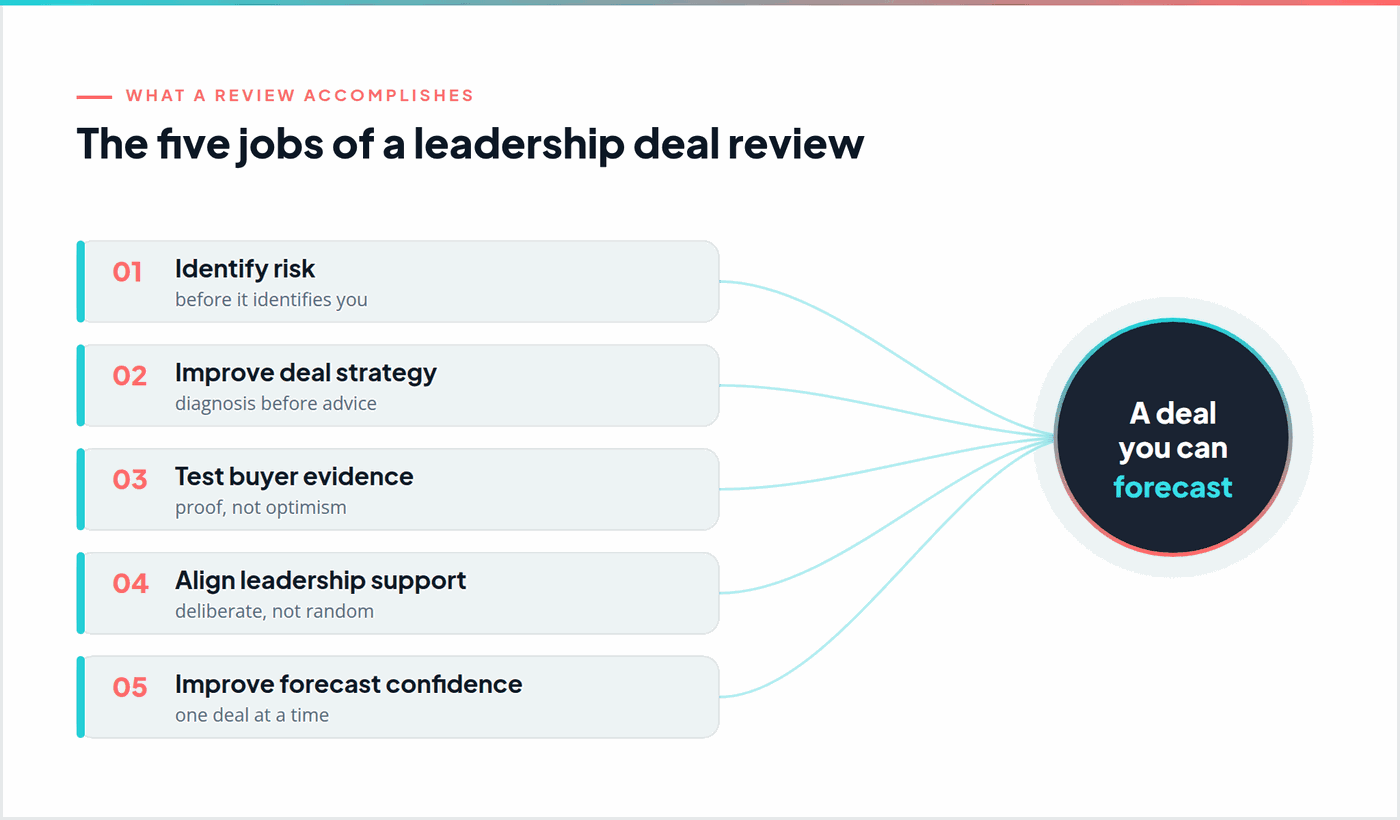
Before you fix the format, get clear on the job. A deal review is not a status update and it is not a coaching session dressed up as one — it is an inspection with a purpose, and a good one accomplishes five things in the same hour. Design the review around these outcomes instead of around the rep’s narrative, and it stops being a meeting people sit through and starts being one that changes what happens on the deal.
Identify risk before it identifies you
The first job of a review is to surface what could kill the deal while there is still time to do something about it. Every deal carries risk — a stakeholder who has gone quiet, a business case that has not been quantified, a competitor nobody has named out loud — and the review exists to drag that risk into the open. If a deal walks out of the room feeling safer than the evidence justifies, the review failed at its most important task.
Improve the deal strategy
Inspection and improvement are not opposites; a well-run review does both. Once leadership actually understands where the deal is, the conversation can turn to strategy — the sequence of the next few moves, which stakeholder to engage, how to reframe the business problem so it lands with the economic buyer. The point is that strategy follows diagnosis, not the other way around, and most reviews get this backward.
Test the buyer evidence
This is where a review does its most important work. A deal is only as real as the evidence the buyer has given you, and the review is where that evidence gets tested rather than assumed. A “verbal yes” is not evidence, and neither is a champion’s confidence. A buyer-confirmed next step, a documented business problem, an engaged economic buyer, and a defined decision process — that is evidence, and pulling it apart from optimism is what protects you from betting a quarter on a deal that only looked real.
Reviews like this often reveal that a stalling quarter is really a qualification problem in sales, the same root cause behind teams that hit activity targets while deals keep slipping.
Align leadership support
Some deals need something only leadership can provide — an executive sponsor call, a pricing exception, a resource the rep cannot unlock alone. A structured review makes that ask explicit and gets a decision on it in the room, so support is deliberate and tied to the deals that actually need it, instead of leadership parachuting into random deals on instinct.
Improve forecast confidence
Every deal review is, quietly, a forecast review. When leadership inspects the evidence behind the deals carrying the number, the forecast that rolls up stops being a collection of rep sentiment and starts being a defensible position you can take to your CFO and board. A disciplined deal review cadence is how forecast confidence gets built one deal at a time — which is exactly why review outputs and forecast discipline should be connected rather than run as separate meetings.
A deal is only as real as the evidence the buyer has given you. The review is where that evidence gets tested, not assumed.
What Most Deal Reviews Get Wrong
If your reviews feel busy but never seem to change an outcome, look at how the meeting is built. Five failure patterns show up again and again, and they compound: each one makes the next more likely, until the review becomes a ritual that produces confidence without producing clarity.
Too much rep storytelling
Reps are, by design, the most optimistic people in the building, and an unstructured review hands them the microphone and lets optimism set the agenda. The deal that gets the most airtime is usually the one the rep is most excited about, not the one that most needs scrutiny, and the narrative smooths over exactly the gaps a review is supposed to expose.
Too little buyer evidence
The flip side of too much story is too little proof. When a review runs on what the rep believes rather than on what the buyer has actually done, you are inspecting sentiment, and sentiment is the least reliable input you can feed a forecast. The question “what did the buyer do that tells us this is real?” almost never gets asked, and its absence is where forecasts come apart at the end of the quarter.
No consistent inspection criteria
When every review is improvised, “commit” means something different for every rep and every manager, and there is no shared bar a deal has to clear. Without consistent criteria, you cannot compare two deals, you cannot trust the roll-up, and you cannot coach against a standard because there is no standard — just whoever is most persuasive in the moment.
Leadership jumping straight to advice
This is the most common leadership failure, and it feels like helping. The rep gets thirty seconds into the deal and a senior leader jumps in with “here’s what you should do,” before anyone has established where the deal actually is. Advice given before diagnosis is just a more confident guess, and it teaches the room that the review is about impressing leadership rather than inspecting reality.
No clear owner or next action
The quiet killer. A review generates energy, opinions, and a few good ideas, and then it ends without a single committed next step, a named owner, or a date. Nothing decided in the room carries into the following week, so the same deal shows up at the next review no further along, because inspection without a committed action is just observation.
| What most deal reviews do | What a good deal review does |
|---|---|
| Let the rep narrate activity and set the agenda | Walk every deal through the same elements, in the same order |
| Run on rep sentiment and confidence | Run on buyer evidence — what the buyer actually did |
| Improvise, so “commit” means something different per rep | Apply one consistent inspection standard across the team |
| Jump to advice before diagnosing the deal | Ask the evidence questions first, then coach |
| End with opinions and no owner | End with a buyer-confirmed next action and a date |
The Recommended Deal Review Format
The fix is a consistent structure every deal moves through, in the same order, every time. Consistency is the point — when every deal is presented against the same eight elements, leadership can inspect instead of react, reps prepare instead of perform, and you can finally compare one deal to another. Keep the whole walkthrough tight; the discipline is in covering every element, not in talking longer.
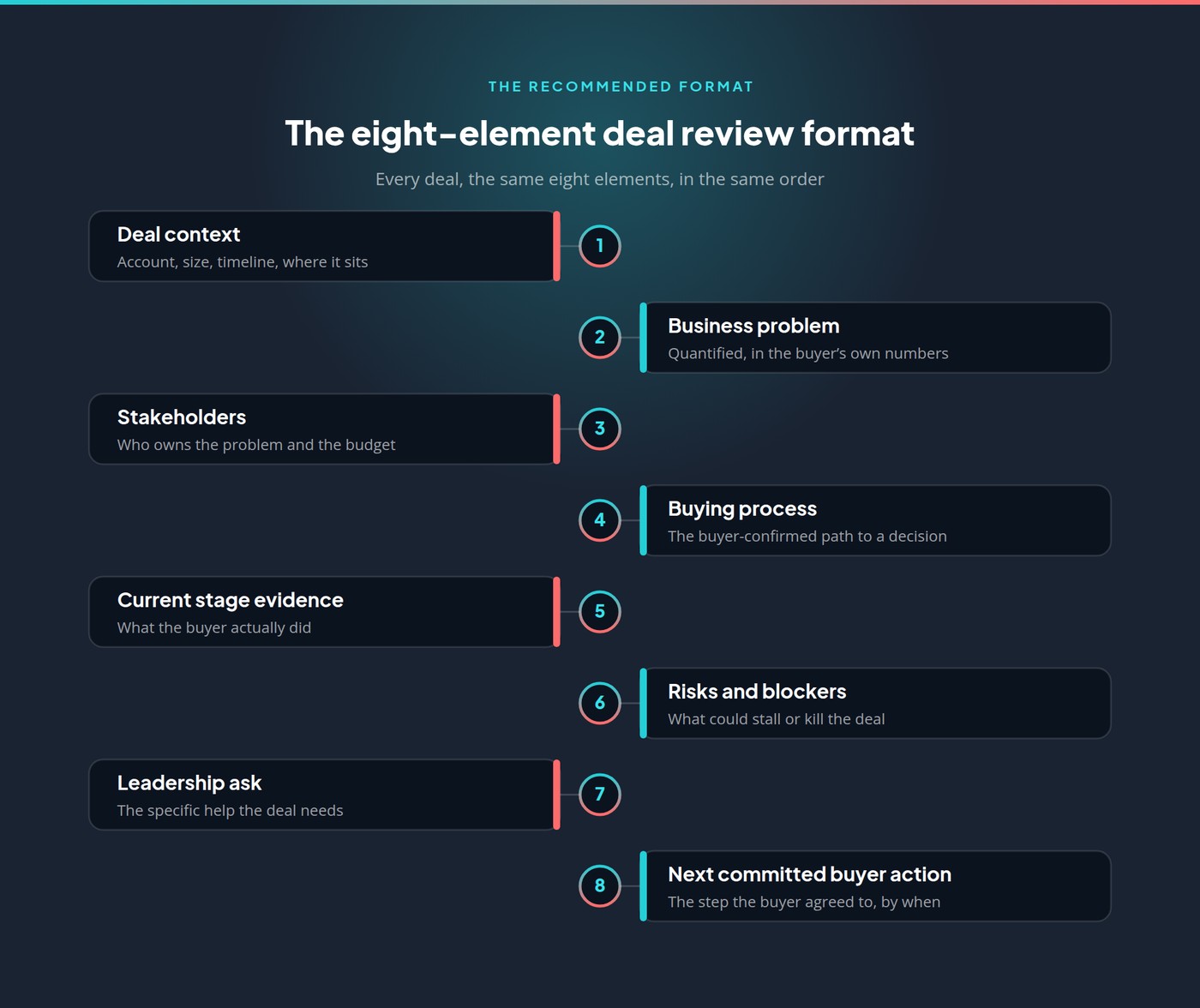
- 1. Deal context
- The one-paragraph version: who the account is, deal size, timeline, and where it sits in the process. Enough to orient the room, not a biography. If this takes more than a minute, the rep does not yet know what the deal is really about.
- 2. Business problem
- What is the buyer actually trying to solve, in their words and their numbers? A deal anchored to a real, quantified business problem has gravity; a deal anchored to “they’re interested in the product” does not. This is the foundation everything else rests on.
- 3. Stakeholders
- Who is involved, what each person cares about, and — critically — who owns the business problem and who controls the money. A single-threaded deal with one friendly champion and no economic buyer is a common shape, and naming it out loud is the first step to fixing it.
- 4. Buying process
- How this company actually makes a decision like this: the steps, the approvals, legal and procurement, the timeline the buyer has confirmed. If the close date is not anchored to a buyer-verified decision process, it is a hope with a calendar entry, not a forecast input.
- 5. Current stage evidence
- What has the buyer done that proves the deal is where the rep says it is? Attended the technical validation, shared the internal business case, introduced procurement, confirmed the next step. Evidence is what the buyer did, not what the rep feels — and this element is where a review earns its keep.
- 6. Risks and blockers
- What could stall or kill this deal, stated plainly. The strongest reps volunteer their risks; the format requires everyone to. A deal presented with no risks is not a low-risk deal, it is an unexamined one.
- 7. Leadership ask
- What does the rep specifically need from leadership — an executive sponsor call, a pricing decision, a resource? Making the ask explicit turns leadership support from random intervention into a deliberate move on the deals that need it.
- 8. Next committed buyer action
- The single most important line in the review: what is the next step the buyer has agreed to take, by when? Not what the rep will do — what the buyer has committed to. A deal without a buyer-confirmed next action is stalled, no matter how good the story sounds, and naming that is often the most useful outcome of the hour.
You do not need software to run this. You need the same eight prompts on the same page for every deal, and the discipline to walk each one all the way through before leadership starts offering advice. The scorecard below turns these elements into a fast readiness check you can run on any deal before it goes into a review.
Deal Review Readiness Scorecard
Check every element you can back with real buyer evidence — not what the rep believes, but what the buyer has actually done. The score tells you whether this deal is ready to inspect, still full of gaps, or resting on story instead of evidence.
Run this before a deal goes into a review, or live in the room. The gaps you cannot check are exactly what leadership should be inspecting.
The Questions Leaders Should Ask
A good review depends less on the presenter than on the questions leadership asks, because the right questions do the inspecting for you. These five cut straight through story to evidence, and the discipline is to ask them before offering any advice — diagnose first, prescribe second. Ask them consistently and reps start pre-answering them, which is the moment your whole pipeline gets more honest.
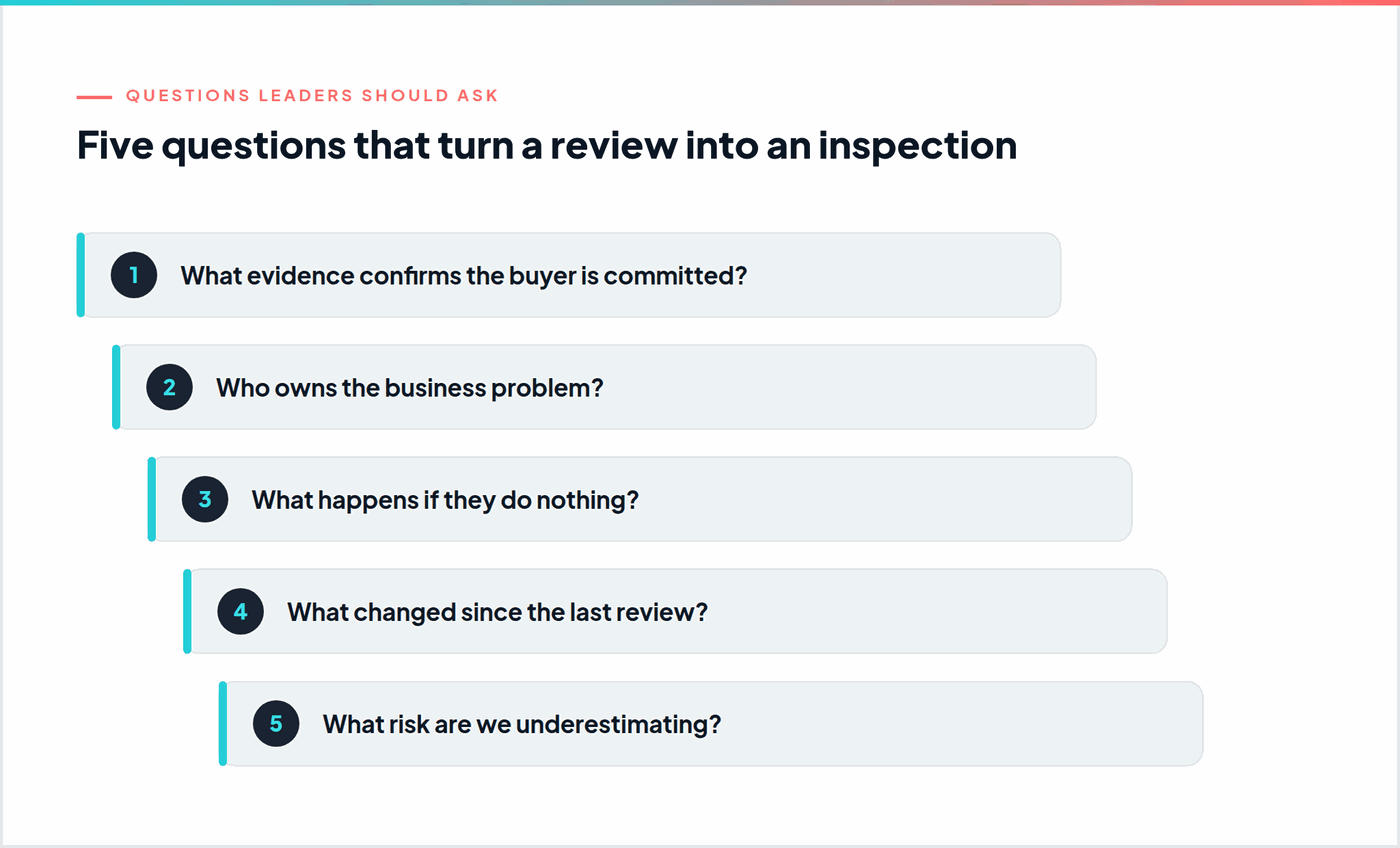
- “What evidence confirms the buyer is committed?”
- The question that separates a real deal from a hopeful one. It forces the conversation off what the rep believes and onto what the buyer actually did, and if the honest answer is “they seem enthusiastic,” you have just found the gap the whole review exists to find.
- “Who owns the business problem?”
- Deals close when the person who owns the problem and the person who owns the budget are engaged and aligned. This question surfaces single-threaded deals and missing economic buyers fast, and those are two of the most common reasons a “sure thing” falls apart late.
- “What happens if they do nothing?”
- The most underused question in sales. If the cost of the buyer’s status quo is low, the deal will slip no matter how good your solution is, because “do nothing” is your real competitor in most complex deals. A weak answer here predicts a stalled deal better than almost anything else.
- “What changed since the last review?”
- Momentum is evidence. A deal where nothing has moved since last time — no new stakeholder, no completed step, no buyer action — is a deal that is stalling, even when the story stays upbeat. This question turns your review cadence into an early-warning system for slippage.
- “What risk are we underestimating?”
- Every deal has one, and the reps who cannot name theirs are usually sitting on the biggest ones. Asking directly gives permission to surface the uncomfortable thing — the quiet stakeholder, the un-run procurement gauntlet — while there is still time to act on it rather than explain it after the loss.
Ask the questions before you offer the advice. Diagnose first, prescribe second — every time.
How TheSchuck.Agency Helps Implement Deal Reviews
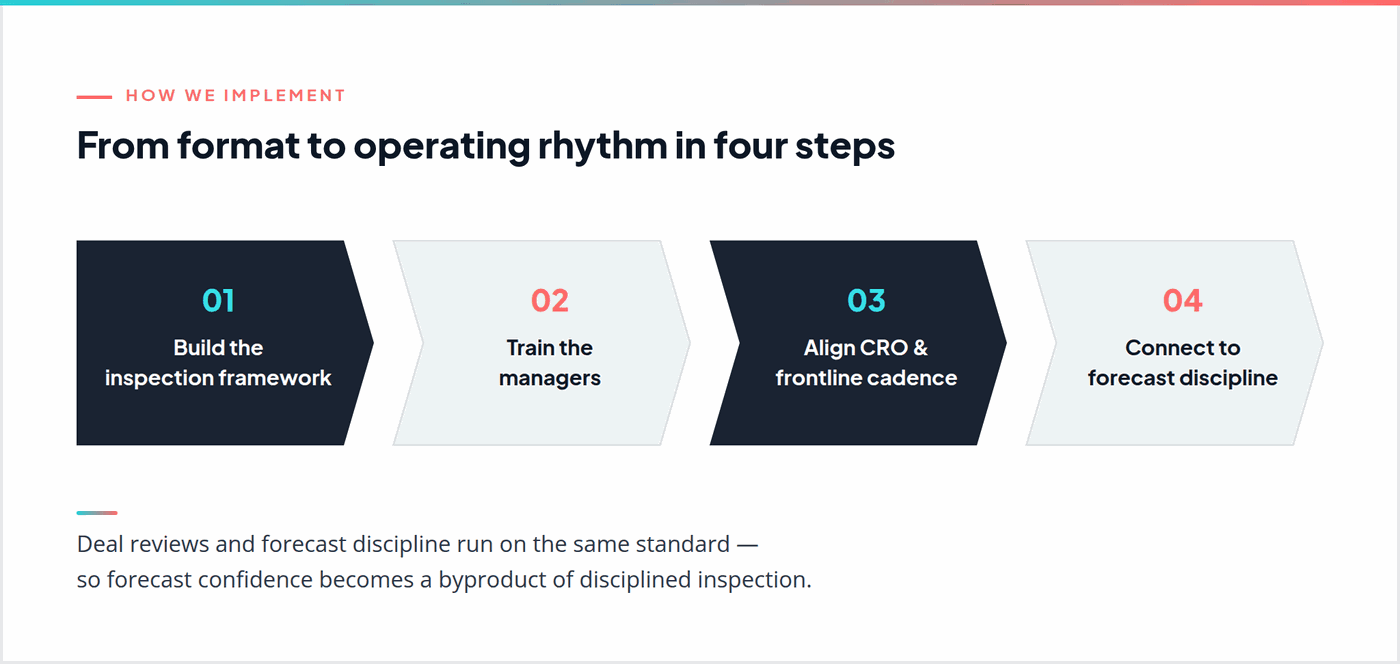
Knowing what a good review looks like and getting one to run consistently across every manager and every rep are two different problems, and the second is where most teams get stuck. A format on a slide does not survive contact with a busy quarter unless it is built into the operating rhythm and reinforced from the top. This is the work I do with revenue teams, and it comes down to four things.
Build the inspection framework
We start by turning the review format into a concrete, repeatable inspection standard — the elements every deal is presented against, the evidence that qualifies as evidence, and the bar a deal has to clear to earn each forecast category. This is what replaces improvised reviews with a consistent standard the whole team is measured against, so “commit” finally means the same thing everywhere.
Train the managers
The frontline manager runs more reviews than anyone, so the cadence is only as good as they are. We train managers to inspect rather than advise, to ask the evidence questions before offering solutions, and to hold the line on buyer-confirmed next actions, because a framework only works if the people running the day-to-day reviews know how to use it under pressure.
Align the CRO and frontline cadence
Reviews break when the executive review and the frontline review inspect against different standards, so we connect them into one coherent rhythm. The CRO‘s review reinforces the same criteria the manager uses, leadership support requests flow up cleanly, and the whole cadence pulls in the same direction instead of sending reps mixed signals about what “good” looks like.
Connect review outputs to forecast discipline
Finally, we wire the review back into the forecast, so the evidence inspected in the room is the same evidence backing the number you commit to the board. When deal reviews and forecast reliability run on the same standard, forecast confidence stops being a feeling and becomes a byproduct of disciplined inspection — which is the entire point of doing this work.
Review the evidence, not the story. Commit the deals that hold up to the questions, and go to work on the ones that don’t.
Frequently Asked Questions
How should we structure deal reviews with leadership?
Structure them around inspection, not recap. Walk every deal through the same elements in the same order — deal context, the quantified business problem, stakeholders and who owns the budget, the buyer-confirmed decision process, current-stage buyer evidence, risks and blockers, the specific leadership ask, and the next action the buyer has committed to. The goal is for leadership to test whether the deal is real and decide what has to happen next, not for the rep to narrate activity. Consistency across every deal is what lets you compare deals, trust the roll-up, and turn the review into a forecast you can defend.
What is the purpose of a leadership deal review?
To find out whether a deal is real before you bet the quarter on it. A good review does five things: it surfaces risk while there is still time to act, sharpens the deal strategy, tests the buyer evidence behind the deal, aligns any leadership support the deal needs, and grounds the forecast in evidence rather than rep sentiment. The test of a good one is simple — it ends in a decision about the deal, not in “keep me posted.”
What do most deal reviews get wrong?
They let rep storytelling set the agenda while too little buyer evidence gets tested, they run without consistent inspection criteria so “commit” means something different for every rep, leadership jumps to advice before establishing where the deal actually is, and the meeting ends with no owner and no committed next step. The result is a room full of confidence and a forecast that is no more reliable on the way out than it was on the way in. Fixing the review is usually step three of a wider sequence, which I lay out as a 90-day sales transformation plan.
What questions should leaders ask in a deal review?
Five cut through story to evidence: “What evidence confirms the buyer is committed?” forces the conversation onto what the buyer actually did; “Who owns the business problem?” surfaces single-threaded deals and missing economic buyers; “What happens if they do nothing?” tests whether the buyer’s status quo is your real competitor; “What changed since the last review?” catches stalling deals early; and “What risk are we underestimating?” gives the room permission to name the uncomfortable thing while there is still time to act on it. Ask them before offering any advice.
How often should deal reviews happen?
Frequently enough that “what changed since last time?” is a meaningful question — for most complex B2B teams that means a weekly or bi-weekly frontline cadence on active, forecasted deals, with a lighter executive review layered on top. The exact frequency matters less than the consistency and the standard: a disciplined weekly review on your top deals will improve forecast reliability far more than an elaborate monthly one. The frontline manager’s review is where inspection actually happens, so that is the cadence to protect first.
How do deal reviews improve forecast accuracy?
Because a forecast is only as reliable as the evidence behind the deals carrying it, and the deal review is where that evidence gets tested. When leadership inspects buyer-confirmed next steps, engaged economic buyers, and verified decision processes deal by deal, the categories those deals roll into stop reflecting rep optimism and start reflecting reality. Connect the review standard to your forecast categories and the number you commit to the board becomes a byproduct of disciplined inspection rather than a hopeful estimate.
