MEDDPICC Sales Methodology: A Practical Guide for Complex B2B Sales
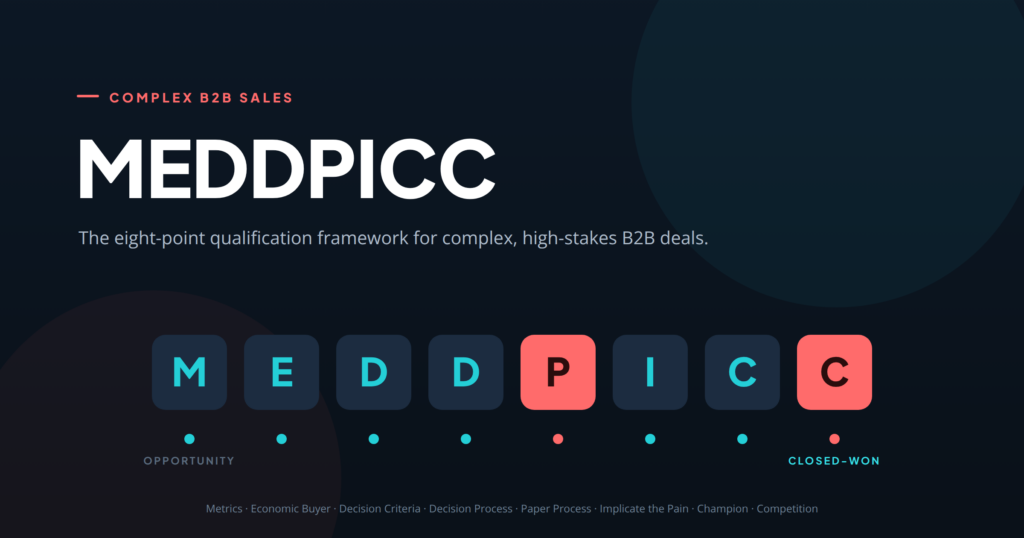
MEDDPICC is a sales qualification methodology used in complex B2B sales to evaluate deal quality, forecast accuracy, stakeholder alignment, procurement risk, and competitive position. It stands for Metrics, Economic Buyer, Decision Criteria, Decision Process, Paper Process, Implicate the Pain, Champion, and Competition.
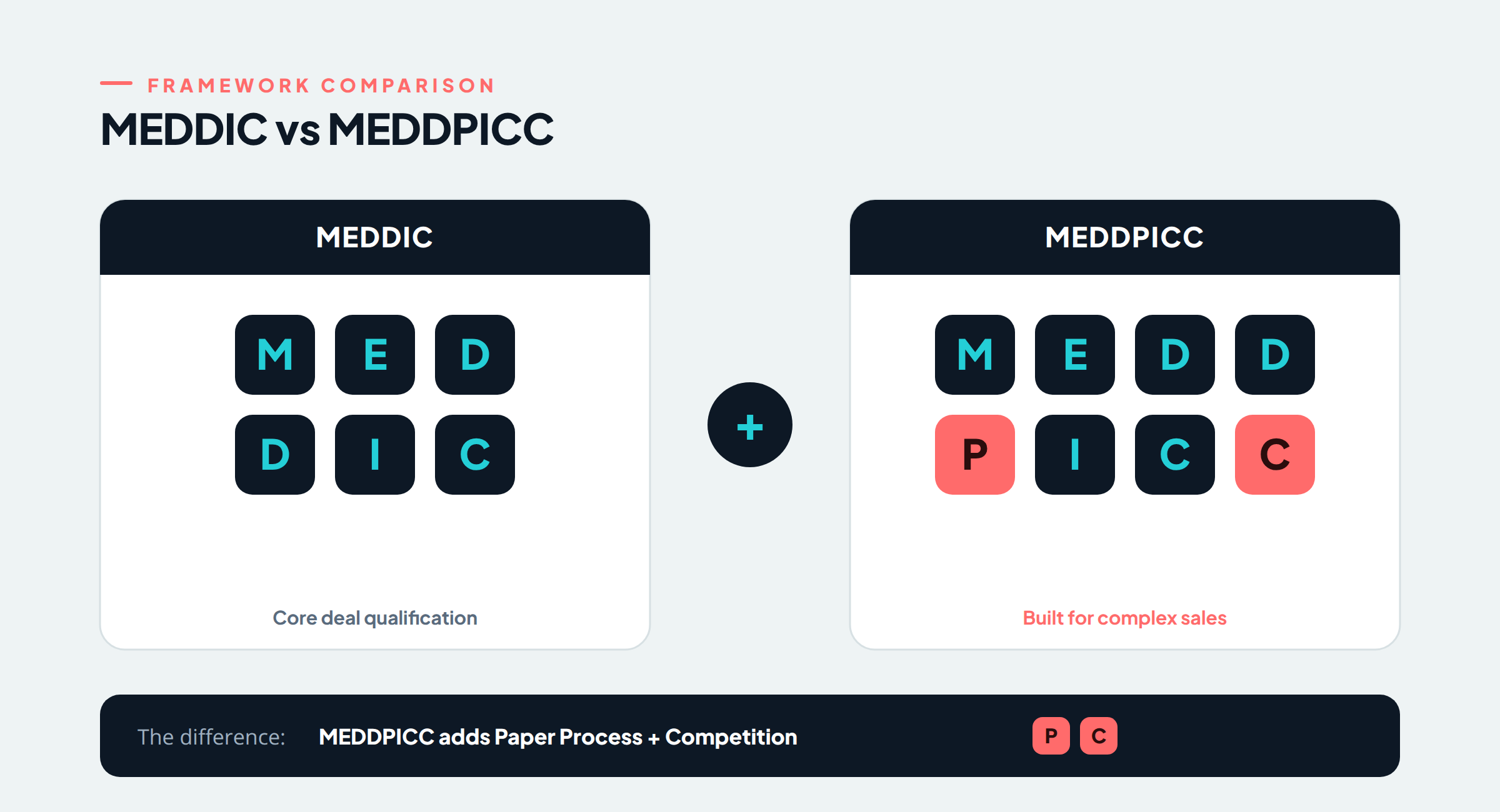
It expands the older MEDDIC framework by adding Paper Process and Competition — the two areas where enterprise deals most often stall, slip, or quietly die.
MEDDIC is a useful framework, and plenty of good sales teams run on it. But in genuinely complex sales, deals rarely fall apart because discovery was weak. They fall apart because procurement was never mapped, the economic buyer stayed one layer out of reach, the champion turned out to be an enthusiast rather than an advocate, or the team underestimated how hard the status quo would fight back. MEDDPICC is built for exactly those failure modes, which is why I reach for it whenever the buying process is long, political, and expensive to get wrong.
I’ve spent more than twenty years inside revenue organizations — including leading enterprise sales transformation at a global Fortune 500 company, where I rolled out MEDDPICC across a large, multi-region sales force selling seven-figure deals into formal procurement. This guide is written from that chair: what each element actually means, how MEDDPICC differs from MEDDIC, how to run it in a real sales process, and how to know when it’s the right tool and when it’s too much.
What Is MEDDPICC?
MEDDPICC is a qualification framework — a structured way to test how real a deal is and where it’s exposed. Each letter is a question you should be able to answer with evidence from the buyer, not assumptions from the rep. When you can’t answer one of them, you haven’t found a gap in your notes; you’ve found a risk in the deal.
Read as a set, those eight elements describe the whole shape of a complex decision: the business case, the people who own it, the path it has to travel, and the forces working against it. That’s the part worth holding onto — MEDDPICC isn’t a form to fill out, it’s a lens for seeing where a deal is thin before that thinness becomes a slipped quarter.
MEDDIC vs MEDDPICC: What Is the Difference?
The difference between MEDDIC and MEDDPICC is that MEDDPICC adds Paper Process and Competition. MEDDIC covers the core qualification elements of a deal; MEDDPICC is built for complex sales cycles where procurement, legal review, security approval, multiple stakeholders, competitive evaluations, and status-quo risk can delay or derail the revenue.
MEDDIC came out of the enterprise software world in the 1990s and it holds up well for its purpose: it forces reps to quantify value, find the real decision-maker, and understand how the buyer will choose. What it doesn’t force is a hard look at the two things that tend to kill big deals late — the mechanics of getting a contract signed, and the competitive reality you’re selling against, including the buyer’s option to simply keep living with the problem. MEDDPICC pulls both of those into the qualification itself, where they belong, instead of leaving them as surprises for the last two weeks of the quarter.
Neither framework is universally “better.” The right one depends on the deal in front of you.
MEDDIC is enough when
- The deal is smaller and the ACV doesn’t justify heavy process
- The buying committee is simple
- Procurement is minimal or informal
- The buyer already understands the problem
- Competitive risk is low
MEDDPICC is better when
- The sales cycle is long and multi-threaded
- Several stakeholders shape the decision
- Legal, procurement, or security review is required
- There’s a meaningful competitive evaluation
- The buyer might choose to do nothing
- Forecast accuracy matters to leadership
- You need to qualify risk before pouring in resources
If you’re weighing the two for your own team, the honest test is how your deals actually die. If they die in discovery, tighten MEDDIC. If they die in legal, in procurement, or against an incumbent who discounts at the eleventh hour, you need the two letters MEDDPICC adds.
Why MEDDPICC Matters in Complex Sales
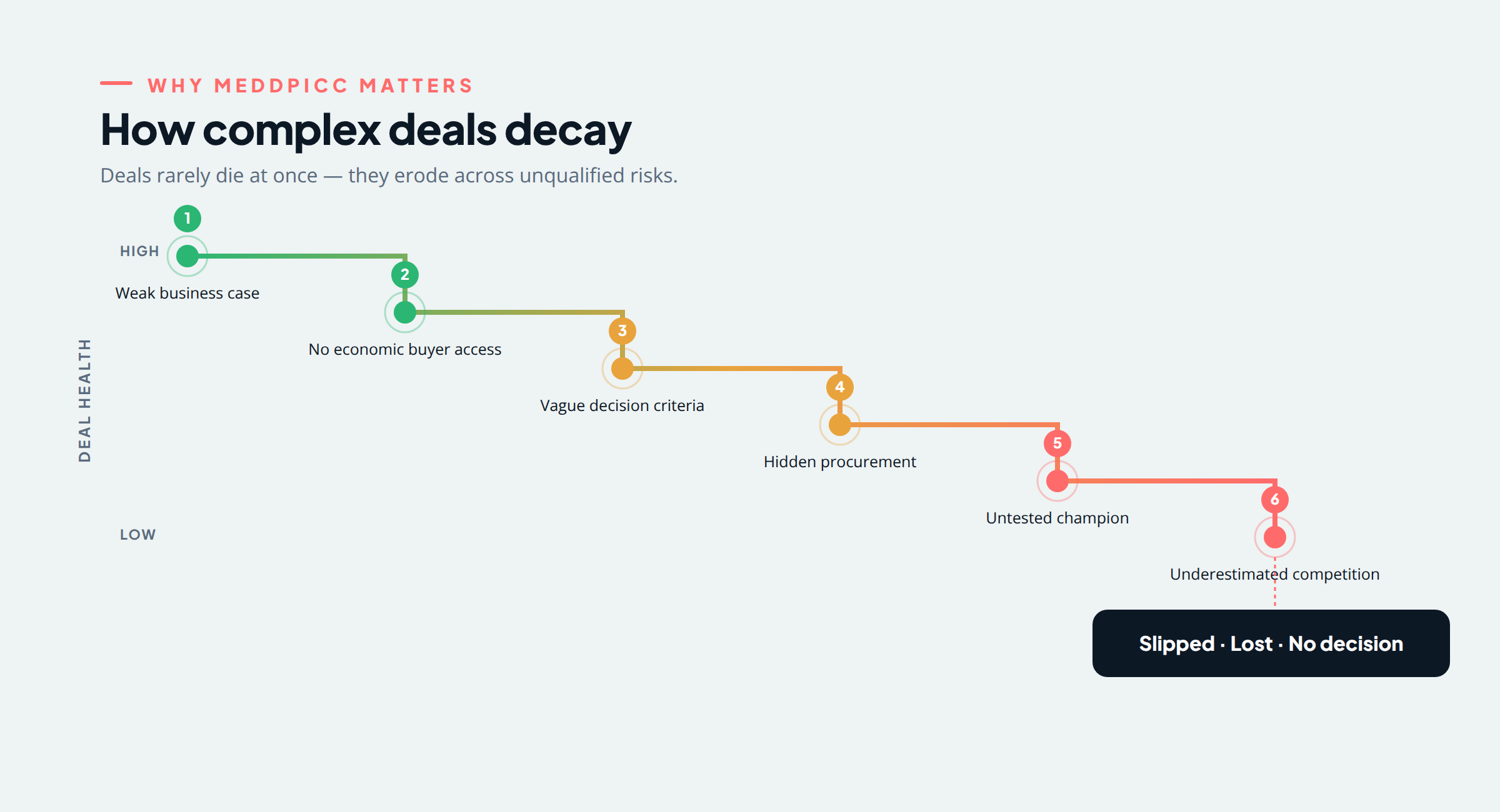
Complex sales are almost never lost in a single dramatic moment. They decay, quietly, across a handful of unqualified risks: a business case nobody can put a number on, an economic buyer the team never actually reached, decision criteria that stayed vague, a procurement path that was invisible until it wasn’t, a champion who liked the demo but couldn’t move finance, or a competitor — often the status quo — that was underestimated the whole way through. Each of those looks survivable on its own. Stacked together, they’re why a “committed” deal slips two quarters and lands as a no-decision.
MEDDPICC matters because it makes those risks inspectable before they show up on the forecast as a miss. It gives sales leaders a shared language for what “qualified” actually means, and it gives reps a way to tell the difference between a deal that feels good and a deal that is backed by buyer evidence. That distinction — feeling versus evidence — is the entire game in enterprise sales.
This is the same failure mode behind teams that keep hitting activity targets but deals are not closing: the motion looks healthy while the deals underneath were never qualified against these eight gates.
When I rolled MEDDPICC out across a large enterprise sales force at a global Fortune 500 company, the framework didn’t change what our best reps knew in their gut — it made that knowledge transferable and inspectable. Deal reviews stopped being a recitation of activity and became a conversation about evidence: show me the economic buyer’s own words, show me where we are in their paper process, show me why the champion has skin in the game. The forecast got more honest almost immediately, because we could finally see which “strong” deals were actually thin.
To make it concrete, here are the patterns MEDDPICC is built to catch — the ones I’ve watched turn a confident forecast into a painful one:
- A verbal yes that stalls the moment it hits legal
- A champion who loves the solution but has no real influence over finance
- A buyer who agrees the pain is real but can’t quantify what it costs
- A deal that looks locked until the incumbent vendor drops price
- A team forecasting on rep activity instead of buyer evidence
A deal that feels qualified and a deal that is qualified look identical on a pipeline report. MEDDPICC is how you tell them apart before the quarter closes.
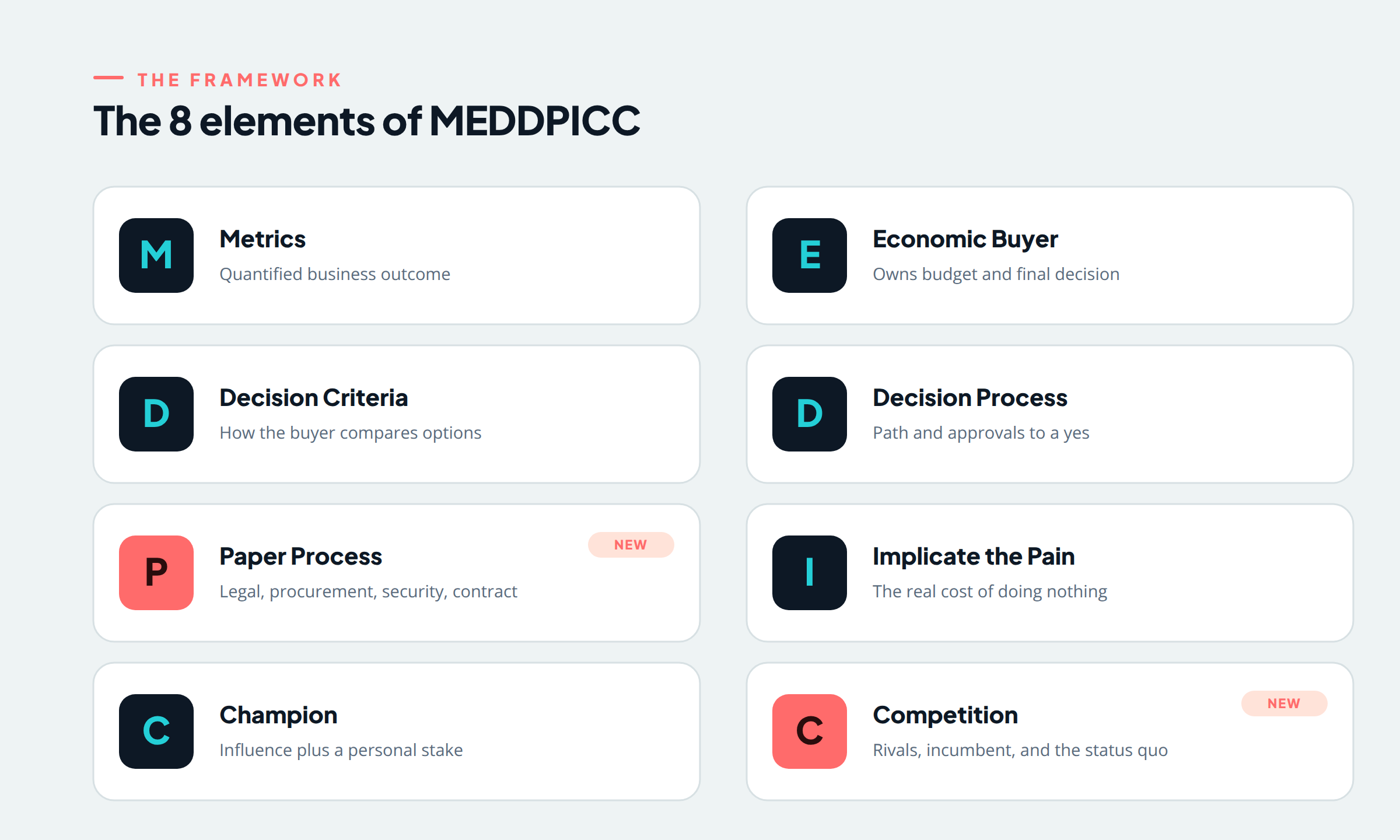
The 8 Elements of MEDDPICC
Each element is worth understanding on its own, because each one is a distinct kind of risk with its own questions and its own tells. Below is what each means, the questions I’d want answered before I’d call it validated, and where teams most often fool themselves.
MMetrics
Metrics quantify the business outcome the buyer needs — the number that makes this project worth funding. Weak metrics are the reason so many deals can’t survive a CFO conversation: “improve productivity” doesn’t compete for budget, but “cut ramp time from nine months to six” does. Your job isn’t just to discover the metric; it’s to help the buyer make it specific enough to defend internally.
- What business result does the buyer need to improve, and by how much?
- How is that problem measured today?
- What is the cost of inaction, per month or per quarter?
- What number would make this worth funding over everything else competing for budget?
Instead of “improve sales productivity,” a strong metric sounds like “reduce ramp time from 9 months to 6” or “lift win rate from 18% to 25%.” If you can’t put it in those terms, you haven’t finished qualifying Metrics.
EEconomic Buyer
The economic buyer owns the budget and the final business decision — and, critically, is often not the person running the evaluation. In complex sales they’re frequently absent from early discovery, which is exactly what creates forecast risk: the team ends up selling hard to evaluators and influencers while the person who actually says yes has never heard the business case in their own terms.
- Who owns the budget this comes out of?
- Who can approve the business case without asking anyone else?
- Who can say yes when others are saying maybe?
- What does that person care about most — and have they heard our case in those words?
If your champion can’t get you access to the economic buyer — even indirectly, even just to validate the priority — that’s not a scheduling problem. It’s a signal about how real the deal is.
DDecision Criteria
Decision criteria are the standards a buyer uses to compare options — and they’re rarely just the technical ones. There are business criteria, technical criteria, financial criteria, risk criteria, and the personal or political criteria nobody writes down. Strong sellers don’t only discover these; they help shape them, anchoring the criteria to the business outcomes where they’re genuinely differentiated.
- Business, technical, and financial requirements
- Risk and security requirements
- The personal or political factors the decision-makers won’t say out loud
Decision criteria are the standards a buyer uses to compare options. In MEDDPICC, strong sellers don’t just discover the criteria — they help shape them around the outcomes that matter most, before a competitor frames them first.
DDecision Process
The decision process is the actual path from evaluation to signature: the people, meetings, approvals, reviews, and timing required to reach — and act on — a yes. Reps who skip this end up “waiting to hear back” with no idea what they’re waiting on. Reps who map it can see slippage coming weeks out.
- What happens right after the demo or evaluation?
- Who has to approve the business case, and in what order?
- What meetings or committees are required before a decision is real?
- What could realistically delay it — and what date is the buyer working backward from?
PPaper Process
Paper Process is the legal, procurement, security, compliance, finance, and contracting work required to turn a verbal decision into a signed agreement — and it deserves the extra emphasis, because along with Competition it’s the whole reason to move from MEDDIC to MEDDPICC. This is where “we won” becomes “we’re in redlines,” and where a Q3 deal quietly becomes a Q4 deal. The specifics vary, but the map usually includes:
- MSA review and redlines
- Security questionnaires and reviews
- Vendor onboarding and procurement approval
- Data privacy and compliance review
- Budget documentation and the purchase-order process
Paper Process should not start after the buyer says yes. It should be mapped early, because it often decides whether a deal closes this quarter, slips to next quarter, or disappears entirely. In enterprise deals I’ve run, the difference between hitting the number and missing it was frequently nothing more than whether we’d started security review in week three or week thirteen.
IImplicate the Pain
There’s a real difference between identifying pain and implicating it. Identifying pain means finding the problem. Implicating the pain means connecting that problem to measurable business consequences, personal risk, and a reason it matters now. A buyer who merely acknowledges a problem will happily live with it for another year; a buyer who has felt the full cost of inaction starts moving.
- What happens if this isn’t solved — specifically?
- Who inside the organization is affected, and how?
- What does the problem cost every month it continues?
- Why does this matter now, and what strategic goal is at risk if it waits?
CChampion
A champion is not just someone who likes your solution. A real champion has influence, access to decision-makers, credibility inside the organization, and a personal reason to drive the change. The most common — and most expensive — mistake in complex sales is mistaking an enthusiast for a champion, and only discovering the difference when you need them to push and they can’t.
A true champion can:
- Explain the business problem internally, in their own words
- Introduce you to the economic buyer
- Confirm the decision criteria and the process
- Warn you about internal objections before they surface
- Advocate for you when you’re not in the room
CCompetition
In MEDDPICC, competition is broader than the vendor in the next tab. It includes direct competitors, the incumbent tool, an internal build, a budget trade-off against a higher priority, and the ever-present option to do nothing. Reps who only track named competitors get blindsided by the alternatives they never put on the board.
- A known competing vendor
- The current tool or manual process
- A spreadsheet or workaround the team already trusts
- An internal team building their own version
- A higher-priority initiative pulling the budget
- No decision at all
The most dangerous competitor in complex sales usually isn’t another vendor. It’s the buyer’s ability to tolerate the current pain.
When Should You Use MEDDPICC?
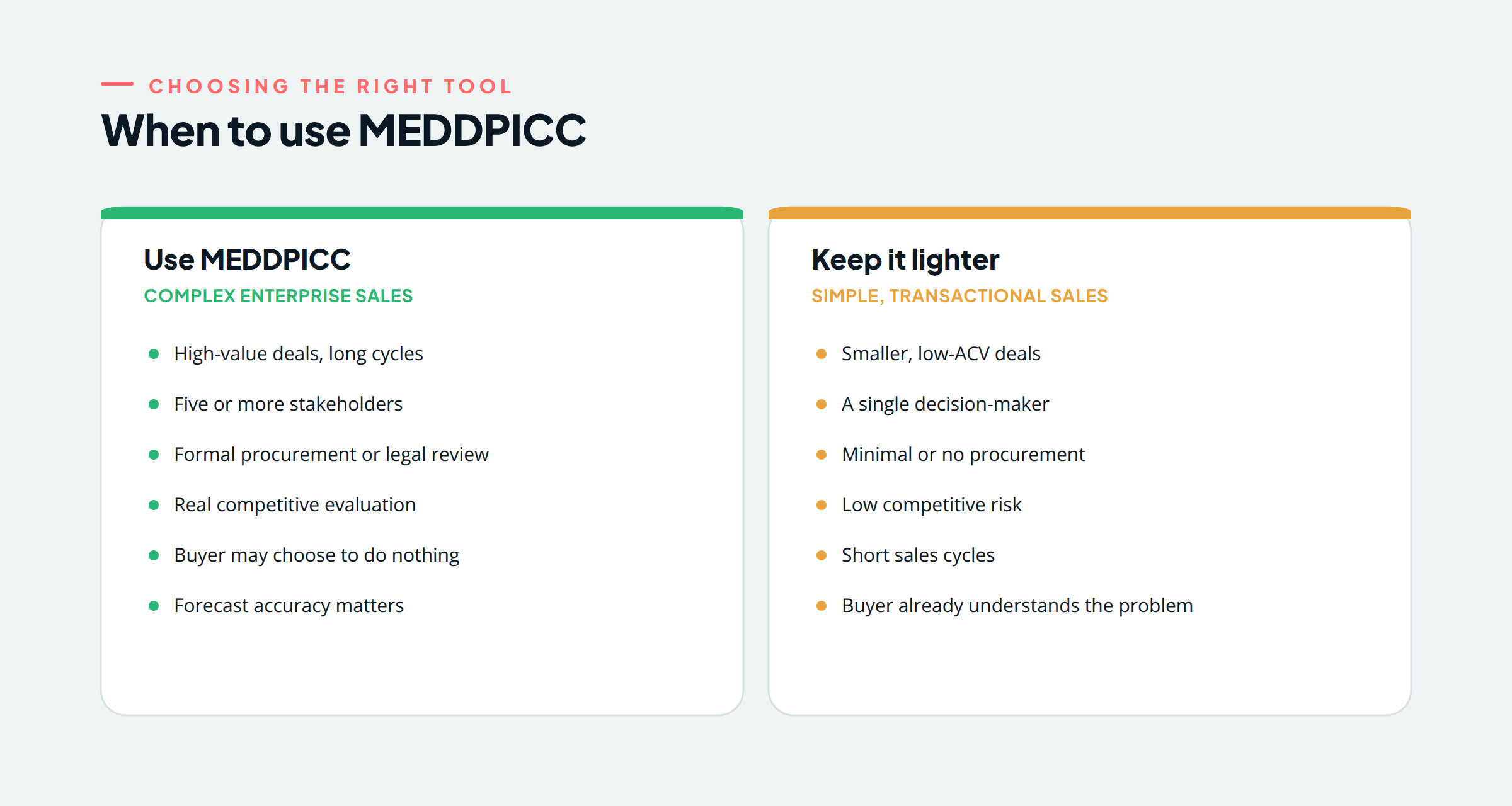
Use MEDDPICC when your sales process involves high-value deals, long buying cycles, multiple stakeholders, formal procurement, legal or security review, competitive evaluations, or meaningful forecast risk. It’s especially well suited to B2B companies selling into enterprise or complex mid-market accounts.
Put practically, MEDDPICC earns its weight when:
- Deals involve five or more stakeholders
- Sales cycles run longer than 90 days
- Procurement or legal review can delay the close
- Forecast accuracy is a leadership priority
- Reps struggle to identify the economic buyer
- Deals routinely stall after a verbal yes
- Competitive losses aren’t well understood
- The team needs one consistent deal-review framework
When MEDDPICC May Be Too Heavy
MEDDPICC can be too heavy for transactional sales, low-ACV deals, short cycles, or simple buying processes with few stakeholders and minimal procurement. In those cases, MEDDIC or a lighter qualification framework is easier to adopt and just as effective.
I’d rather say this plainly than sell you a framework you don’t need. Forcing eight elements onto a two-week, single-signer deal doesn’t make your pipeline more rigorous — it makes your reps resent the CRM and fill in fields to satisfy a manager rather than to qualify a buyer. Match the framework to the complexity of the sale, not to the ambition of the rollout.
How to Implement MEDDPICC in Your Sales Process
Adopting MEDDPICC is a change-management project, not a training session. The teams that make it stick treat it as a way of running deal reviews and forecasting, not a set of fields to backfill. Here’s the sequence I use.
- Audit your current pipeline. Review active deals and mark where each is weak across the eight elements. You’ll usually find the same two or three gaps repeating — that’s your coaching priority.
- Define what “qualified” means at each stage. Don’t let a deal move to late stage unless the key MEDDPICC elements for that stage are actually validated with buyer evidence.
- Add MEDDPICC fields to your CRM. Create fields for Metrics, Economic Buyer, Decision Criteria, Decision Process, Paper Process, Implicated Pain, Champion, and Competition — so the qualification lives in the system, not in a rep’s head.
- Use MEDDPICC in deal reviews. Managers inspect buyer evidence, not rep optimism. The question is never “how do you feel about it” — it’s “show me.”
- Coach the weakest elements first. For most teams that’s Economic Buyer access, Paper Process, Champion strength, and Competition. Fix those and forecast accuracy improves fast.
- Build a MEDDPICC scorecard. Score each element as missing, weak, validated, or strong, so deal health is visible at a glance instead of buried in notes.
- Tie MEDDPICC quality to forecast accuracy. Track which qualification gaps correlate with slipped, lost, and no-decision deals. That’s how the framework earns its keep with leadership.
- Review and refine monthly. Use closed-won and closed-lost data to sharpen your qualification standards over time.
When I led this rollout at enterprise scale, adoption didn’t come from the training deck — it came from managers refusing to run deal reviews any other way. The moment “show me the evidence” replaced “I think it’s looking good,” the framework became how the team thought, not one more thing they had to do. Getting a team to that point is rarely just a methodology question. It is the manager layer, the inspection cadence, and the data underneath, which is what building a durable sales transformation actually involves.
MEDDPICC Scorecard for Deal Reviews
The fastest way to make MEDDPICC operational is to score every element the same way, so deal health is a picture instead of a paragraph. I use four levels:
- Missing — no evidence captured at all
- Weak — the rep has assumptions, but no buyer confirmation
- Validated — the buyer has confirmed the information
- Strong — confirmed, plus documented proof, stakeholder alignment, or clear next steps
Applied to a single element, it’s obvious how much lift the language adds. Take Economic Buyer: Missing means unknown; Weak means named but no access; Validated means identified and confirmed by the champion; Strong means you’ve had a direct conversation and documented their business priorities. Score all eight that way and you can see, in about ten seconds, whether a deal is real.
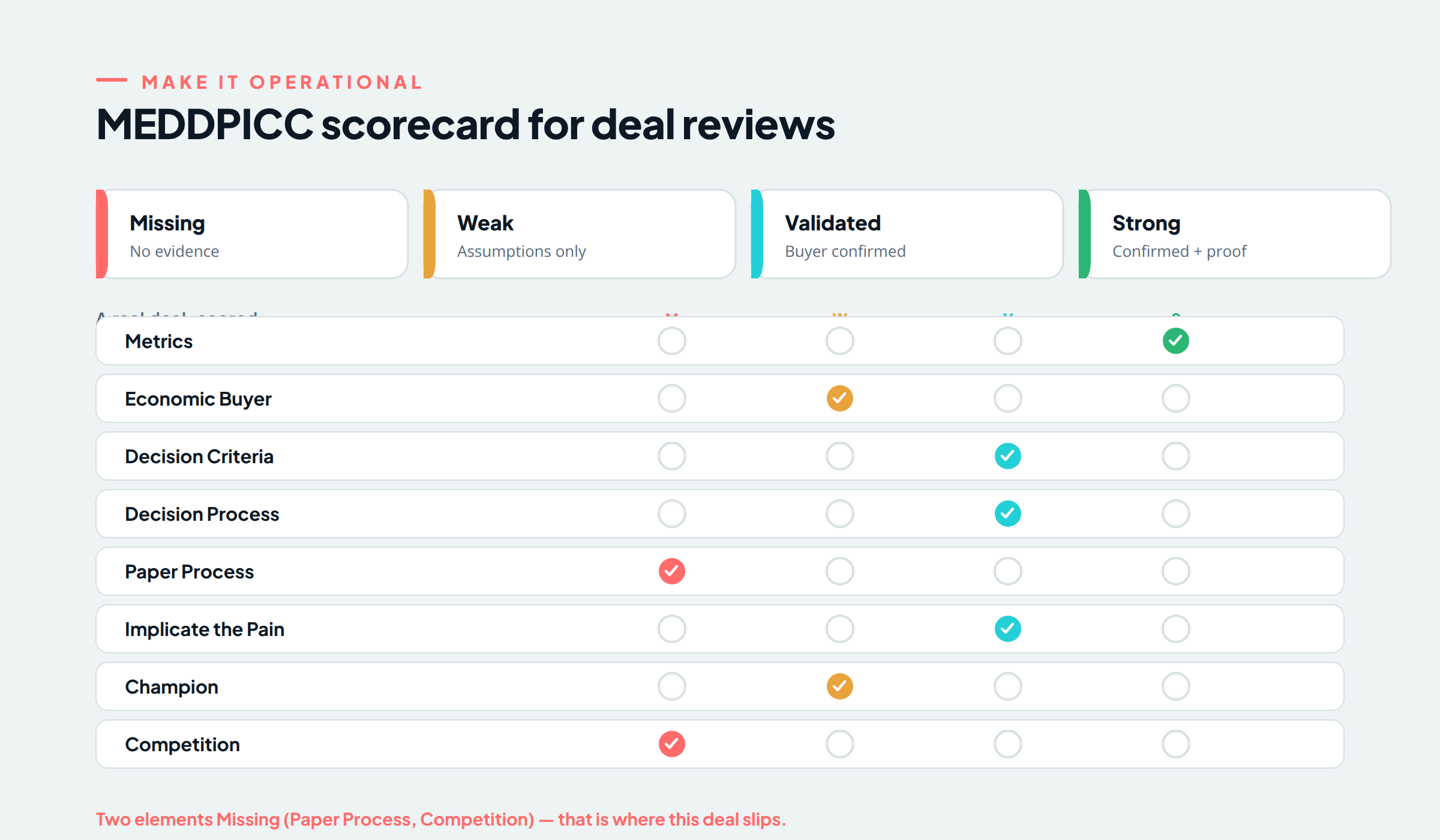
Try it on a live deal below. Score each element honestly — from the buyer’s evidence, not your optimism — and watch where the gaps are.
MEDDPICC Deal Health Scorecard
Score each element from buyer evidence. Missing / Weak / Validated / Strong.
Every element left Missing or Weak is a risk you haven’t closed yet.
Frequently Asked Questions
What is MEDDPICC?
MEDDPICC is a sales qualification methodology for complex B2B deals. It evaluates deal quality and risk across eight elements — Metrics, Economic Buyer, Decision Criteria, Decision Process, Paper Process, Implicate the Pain, Champion, and Competition — so teams can forecast more accurately and see where a deal is exposed before it slips.
What does MEDDPICC stand for?
Metrics, Economic Buyer, Decision Criteria, Decision Process, Paper Process, Implicate the Pain, Champion, and Competition. The two letters that separate it from MEDDIC are the second P (Paper Process) and the final C (Competition).
What is the difference between MEDDIC and MEDDPICC?
MEDDPICC adds Paper Process and Competition to MEDDIC. MEDDIC covers the core qualification elements of a deal, while MEDDPICC is built for complex sales cycles where procurement, legal review, security approval, multiple stakeholders, competitive evaluations, and status-quo risk can delay or derail the revenue.
When should you use MEDDPICC?
Use MEDDPICC for high-value deals with long cycles, multiple stakeholders, formal procurement, legal or security review, competitive evaluations, or meaningful forecast risk — typically enterprise or complex mid-market sales. For small, transactional, single-signer deals, MEDDIC or a lighter framework is usually enough.
What is the Paper Process in MEDDPICC?
Paper Process is the legal, procurement, security, compliance, finance, and contracting work needed to turn a verbal yes into a signed agreement — MSA redlines, security questionnaires, vendor onboarding, privacy review, and the purchase-order process. Mapping it early is often what determines whether a deal closes on time or slips a quarter.
Is MEDDPICC better than MEDDIC?
Neither is universally better; it depends on the deal. MEDDPICC is more appropriate for complex, high-stakes sales because it qualifies the two risks MEDDIC leaves out — getting a contract signed, and the competition, including the status quo. For simpler sales, MEDDIC's lighter footprint makes it easier to adopt and run.
Sharper GTM and revenue thinking for B2B leaders — signals, not noise. Get the brief.
Subscribe to the GTM Decision Brief