Sales Transformation Framework for Mid-Market B2B Companies
Most mid-market B2B companies hit the same wall. Founder-led selling, an informal sales process, and activity-based management got them here, but none of it produces predictable growth anymore. Pipeline looks healthy on the dashboard, yet conversion is all over the map. Forecasts slip. Managers spend more time building reports than coaching their reps. Sales and marketing can’t even agree on what’s actually working.
That’s the moment a sales transformation framework stops being optional. And to be clear about what I mean: not a CRM project, not a training initiative, not a dashboard cleanup. A redesign of the entire sales operating system, so that strategy, process, people, cadence, technology, and metrics finally pull in the same direction and create predictable revenue growth. If you want the wider view first — what sales transformation actually covers and why roughly 70% of these programs fail — start there, then come back here for the mid-market build.
For mid-market companies, the problem has a very specific shape. The business is too complex for informal selling, but it’s usually not big enough to absorb enterprise consulting bloat. The right B2B sales transformation framework meets you there. It helps leadership diagnose what’s actually broken, redesign how revenue work gets done, and install the weekly execution cadence that makes growth repeatable instead of heroic.
This guide covers what sales transformation actually is, a practical seven-stage framework, a 30-60-90 day roadmap, the reasons these efforts fail, and the KPIs that tell you whether the work is paying off.
What Is Sales Transformation?
Done well, a sales transformation connects strategy to execution. It improves pipeline quality, forecast accuracy, sales process discipline, manager effectiveness, and cross-functional alignment all at once. It is not a single project with a start date and a finish line. It’s a deliberate shift in how revenue work gets done across the whole organization.
For mid-market B2B companies, the trigger is almost always the same: the business has outgrown informal selling but hasn’t yet built a scalable revenue system. And the symptoms are predictable. I see the same ones over and over:
- Pipeline coverage looks healthy, but deals don’t close at the rate you’d expect
- Forecasts run on gut instinct instead of stage-based evidence
- The sales process lives in a slide deck and gets interpreted differently by every rep
- Frontline managers spend their week updating spreadsheets instead of coaching behavior
- Revenue depends on two or three top performers rather than a repeatable system
Here’s the part most people miss. Sales transformation is not about adding more process. It’s about building the minimum operating system required for predictable growth. That distinction matters, because most mid-market companies don’t actually have a process problem. They have an execution and accountability problem, and no amount of extra process will fix that.
The Schuck Sales Transformation Framework
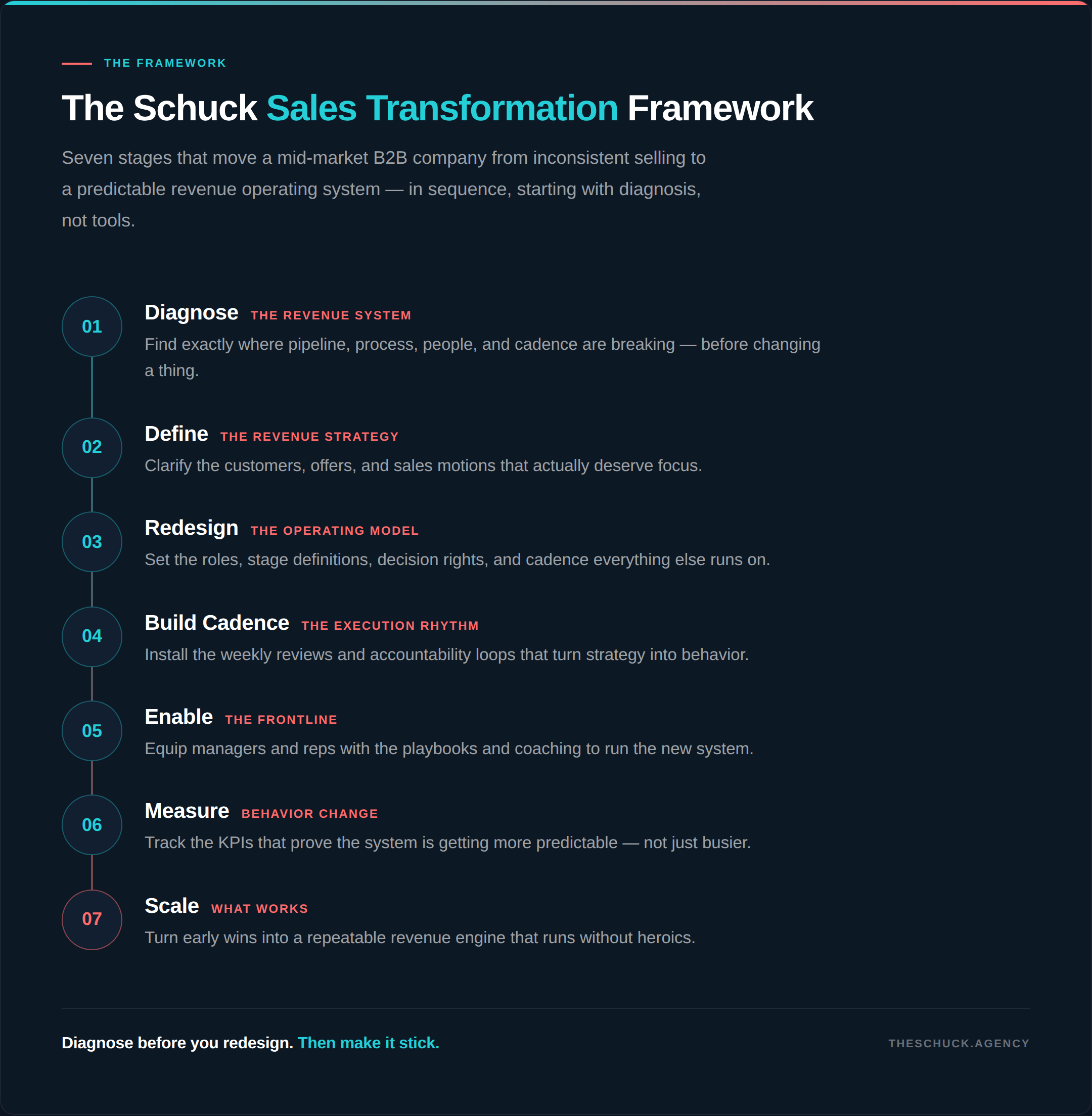
Most sales transformation efforts fail because they start in the middle — a new CRM gets deployed, a training program gets launched, a dashboard gets built — and none of it sticks, because the underlying operating model never changed. This framework starts where the work should actually start, which is at the beginning.
Stage 1: Diagnose the Revenue System
Diagnose before you prescribe. Every transformation should start here, not with implementation. If you don’t understand where pipeline, process, people, and cadence are breaking, you’ll spend months solving symptoms while the root cause keeps generating new ones.
The diagnosis covers pipeline quality, funnel conversion rates, sales stage definitions, CRM hygiene, win-loss patterns, forecast accuracy, sales and marketing handoffs, manager routines, and rep productivity. What you get out of it is a clear, honest picture of where the revenue system is breaking and what needs to change first.
Key deliverables: Revenue system diagnosis, pipeline quality review, sales process gap map, forecast reliability assessment, priority issue list.
Stage 2: Define the Revenue Strategy
Mid-market sales transformation works best when you get clear on which customers, offers, and sales motions deserve your focus before you redesign anything. Skip this and you’ll build a beautiful operating model around the wrong priorities.
This stage covers the ideal customer profile, target market segments, sales motion, offer structure, average deal size, sales cycle, acquisition channels, and revenue goals. Get the strategy right and everything downstream has something solid to attach to.
Key deliverables: ICP definition, segment strategy, sales motion map, revenue priorities, GTM focus areas.
Stage 3: Redesign the Sales Operating Model
A sales operating model defines how revenue work gets done: who owns each part of the process, what metrics matter, and how leaders inspect progress. It’s the architecture everything else runs on.
This stage creates the structure that governs sales execution: roles and responsibilities, decision rights, pipeline stage definitions, exit criteria, manager expectations, meeting cadence, CRM requirements, and the sales and marketing handoffs. It doesn’t need to be elaborate, it just needs to be clear enough that two reps looking at the same deal reach the same conclusion about where it actually stands.
Key deliverables: Sales operating model, process map, role clarity document, stage definitions, operating cadence design.
Stage 4: Build the Execution Cadence
This is where sales transformation becomes real. Strategy changes on paper, but behavior changes in meetings, and if the weekly reviews, inspection routines, and accountability loops don’t change along with everything else, the transformation simply won’t hold.
This stage installs the rhythm that turns strategy into weekly behavior: pipeline reviews, forecast calls, deal inspection, manager one-on-ones, coaching cadence, win-loss reviews, cross-functional GTM meetings, and leadership scorecards. The cadence is the transformation.
Key deliverables: Meeting rhythm, pipeline review format, forecast inspection model, manager scorecard, accountability loop.
Stage 5: Enable the Frontline
Frontline managers are the conversion layer between sales strategy and sales execution. Enable them and the system takes hold. Skip them and the whole thing stays theoretical.
This stage equips managers and reps to actually run the new system: discovery and qualification frameworks, messaging guides, objection handling, deal strategy, coaching models, playbooks, and behavior reinforcement. One warning worth taking seriously here — training without a supporting cadence has never once changed behavior on its own, and it isn’t going to start now.
Key deliverables: Manager coaching guide, sales playbook, qualification framework, deal inspection checklist, frontline enablement plan.
Stage 6: Measure Behavior Change
The best sales transformation KPIs measure behavior change, not just activity. Leaders need to know one thing above all: is the sales system becoming more predictable?
This stage defines and tracks the metrics that actually answer that question. Qualified pipeline, stage conversion, win rate, sales cycle length, forecast accuracy, deal slippage, pipeline coverage, manager coaching frequency, rep productivity, and revenue per rep.
Key deliverables: KPI dashboard, leading indicator scorecard, forecast accuracy report, sales execution metrics, adoption tracking.
Stage 7: Scale What Works
Sales transformation isn’t finished until the new operating model runs without constant executive intervention, and that’s really the whole point of the work. A system that only holds together when the CEO is in the room isn’t a system at all.
This stage turns early wins into durable infrastructure: templates, dashboards, manager routines, updated onboarding, hiring profiles, playbooks, enablement assets, and quarterly business review formats. The goal is a revenue operating system that runs without heroics.
Key deliverables: Repeatable operating system, scalable dashboards, manager enablement assets, updated onboarding, growth playbook.
30-60-90 Day Sales Transformation Roadmap
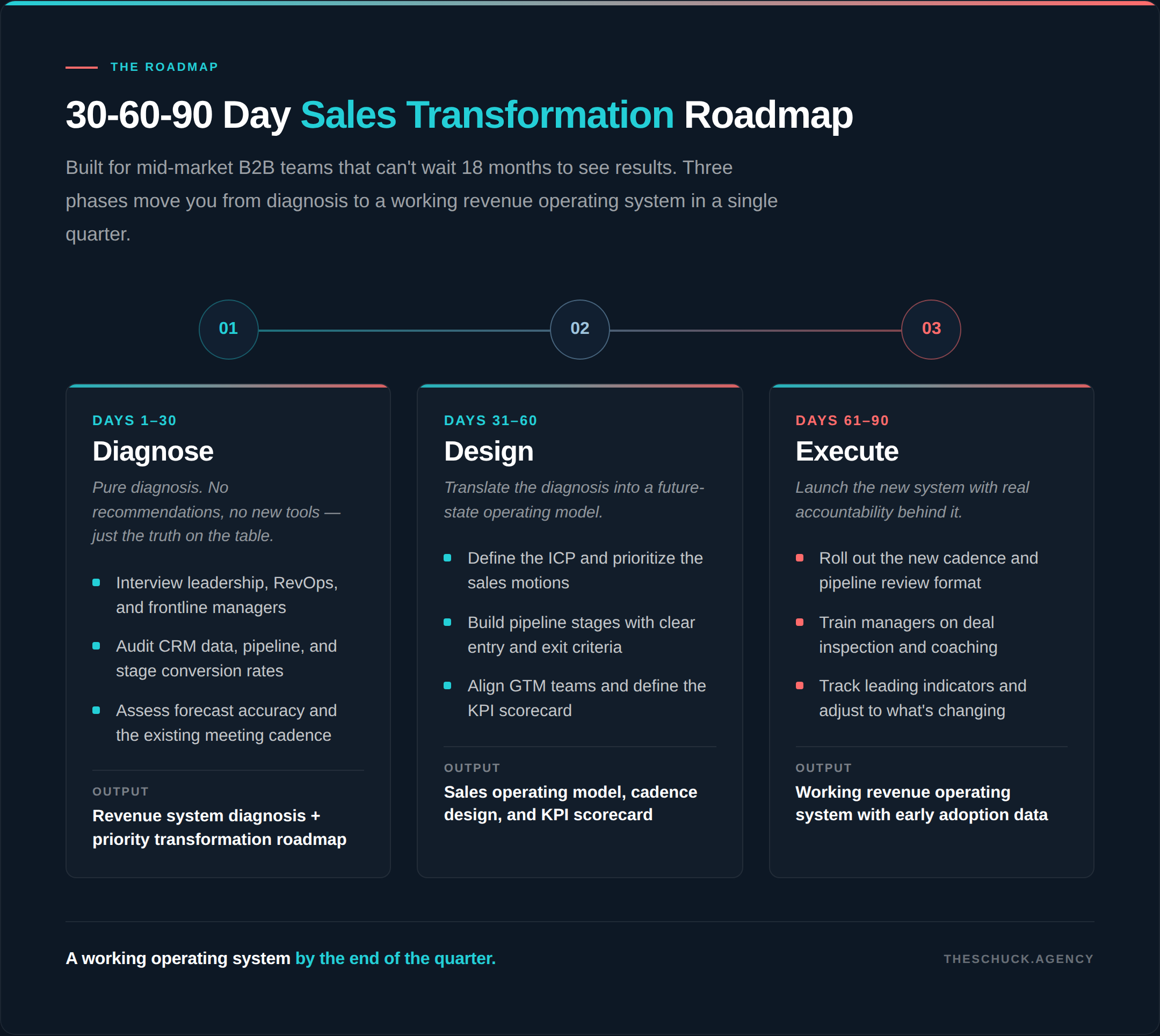
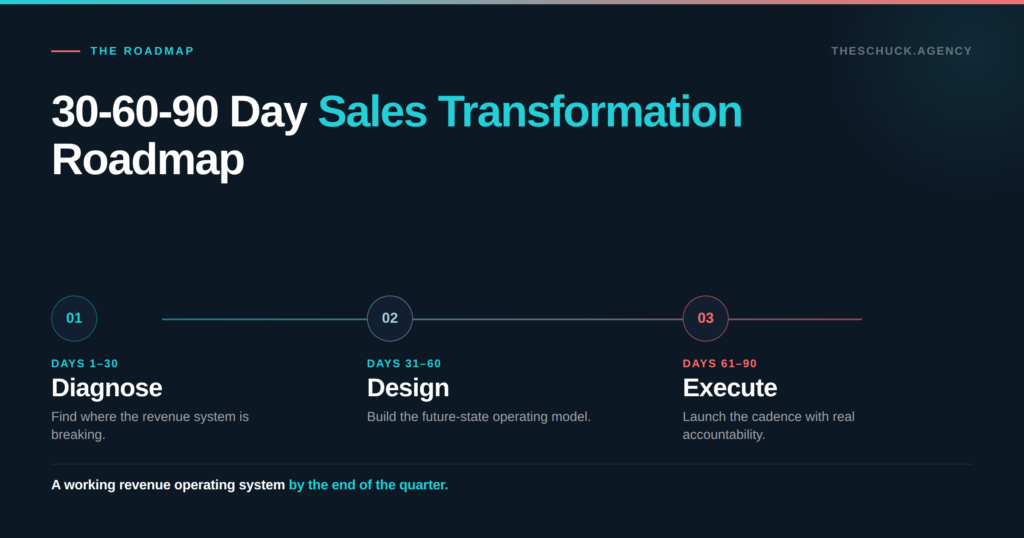
A 90-day sales transformation plan moves through three phases: diagnose the revenue system, design the future-state operating model, and execute the new cadence with your managers and frontline teams.
I built this roadmap specifically for mid-market B2B companies, where speed matters and leadership does not have the runway for an 18-month consulting engagement before anyone sees results.
Days 1-30: Diagnose
The first 30 days are pure diagnosis. No recommendations, no redesigns, no new tools. Just get the truth on the table.
- Interview the CEO, CRO, sales leaders, RevOps, marketing, customer success, and frontline managers
- Audit CRM data, pipeline composition, and stage conversion rates
- Review the current sales process and how it’s actually being used, not how it’s supposed to be used
- Identify funnel conversion issues and where deals are stalling or slipping
- Assess forecast accuracy and the inputs behind current forecasts
- Map the existing meeting cadence and pinpoint where accountability breaks down
Output: Revenue system diagnosis and priority transformation roadmap.
Days 31-60: Design
The second 30 days translate the diagnosis into a future-state operating model.
- Define the ideal customer profile and clarify which sales motions get prioritized
- Create pipeline stage definitions with clear entry and exit criteria
- Build forecast and deal inspection routines
- Align sales, marketing, RevOps, and customer success on handoffs and shared metrics
- Define KPIs and build the scorecard leadership will use to track execution
Output: Sales operating model, cadence design, and KPI scorecard.
Days 61-90: Execute
The final 30 days are about launching the new system with real accountability behind it.
- Roll out the new meeting cadence and pipeline review format
- Train frontline managers on deal inspection and coaching routines
- Introduce playbooks and qualification frameworks to the sales team
- Begin tracking leading indicators against the new scorecard
- Review early adoption signals and adjust based on what is and isn’t changing
Output: Working revenue operating system with early adoption data.
What this phase proves: Whether the transformation is changing behavior, not just documentation.
Common Signs Your Company Needs Sales Transformation
A mid-market company usually needs sales transformation when activity stays high but revenue predictability keeps slipping. If several of these are true at once, you’re not looking at a rough patch. You’re looking at a systemic problem.
- Revenue targets get missed even when sales activity looks healthy
- Pipeline coverage hits the ratio on paper, but the deals don’t convert
- Forecasts are consistently wrong by more than 20 percent
- Sales stages mean different things to different reps
- Managers spend more time preparing pipeline reports than coaching behavior
- Marketing and sales disagree on lead quality or what the ideal customer even looks like
- The CRM is used for reporting but doesn’t actually drive decisions
- Top performers carry the number while average reps struggle to hit quota
- Sales cycles are getting longer and nobody can explain why
- Win rates are declining despite more outreach and new tools
- The CEO or founder is still needed to close too many late-stage deals
- Growth has stalled even though you’ve added headcount, tools, and training
The pattern is always the same: activity isn’t the problem. The operating system is.
Why Sales Transformations Fail
Most mid-market companies that attempt a sales transformation don’t fail for lack of ambition. They fail because they started in the wrong place. Here’s where it usually goes sideways.
The Transformation Is Too Tool-Led
CRM cleanup, sales engagement platforms, a shiny new dashboard — these are the most common places companies start, and they also happen to be the least effective. Tools don’t fix an unclear strategy or weak execution discipline; they amplify whatever operating model you already have. So if that model is broken, better tools just make it broken in higher resolution.
The Sales Process Is Documented but Not Managed
Most mid-market companies have a sales process. The problem is that it lives in a slide deck and gets interpreted differently by every rep. A process only works if managers inspect it, coach to it, and reinforce it in every pipeline review. Documentation without management is just paperwork.
Leadership Skips the Operating Cadence
Strategy changes on paper. Behavior changes in meetings. If the weekly pipeline reviews, forecast calls, and manager one-on-ones don’t change, behavior won’t either. I’ll say it again because it’s the thing people skip: the cadence is the transformation.
Managers Are Not Enabled
Frontline managers are the single most important variable in a sales transformation. They’re the ones who turn strategy into daily execution. If they aren’t coached on deal inspection, pipeline management, and behavior-based feedback, the whole thing stalls at the manager layer. This is exactly where most efforts underinvest, and it’s exactly where they die.
Metrics Reward Activity Instead of Behavior Change
If leadership tracks calls made, emails sent, and meetings booked, they’re measuring motion, not progress. The metrics that matter during a transformation are pipeline quality, stage conversion, forecast accuracy, and win rate. Activity metrics tell you people are busy, while behavior metrics tell you whether the system is actually becoming more predictable — and those two things are nowhere near the same.
Key Sales Transformation Metrics and KPIs
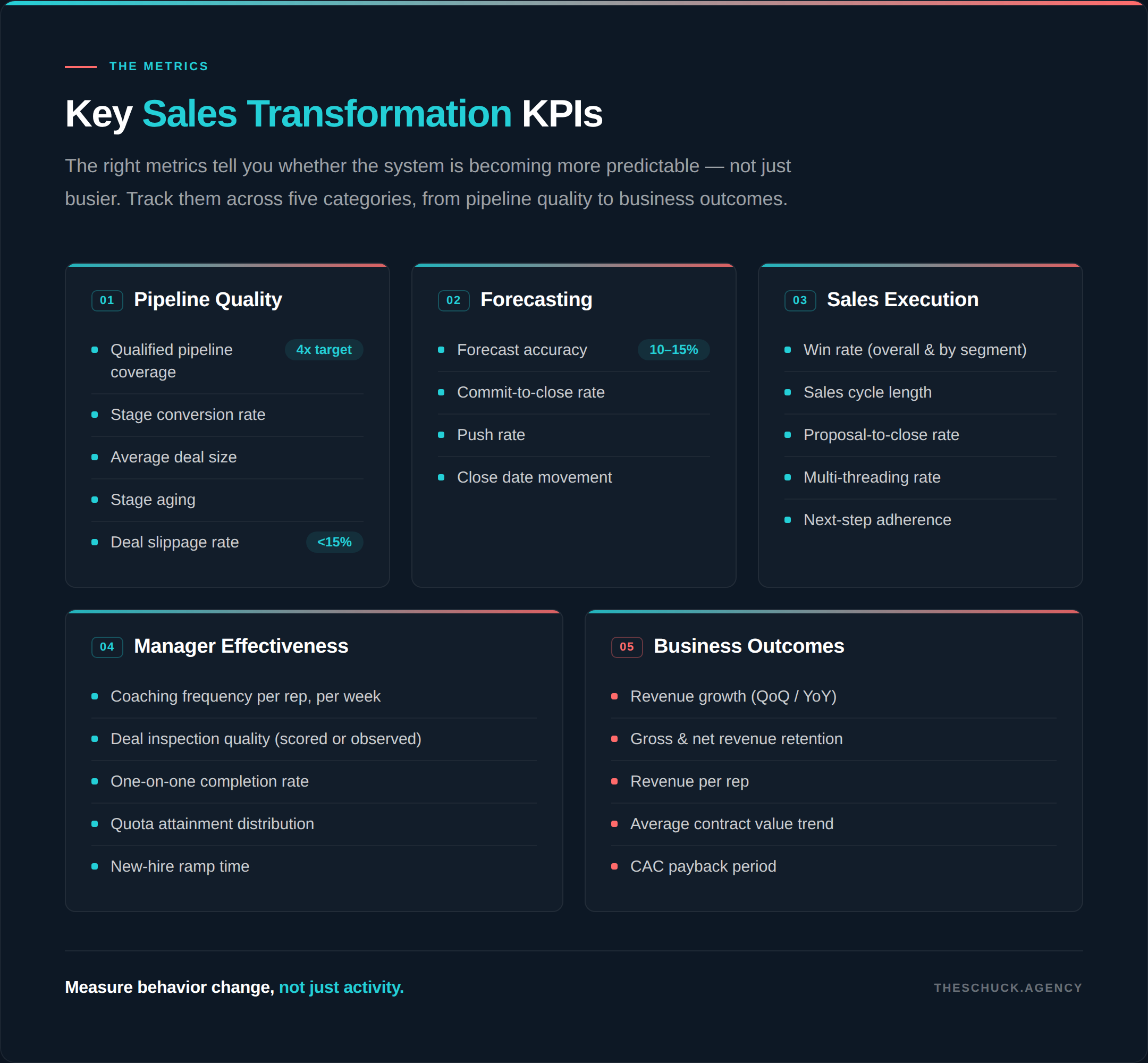
The right metrics tell you whether the sales system is becoming more predictable. Organize them into five categories so you’re reading signals, not drowning in numbers.
Pipeline Quality Metrics
| Metric | Mid-Market Target |
|---|---|
| Qualified pipeline coverage | 4x quarterly revenue target |
| Stage conversion rate | Tracked by stage; improving quarter over quarter |
| Average deal size | Stable or growing |
| Stage aging | No deal stuck beyond expected stage duration |
| Deal slippage rate | Below 15% per quarter |
Forecasting Metrics
- Forecast accuracy: Within 10-15% of actual closed revenue
- Commit-to-close rate: Percentage of committed deals that close in the period
- Push rate: Percentage of deals moving to a future period; a high push rate signals forecast inflation
- Close date movement: Frequency of close date changes per deal
Sales Execution Metrics
- Win rate (overall and by segment)
- Sales cycle length (trend over time)
- Proposal-to-close rate
- Multi-threading rate on enterprise deals
- Next-step adherence after each meeting
Manager Effectiveness Metrics
- Coaching frequency per rep per week
- Deal inspection quality (scored or observed)
- One-on-one completion rate
- Rep productivity and quota attainment distribution
- Ramp time for new hires
Business Outcome Metrics
- Revenue growth (quarter over quarter, year over year)
- Gross revenue retention and net revenue retention
- Revenue per rep
- Quota attainment rate across the team
- Average contract value trend
- CAC payback period
Sales Transformation vs. Sales Enablement vs. RevOps
These three get confused constantly, especially in mid-market companies where one person is often wearing all three hats. They’re related, but they are not interchangeable, and treating them like they are is how you end up solving the wrong problem.
| Area | Sales Transformation | Sales Enablement | RevOps |
|---|---|---|---|
| Primary focus | Revenue operating system | Seller effectiveness | Systems, process, and data |
| Main owner | CEO, CRO, VP Sales | Enablement leader or sales leader | RevOps leader |
| Core work | Strategy, process, cadence, accountability | Training, messaging, content, playbooks | CRM, reporting, process, analytics |
| Best use case | Growth is unpredictable or execution is broken | Sellers need better tools and skills | Revenue data or process is fragmented |
| Outcome | Predictable revenue growth | Better seller execution | Better operational visibility |
A mid-market company preparing for a sales transformation will most likely need all three working together. Sales transformation sets the direction and installs the operating model. Sales enablement equips the team to execute it. RevOps provides the data infrastructure to prove whether it’s working.
The mistake is treating any one of them as a substitute for the others. Enablement without a strong operating model gives you better-skilled reps executing a broken system. RevOps without a clear sales process gives you cleaner data about a process that still doesn’t work.
What Does a Sales Transformation Consultant Do?
For mid-market B2B companies, the best consultant isn’t just a strategist. The best consultant helps leadership install the operating cadence, manager routines, metrics, and execution discipline that make the strategy actually work in the field.
A sales transformation consultant typically helps with:
- Revenue system diagnosis and root-cause analysis
- Sales process redesign and stage definition
- Pipeline quality improvement and deal inspection frameworks
- Forecasting discipline and accuracy improvement
- Frontline manager enablement and coaching model design
- GTM alignment across sales, marketing, RevOps, and customer success
- CRM and operating cadence design
- KPI selection and scorecard development
- Executive advisory during the transformation
- Change management and adoption tracking
Here’s the real difference between a strategy consultant and a sales transformation consultant: implementation. Strategy consultants deliver recommendations and leave. Sales transformation consultants stay in the work until the new operating model is running, the managers are executing it, and the metrics are moving in the right direction.
When Should a Mid-Market Company Hire a Sales Transformation Consultant?
Bring in outside help when growth problems are no longer isolated to one rep, one campaign, or one quarter. When pipeline, forecasting, process, management, and GTM alignment are all straining at the same time, you’re not dealing with a series of unlucky breaks. The issue is systemic.
Specific triggers that tell you it’s time:
- Growth has stalled despite adding headcount, tools, or marketing spend
- Revenue targets get missed even when the team is active and engaged
- Forecasts are consistently off by more than 20 percent
- Pipeline coverage looks healthy on paper but deals don’t close
- Sales and marketing are misaligned on ICP or lead quality
- The CEO is still getting pulled into too many late-stage deals to close them
- Frontline managers don’t have a consistent coaching or inspection rhythm
- Sales stages are unclear or used inconsistently across the team
- RevOps is reporting the numbers but not shaping how the team operates
- A new CRO, VP of Sales, or CEO needs a 90-day operating plan to accelerate results
- The company is preparing for a funding round, acquisition, or a new GTM motion
The common thread runs through all of them: the company has outgrown its current operating model and needs a new one installed before the next growth phase begins.
How TheSchuck.Agency Approaches Sales Transformation
TheSchuck.Agency helps mid-market B2B companies move from inconsistent sales performance to predictable revenue growth. We do it by diagnosing the revenue system, redesigning the sales operating model, and installing the cadence, metrics, and manager routines that make execution stick.
The work follows four phases:
1. Diagnose. Every engagement starts with a practical, unflinching review of pipeline quality, sales process, CRM data, forecast accuracy, manager routines, GTM alignment, and revenue performance. The 90-day sales audit is where most clients begin. It surfaces where the revenue system is breaking before we redesign a single thing.
2. Design. Next we build the future-state sales operating model: roles, pipeline stage definitions, exit criteria, meeting cadence, KPI scorecard, and accountability loops. This is where strategy becomes an actual system instead of a wish.
3. Implement. We help leadership roll out the new cadence, enable managers, improve frontline execution, and make the operating model part of weekly sales behavior. As a fractional CRO consultant, I don’t stop at the slide deck. The work happens inside the real meetings, reviews, and coaching conversations where behavior actually changes.
4. Optimize. We refine the transformation through KPI tracking, adoption reviews, manager feedback, and ongoing revenue performance analysis. The goal, always, is a system that runs without constant executive intervention.
Not sure where to start? The GTM decision brief can help you clarify the right first move. You can also review client case studies.
If your company has outgrown informal selling but hasn’t yet built a predictable revenue operating system, start with a 90-day sales audit to identify where the revenue system is breaking and what needs to change first.
Frequently Asked Questions
What is sales transformation?
Sales transformation is the process of redesigning a company’s sales strategy, process, operating model, talent, technology, and management cadence to improve predictable revenue growth. It’s broader than a CRM project or a training initiative. It changes how revenue work gets done across the entire organization.
What is a sales transformation framework?
A sales transformation framework is a structured model for diagnosing revenue issues, redesigning the sales operating system, improving execution, and measuring performance change across pipeline, forecasting, process, people, and leadership cadence. The Schuck Sales Transformation Framework uses seven stages: Diagnose, Define, Redesign, Build Cadence, Enable, Measure, and Scale.
How long does sales transformation take?
A focused sales transformation can create operational improvements in the first 90 days, but a full transformation often takes 6 to 12 months depending on team size, process complexity, data quality, and leadership alignment. The 30-60-90 day roadmap delivers a working operating system by the end of the first quarter.
Why do sales transformations fail?
Sales transformations fail because companies focus on tools, training, or dashboards without changing the operating cadence, manager behavior, sales process discipline, and accountability systems that drive execution. The cadence and the manager layer are where most transformations stall.
What does a sales transformation consultant do?
A sales transformation consultant helps companies identify revenue performance gaps, redesign the sales operating model, improve sales process execution, align GTM teams, strengthen frontline management, and install metrics and routines that support predictable growth. The work is implementation-focused, not just advisory.
What is the difference between sales transformation and sales enablement?
Sales enablement improves seller skills, messaging, training, and content. Sales transformation is broader and redesigns the entire sales system, including strategy, process, roles, management cadence, metrics, technology, and accountability. Enablement is one component of a successful transformation.
What are the most important sales transformation KPIs?
Important sales transformation KPIs include qualified pipeline, stage conversion rate, win rate, sales cycle length, forecast accuracy, pipeline coverage, deal slippage rate, manager coaching frequency, rep productivity, and revenue growth. The best KPIs measure whether behavior is changing, not just whether activity is increasing.
When should a mid-market B2B company hire a sales transformation consultant?
A mid-market B2B company should hire a sales transformation consultant when growth has stalled, forecasts are unreliable, pipeline quality is inconsistent, managers lack a clear operating cadence, or leadership needs a repeatable revenue system. If the problems are recurring across multiple quarters, the issue is systemic and requires a structured approach.
Sales transformation works when it changes how revenue work gets done every week — not just once at the kickoff, but as a rhythm the business keeps running long after the launch meeting is over.
For mid-market B2B companies, the goal is never more process for the sake of process. The goal is a practical revenue operating system that improves pipeline quality, forecast accuracy, sales execution, frontline management, and leadership visibility.
The companies that make sales transformation stick all do the same three things. They diagnose before they redesign. They install a management cadence that actually changes behavior. And they measure whether the system is becoming more predictable over time.
If your company has outgrown informal selling but hasn’t yet built a repeatable revenue engine, a focused sales transformation is how you move from inconsistent performance to predictable growth.