AI in B2B Sales: How Revenue Teams Are Rebuilding the Sales Motion in 2026
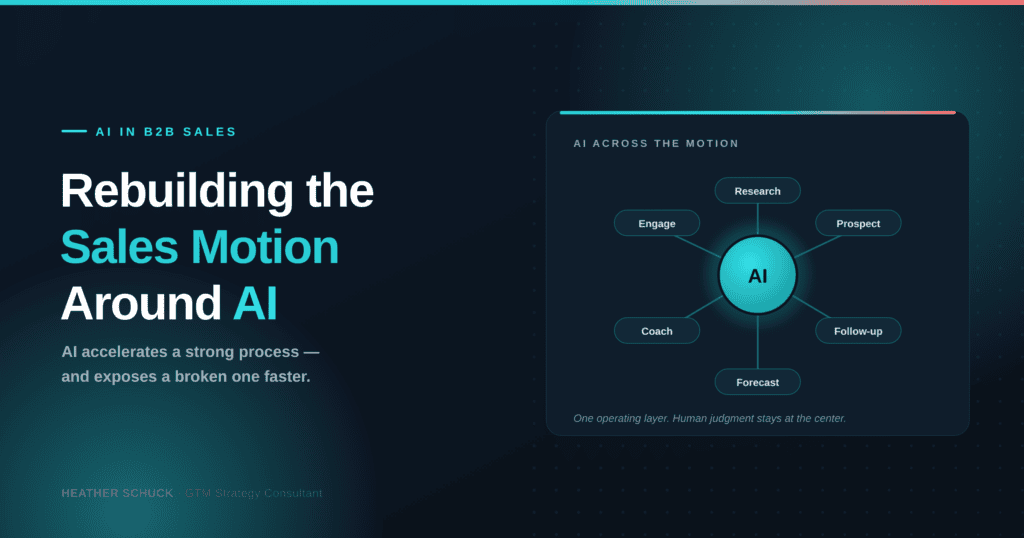
AI in B2B sales has moved past the novelty stage.
The question is no longer whether sellers can use AI to write emails, summarize calls, or research accounts faster. Most teams already know that. The real question is whether revenue leaders can redesign the sales motion around AI without losing the human judgment that complex deals still require.
In 2026, the best sales teams are not simply adding AI tools to old workflows. They are rebuilding how sellers prepare, engage, follow up, forecast, and coach. AI is becoming the connective tissue across the revenue process, but it only works when the underlying go-to-market system is clear.
That distinction matters.
AI can accelerate a strong sales process. It can also expose a broken one faster.
AI in B2B sales in 2026 is not about adding more tools — it is about rebuilding the sales motion so AI supports sellers at every stage. AI creates leverage where the revenue process is slow, manual, or inconsistent. But it scales whatever system it is layered onto, which is why process clarity has to come before automation.
- AI is moving from sales tool to revenue operating system
- What changed since early AI adoption
- The real problem is sales process clarity
- The AI-assisted sales workflow
- Automating sellers vs. elevating them
- Where AI can hurt revenue teams
- The three pillars of an AI-ready team
- What revenue leaders should do next
- The future belongs to the curious
- Frequently asked questions
AI Is Moving From Sales Tool to Revenue Operating System
For the past few years, most sales teams have used AI in isolated ways.
A rep might use ChatGPT to draft an email. A manager might use call intelligence to review a meeting. RevOps might use automation to clean up CRM data or flag pipeline risk.
Those use cases are useful, but they are no longer the edge.
The bigger shift is that AI is becoming embedded across the full revenue workflow. Instead of helping with one task at a time, AI is starting to connect account research, prospecting, meeting preparation, follow-up, forecasting, coaching, and customer expansion.
That changes the role of sales leadership.
Revenue leaders can no longer think of AI as a collection of tools. They need to think of AI as an operating layer across the entire sales motion.
The companies seeing the most value are not asking, "Where can we plug in AI?" They are asking, "Where is our revenue process too slow, too manual, too inconsistent, or too dependent on individual seller habits?"
That is where AI creates leverage.
What Changed in B2B Sales Since Early AI Adoption
A year or two ago, many founders and sales leaders tested AI and walked away unimpressed.
That reaction made sense at the time. Early AI outputs were often generic, inconsistent, or disconnected from the actual sales process. Many tools created more noise than value.
But judging today's AI by those early experiences is like judging smartphones by a 2010 BlackBerry.
The technology has changed quickly. More importantly, the use cases have matured. According to McKinsey's research on B2B sales and AI, high-growth B2B companies are significantly more likely to increase AI investment than their slower-growing peers. Gartner has also projected that seller research workflows will increasingly begin with AI in the coming years.
AI is now being used across several critical B2B sales workflows:
- Account research and ICP analysis
- Trigger-event monitoring
- Personalized outreach at scale
- Meeting preparation and buyer intelligence
- Conversation intelligence and sentiment analysis
- Follow-up automation and next-step generation
- Proposal and business-case creation
- CRM updates and pipeline hygiene
- Forecasting and deal-risk detection
- Manager coaching and rep enablement
The direction is clear: AI is becoming part of how modern revenue teams operate.
But adoption alone is not the same as advantage.
The Real Problem Is Not AI Adoption. It Is Sales Process Clarity.
Many companies have already bought AI tools. Fewer have redesigned their sales motion around them.
That is where the gap is opening.
The hard truth: AI does not fix a broken sales process. It scales it.
If your ICP is fuzzy, AI will generate more activity against the wrong accounts. If your messaging is inconsistent, AI will produce more inconsistent messaging. If your CRM data is unreliable, AI will make recommendations based on unreliable inputs. If managers do not inspect deal quality, AI-generated summaries may create the appearance of progress without improving conversion.
This is why revenue leaders need to start with process clarity before automation.
The Questions That Have to Come First
AI works best when the sales motion is already defined. Before layering in tools, leaders need clear answers to:
- Who is the ideal customer, and what signals confirm fit?
- What buying signals matter at each stage?
- What qualifies a real opportunity versus a vanity pipeline entry?
- What should happen before, during, and after each sales conversation?
- Which parts of the process require human judgment?
- Which parts are repeatable enough to automate or assist?
Without those answers, AI becomes a faster way to do more of the wrong things.
The AI-Assisted Sales Workflow: Before, During, and After Every Conversation
The most effective AI sales strategies are not built around random prompts. They are built around workflows that support the seller at every stage of the customer interaction.
Before the Sales Conversation
This is where AI removes the most manual friction. Before a call, AI can help sellers:
- Identify relevant company news and trigger events
- Summarize recent funding, hiring, product, or market changes
- Map likely buyer priorities based on role and industry
- Surface competitors, industry shifts, or strategic pressures the prospect is facing
- Suggest personalized discovery questions
- Draft a relevant point of view for outreach
Generic outreach is becoming easier to spot and easier to ignore. The best sellers will not use AI to send more generic emails. They will use AI to understand the buyer faster and enter the conversation with sharper context.
During the Sales Conversation
AI is also changing what happens inside the meeting itself.
Conversation intelligence tools can identify sentiment, hesitation, objections, competitor mentions, pricing concerns, and moments of urgency in real time. AI can help managers see where reps are asking strong questions, where they are missing cues, and where deals are losing momentum.
This does not replace sales intuition. It gives leaders more visibility into what is actually happening across the pipeline, rather than relying on anecdotal rep updates.
After the Sales Conversation
Post-meeting execution is one of the most practical places to deploy AI immediately. After a sales call, AI can generate:
- Meeting summaries and agreed next steps
- Follow-up emails tailored to each stakeholder
- Proposal outlines and mutual action plans
- CRM updates and deal-risk notes
- Manager coaching prompts based on call analysis
The model that works: AI creates the first draft. The seller reviews, edits, personalizes, and applies judgment. The rep supervises the AI. The rep does not surrender the relationship to it.
Across the Pipeline
The biggest AI opportunity is not at the individual rep level. It is across the revenue system.
AI can help revenue leaders identify deals that are stuck, opportunities with weak next steps, accounts showing intent signals, forecast risk, pipeline gaps, messaging patterns that convert, and rep behaviors that correlate with wins.
That is where AI becomes more than a productivity tool. It becomes a management system.
The Biggest Mistake: Automating Sellers Instead of Elevating Them
The most dangerous AI strategy in B2B sales is using automation to remove the human layer from complex buying decisions.
That may create short-term efficiency. It will damage long-term trust.
B2B buyers do not need more generic automation. They need clarity, relevance, and confidence. This is especially true in complex sales cycles where the buyer is evaluating risk, internal alignment, budget tradeoffs, implementation realities, and strategic fit.
The better goal is not to automate the seller. It is to elevate the seller.
AI should remove low-value administrative work so sellers can spend more time on the work that actually closes deals:
- Understanding the buyer's business deeply
- Asking sharper discovery questions
- Building internal consensus across the buying group
- Creating urgency tied to real business outcomes
- Navigating objections with context and credibility
- Aligning stakeholders across functions
- Connecting the solution to measurable business impact
That is where revenue growth happens. And that is where human expertise is irreplaceable.
Buyer-Side AI Is Changing the Dynamic Too
Sales teams are not the only ones using AI. Buyers are also using it to research vendors, compare options, summarize market information, and prepare questions before ever speaking with a rep.
By the time a prospect enters a sales conversation, they may already have AI-generated assumptions about your company, your competitors, pricing, implementation risk, and category alternatives. Some of those assumptions will be accurate. Some will be incomplete or wrong.
Forrester research has noted that some B2B buyers using generative AI feel less confident in their decisions because of inaccurate or unreliable information. That creates a meaningful opportunity for skilled sellers.
The seller's job is no longer just to provide information. It is to help the buyer interpret information, challenge flawed assumptions, validate priorities, and make a confident decision.
That makes human expertise more valuable, not less.
Where AI Can Hurt Revenue Teams
AI has real upside, but it also creates real risk when used without discipline. Revenue leaders need to watch for five common failure points.
Generic Outreach at Scale
AI makes it easier to produce more messages faster. That does not mean those messages are better. If the underlying message is weak, AI simply scales weak messaging. Real personalization connects the buyer's specific context to a relevant business problem. Inserting a company name or recent news mention into a generic template is not personalization.
Bad Data Creating Bad Recommendations
AI depends entirely on the quality of its inputs. If CRM data is incomplete, outdated, or inconsistent, AI-generated insights will reflect those weaknesses. Before relying on AI for forecasting, lead scoring, or deal coaching, leaders need to audit the quality of the underlying data.
Over-Reliance on AI-Generated Follow-Up
AI can draft a follow-up email in seconds. But a follow-up after a strategic sales conversation needs to capture what mattered to the buyer, what was agreed, what remains unresolved, and what needs to happen next. That requires a human who was actually present in the conversation.
Compliance and Privacy Exposure
AI tools may process customer conversations, emails, CRM records, and sensitive business information. Revenue leaders need to understand how that data is stored, where it is shared, and which workflows require stricter controls. This is not just an IT concern. It is a revenue leadership concern.
Reps Who Stop Thinking Strategically
If sellers rely too heavily on AI-generated research, summaries, and messaging, they may stop developing the instincts that make them effective in complex deals. AI should help reps prepare faster. It should not become a substitute for understanding the buyer.
The Three Pillars of an AI-Ready Revenue Team
To use AI well, revenue teams need more than tools. They need a clear operating model. Here is how I think about AI readiness across three pillars.
1. Process Clarity Before Automation
Before adding AI into the sales process, leaders need to define the process itself. That means clarifying the ICP, sales stages, qualification criteria, handoffs, meeting expectations, follow-up standards, and forecast methodology.
AI should support a clear process, not compensate for an unclear one. If your team cannot describe the ideal sales motion without AI, adding AI will not solve the problem.
2. Human-in-the-Loop Execution
The strongest AI workflows keep humans in control. AI can research, draft, summarize, detect patterns, suggest next steps, and flag risks. But humans need to validate, personalize, prioritize, and decide.
This is especially important in B2B sales because buying decisions are rarely linear. Deals involve competing priorities, internal politics, budget constraints, timing issues, and trust. AI can support the seller through that complexity. It should not replace the seller's judgment inside it.
3. Revenue System Integration
AI becomes more powerful when it connects across the revenue system. A standalone AI writing tool can save time. But an integrated AI workflow that connects CRM, email, conversation intelligence, LinkedIn activity, proposal data, customer history, and forecasting creates far more leverage.
The goal is not simply to make sellers faster. The goal is to make the entire revenue system smarter.
| Pillar | What It Requires | What AI Enables |
|---|---|---|
| Process Clarity | Defined ICP, stages, qualification, handoffs | Consistent execution at scale |
| Human-in-the-Loop | Seller review and judgment at every step | Speed without sacrificing quality |
| System Integration | Connected CRM, calls, email, forecasting | Pipeline intelligence across the revenue motion |
What Revenue Leaders Should Do Next
If you are leading a B2B sales organization, the best place to start is not with a long list of AI tools. Start with the revenue process.
Ask five diagnostic questions:
- Where are sellers spending time on work that does not require their judgment?
- Where are deals slowing down because of inconsistent follow-up, weak discovery, or unclear next steps?
- Where is the team relying on manual effort instead of repeatable systems?
- Where does leadership lack visibility into deal quality, buyer engagement, or pipeline risk?
- Where could AI improve consistency without damaging trust?
Once those answers are clear, choose one workflow to improve first. Do not try to transform the entire revenue organization at once.
High-friction starting points worth prioritizing:
- Account research and pre-call preparation
- Post-call follow-up and CRM hygiene
- Proposal creation and mutual action plans
- Pipeline inspection and forecast risk flagging
Then measure the impact. Look at sales cycle length, conversion rate, follow-up speed, meeting quality, rep capacity, and forecast accuracy.
AI should not be judged by whether the team is using it. It should be judged by whether the revenue motion is improving.
If you want a structured framework for this, the GTM Toolkit includes resources built specifically for revenue leaders working through this kind of process design.
The Future Belongs to Revenue Leaders Who Stay Curious
AI will not replace strong sales leadership.
But revenue leaders who understand AI will replace those who ignore it.
The future of B2B sales belongs to teams that combine clear process, strong human judgment, and intelligent automation. The winners will not be the companies that chase every new AI tool. They will be the companies that know where AI belongs in the sales motion and where human expertise still matters most.
The technology is ready. The bigger question is whether your sales process is ready for the technology.
Frequently Asked Questions
No. The goal is to elevate sellers, not automate them. AI is best used to remove low-value administrative work — research, summaries, follow-up drafts, CRM updates — so sellers can spend more time on the judgment-heavy work that closes deals: discovery, building internal consensus, navigating objections, and connecting the solution to business impact.
Start with the sales process, not the tools. Define your ICP, stages, and qualification first, then pick one high-friction workflow to improve — account research and pre-call prep, post-call follow-up and CRM hygiene, proposals, or pipeline and forecast inspection — and measure the impact before expanding.
Because AI scales whatever process already exists. A fuzzy ICP, inconsistent messaging, or unreliable CRM data will produce faster noise instead of better decisions. AI does not fix a broken sales process; it amplifies it. Process clarity has to come before automation.
Buyers now use AI to research vendors, compare options, and form assumptions before ever speaking with a rep. Forrester has noted that some buyers using generative AI feel less confident because of inaccurate information. That makes skilled sellers more valuable — the job shifts from providing information to helping buyers interpret it and decide with confidence.
Five failure points to watch: generic outreach at scale, bad data driving bad recommendations, over-reliance on AI-generated follow-up, compliance and privacy exposure, and reps who stop thinking strategically. Each one is a discipline problem, not a tooling problem.
Three pillars: process clarity before automation, human-in-the-loop execution, and revenue system integration. Together they let AI support a clear sales motion — with sellers in control and CRM, calls, email, and forecasting connected — instead of automating an unclear one.
If your sales team is experimenting with AI but not seeing measurable revenue impact, the issue may not be the tools. It may be the sales motion underneath them.
The 90 Day B2B Sales Audit and Analysis helps founders and revenue leaders identify where the sales process is leaking revenue, where AI can create real leverage, and what needs to change before adding more technology.
If you want a senior revenue leader involved in the redesign, you can also explore advisory support through the B2B Fractional CRO and Growth Strategy offer.
Is your sales motion ready for the technology?
Start with the process. Find where revenue is leaking — and where AI creates real leverage — before adding more tools.
Prefer weekly insights? Get the GTM Decision Brief.