What Is Revenue Operations? How B2B Teams Build Predictable Pipeline, Forecasting, and Growth
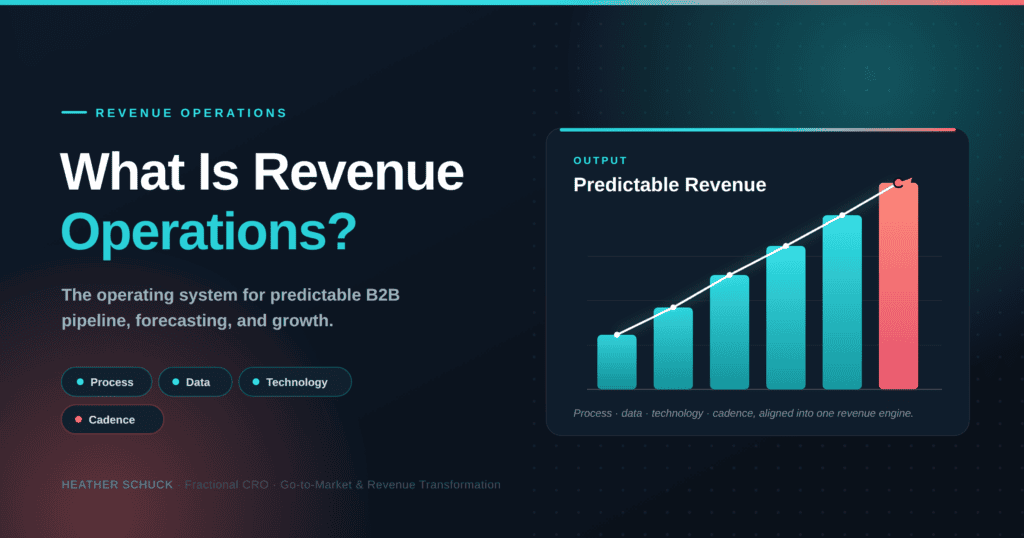
Revenue Operations is no longer just a back-office function for cleaning up dashboards. For B2B companies, RevOps has become the operating system for predictable growth. It connects CRM discipline, sales process execution, marketing attribution, customer handoffs, forecasting, and leadership decision-making into one revenue engine.
The companies that win with RevOps are not simply buying more tools or building prettier dashboards. They are creating a system leaders can trust: clean data, clear process, consistent inspection, and a revenue cadence that turns strategy into execution.
I have spent two decades building and rebuilding those systems as a fractional CRO and, most recently, leading sales transformation for a global enterprise. This guide is the operator's view of revenue operations — what it is, why it matters more now than it did five years ago, how to tell yours is broken, and what it actually takes to make forecasting, pipeline, CRM adoption, and AI readiness predictable.
Revenue operations is the operating system that aligns sales, marketing, customer success, CRM data, process governance, and leadership cadence around predictable revenue growth. It is less a department than a discipline: the connective tissue that makes the numbers trustworthy and the motion repeatable.
- What revenue operations is
- Why RevOps matters now
- Signs your company needs RevOps
- The four pillars of RevOps
- RevOps vs. Sales, Marketing & CS Ops
- Data points worth knowing
- What broken RevOps looks like
- What a RevOps audit includes
- How AI changes RevOps
- Common RevOps mistakes
- When to bring in outside help
- FAQ
What Is Revenue Operations?
Revenue operations is the operating system that aligns sales, marketing, customer success, CRM data, process governance, and leadership cadence around one outcome: predictable revenue growth. Instead of each team optimizing its own slice — marketing chasing leads, sales chasing quota, customer success chasing renewals — RevOps connects them to a single definition of the pipeline, a single source of truth for the numbers, and a single rhythm for reviewing and adjusting the motion.
The easiest way to understand it: sales ops, marketing ops, and CS ops each keep one function running. RevOps makes the whole revenue engine run as one system. It owns the process by which revenue work gets done, the data leaders use to make decisions, the technology that either supports execution or gets in its way, and the operating cadence that turns strategy into weekly action.
Why RevOps Matters Now
RevOps has existed as a concept for years, but the pressure on it has changed. A few forces have made a trustworthy revenue operating system a requirement rather than a nice-to-have:
- Forecasts are less reliable. Longer buying cycles and larger committees have made gut-feel forecasting dangerous. Boards want a number they can stand behind.
- Pipeline quality is harder to trust. More activity does not mean more revenue. Without shared stage definitions, pipeline becomes a debate instead of a plan.
- AI tools are only useful if the data underneath them is clean. The models are only as good as the CRM and process data they run on.
- Boards and CEOs need real revenue visibility. "Trust me, it will close" is no longer an acceptable answer in a revenue review.
- Sales and marketing can't afford disconnected execution. When each function runs its own playbook, deals fall through the seams between them.
The Signs Your Company Needs RevOps
You rarely get a clean memo that says "our revenue operations are broken." Instead you get symptoms. These are the ones I look for first when I audit a revenue org:
- Forecast calls are based on opinions and hope, not data.
- CRM stages do not reflect how your buyers actually make decisions.
- Marketing-sourced pipeline gets debated in every meeting instead of trusted.
- Sales leaders have to inspect deals manually, one by one, every week.
- Customer success has no clean handoff from sales, so value promised is not value delivered.
- AI initiatives stall because the underlying data is too messy to build on.
The problem is almost never your people. It is the system your people are operating inside.— Heather Schuck, Fractional CRO
The Four Pillars of RevOps
Every durable revenue operating system rests on four things. Miss one and the other three get shaky — you can have a beautiful tech stack sitting on data no one trusts, or a clean forecast process no one actually follows.
Process
How revenue work actually gets done: stage definitions that match your buyer's reality, exit criteria that mean something, qualification standards, and clean handoffs between marketing, sales, and customer success. Process is where most "RevOps problems" actually live.
Data
Whether leaders can trust the numbers. If the CRM is a graveyard of stale deals and optional fields, every downstream report and every AI model inherits that mess. Data discipline is what makes a forecast a forecast instead of a guess.
Technology
Whether your tools support execution or quietly create friction. The goal is not more software; it is a stack your team actually uses, with automation that removes busywork instead of automating a broken workflow.
Operating cadence
How the team reviews, decides, and adjusts — weekly pipeline inspection, monthly forecast reviews, quarterly planning. Cadence is the pillar most generic RevOps content ignores, and it is the one that separates an operating system from a set of dashboards.
RevOps vs. Sales Ops vs. Marketing, CS & GTM Ops
These terms get used interchangeably, which causes real confusion in org design. The simplest distinction: the "ops" functions each optimize one team; RevOps and GTM ops coordinate across all of them. Here is how they compare.
| Function | Primary owner of | Optimizes for | Scope |
|---|---|---|---|
| Revenue Operations | The whole revenue engine — process, data, tech, cadence | Predictable, end-to-end revenue | Cross-functional (marketing + sales + CS) |
| Sales Operations | Sales productivity, territories, comp, forecasting | Rep efficiency and quota attainment | Sales team |
| Marketing Operations | Campaign execution, MarTech, attribution, lead flow | Demand and pipeline creation | Marketing team |
| Customer Success Ops | Onboarding, health scoring, renewal & expansion motions | Retention and net revenue | Customer success team |
| GTM Operations | Go-to-market planning, segmentation, coverage, launch | Getting the right motion to the right market | Cross-functional (strategy layer) |
In smaller companies one person may wear several of these hats. The point is not the title — it is making sure someone owns the connective tissue between functions, not just the functions themselves.
Data Points Worth Knowing
The case for RevOps is not just anecdotal. A handful of research findings are worth keeping in your back pocket the next time you make the case to a board or CEO:
What Broken RevOps Looks Like in the Real World
Every one of these engagements started the same way: strong people, real demand, and a revenue system quietly working against them. The numbers below are outcomes from rebuilding that system from the inside — CRM, process, and cadence — not from adding another tool.
None of those results came from a new dashboard. They came from fixing the operating system underneath the numbers. You can see more of these in the case studies.
What a RevOps Audit Should Include
Before you change anything, you diagnose. A real revenue operations audit is not a tech-stack inventory — it is a full read of how revenue actually moves through your company and where it leaks. At minimum it should cover:
- CRM architecture — objects, fields, and whether the structure reflects how you sell.
- Funnel stage definitions — and whether they match real buyer behavior.
- Pipeline hygiene — stale deals, close-date discipline, and data completeness.
- Handoff rules — marketing-to-sales and sales-to-customer-success.
- Forecast process — how the number is built and how often it holds.
- Tech stack usage — what is adopted, what is shelfware, what overlaps.
- Automation gaps — and any broken workflows being automated.
- Reporting accuracy — whether dashboards drive decisions or just decorate them.
- AI readiness — whether the underlying data could support AI at all.
- Leadership decision cadence — how the team inspects, decides, and adjusts.
This is exactly the scope of a RevOps audit and sales process optimization engagement — and the fastest version of it is a focused 90-day B2B sales audit that pressure-tests the whole system.
How AI Changes RevOps
AI doesn't fix broken RevOps. It exposes it.— Heather Schuck, Fractional CRO
The uncomfortable truth for a lot of revenue teams is that AI is a magnifier. Point it at a clean, well-run revenue system and it compounds your advantage. Point it at messy CRM data and inconsistent process, and it confidently produces wrong answers faster. Every AI use case in revenue depends on a foundation most companies haven't built yet:
- AI forecasting depends on clean, consistent CRM inputs.
- AI coaching depends on consistent sales-process data to learn from.
- AI reporting depends on trustworthy field usage across the team.
- AI automation depends on clear handoff and qualification rules.
- AI readiness starts with go-to-market data readiness — not a model.
This is why RevOps has quietly become the prerequisite for AI in revenue. The teams getting real value from AI did the unglamorous work first: they made their go-to-market motion and their data trustworthy enough to build on.
Common RevOps Mistakes
The failure patterns are remarkably consistent across companies and stages. If you recognize more than one of these, it is usually a sign the system needs a diagnosis, not another tool:
- Buying tools before fixing process — automating a broken motion just makes it fail faster.
- Treating RevOps as reporting support instead of an execution function.
- Letting each department define success differently, so no one agrees on the number.
- Automating broken workflows and calling it transformation.
- Ignoring frontline adoption — the best process on paper fails if reps route around it.
- Building dashboards no one uses to actually make decisions.
When to Bring in Outside RevOps Help
The answer is not "when you need another consultant to write a strategy deck." Bring in outside RevOps help when leadership needs an operator who can diagnose the system, work inside the CRM, pressure-test the sales process, and turn revenue strategy into execution that survives contact with the field.
That is the difference between advice and embedded operating. As a fractional CRO and growth strategy consultant, my approach is to diagnose before prescribing, design for how deals actually move, and leave the system stronger than I found it — because revenue leaders deserve better tools than gut instinct and hope.
Start With a 90-Day Revenue Diagnosis
The fastest way to know whether your revenue operations are helping or quietly costing you: a focused audit of your CRM, pipeline, process, forecast, and AI readiness — with a prioritized plan to fix it.
Diagnose the system · fix the leaks · make the number predictableFrequently Asked Questions
What is revenue operations?
Revenue operations (RevOps) is the operating system that aligns sales, marketing, customer success, CRM data, process governance, and leadership cadence around predictable revenue growth. It connects the functions that create and keep revenue into one accountable system rather than three separate ones.
What does RevOps include?
RevOps includes four pillars: process (how revenue work gets done), data (whether the numbers can be trusted), technology (whether the stack supports execution), and operating cadence (how teams review, decide, and adjust). In practice that spans CRM architecture, funnel definitions, pipeline hygiene, forecasting, handoffs, automation, reporting, and leadership rhythm.
How is RevOps different from sales operations?
Sales operations optimizes the sales team — territories, comp, productivity, and forecasting. Revenue operations coordinates across marketing, sales, and customer success so the entire revenue engine runs as one system. Sales ops makes reps more efficient; RevOps makes revenue more predictable end to end.
When does a company need RevOps?
When forecasts are based on opinion instead of data, CRM stages no longer reflect how buyers decide, marketing-sourced pipeline is debated rather than trusted, and leaders inspect every deal by hand. Those are signs the revenue system — not the people — needs attention.
What are the first signs your revenue operations are broken?
Unreliable forecasts, messy CRM data, no clean handoff from sales to customer success, and stalled AI initiatives because the underlying data is too dirty to build on. When the number becomes a debate every week, the operating system is broken.
How does RevOps improve forecasting accuracy?
By enforcing consistent stage definitions and exit criteria, keeping CRM data clean, and running a disciplined inspection cadence. When every deal is qualified the same way and the data is trustworthy, the forecast reflects reality instead of optimism.
What role does AI play in modern RevOps?
AI amplifies whatever system it runs on. It can sharpen forecasting, coaching, and reporting — but only when CRM data and sales process are clean and consistent. AI does not fix broken RevOps; it exposes it. AI readiness starts with go-to-market and data readiness.
What should a RevOps audit include?
CRM architecture, funnel stage definitions, pipeline hygiene, handoff rules, forecast process, tech-stack usage, automation gaps, reporting accuracy, AI readiness, and leadership decision cadence — a full read of how revenue moves through the company and where it leaks.
Sources & Further Reading
- Gartner — "Gartner Predicts 75% of the Highest Growth Companies in the World Will Deploy a RevOps Model by 2025."
- Forrester — research on customer-aligned organizations reporting 2.4× higher revenue growth and 2× higher profitability growth.
- Forrester / SiriusDecisions — findings on tightly aligned revenue teams growing revenue ~24% faster.
- Related reading: How to create a B2B go-to-market strategy · MEDDPICC sales methodology · Sales forecast reliability.