How to Fix Low Adoption of Your Sales Process
Almost every revenue team I walk into has a sales process, and most of them are proud of it — a clean set of stages, exit criteria written down somewhere, fields in the CRM that everyone is supposed to fill in. Then you sit with the reps, listen to how they actually talk about their deals, and it becomes obvious within an hour that the process on the slide and the process in the field are two different things. The stages get updated the night before the forecast call, the exit criteria are a mystery, and the whole system runs on habit and hope rather than on anything the buyer has actually done.
That gap between the process you designed and the process your team runs is the adoption problem, and it is one of the most expensive problems in revenue because it hides in plain sight. Leadership believes it has a repeatable motion; the CRM says the stages are being followed; and yet forecasts still surprise you, deals still slip, and rep performance still swings wildly from one person to the next. Low adoption is rarely a discipline problem you can solve by mandating compliance — it is a sign the process was built in a way that never survived contact with a real deal. The good news is that adoption is fixable, and it is fixable faster than most leaders expect once you stop treating it as a documentation exercise and start treating it as an execution one.
Low sales process adoption usually happens when the process is documented but not operationalized. To fix it, simplify the process, define stage exit criteria around buyer evidence, train managers to coach it, embed it into deal reviews, and measure whether reps actually use it in real selling conversations — not just whether the CRM fields are filled in.
Why Sales Process Adoption Fails
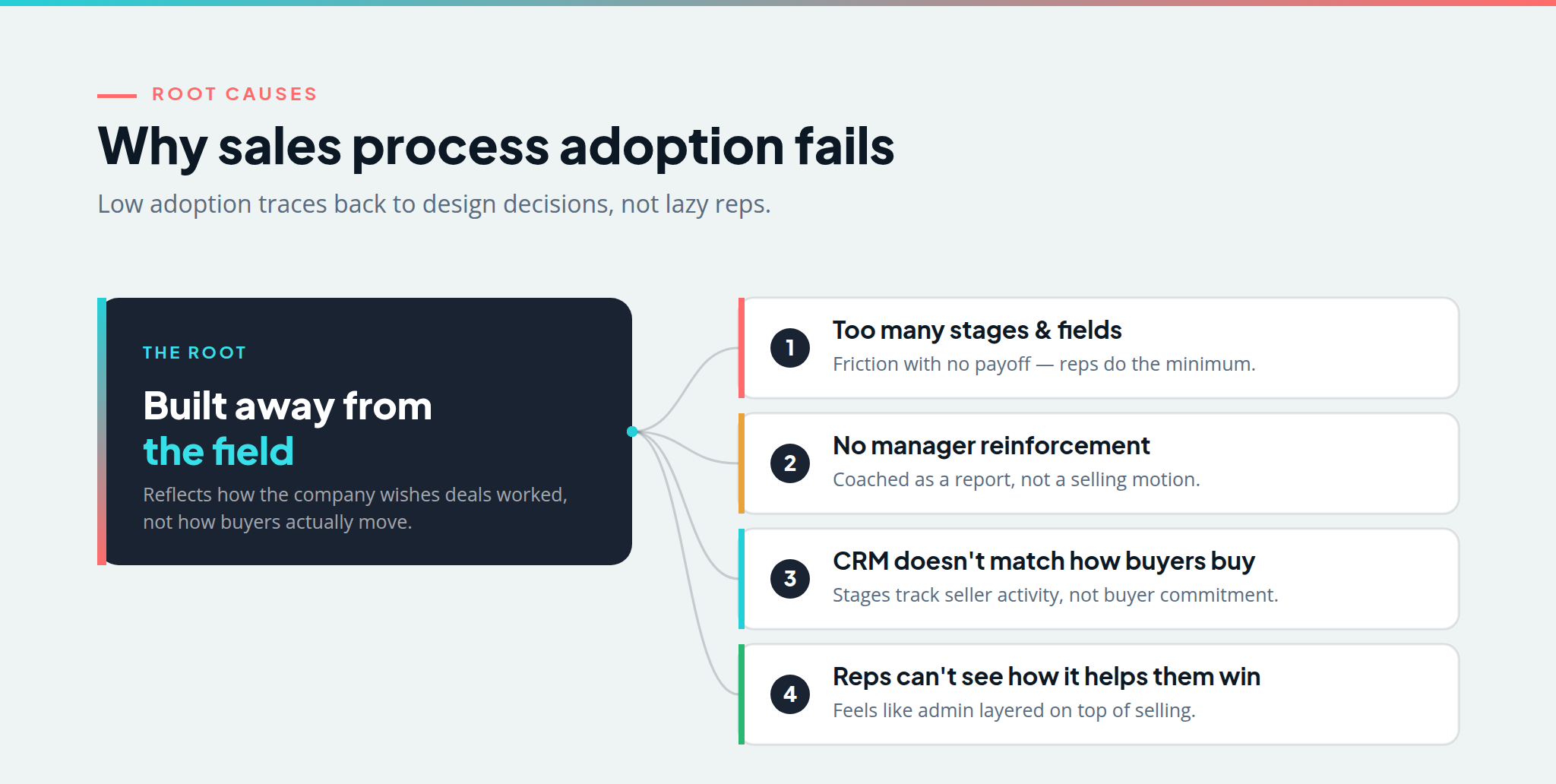
Before you can rebuild adoption you have to be honest about why it broke, and in my experience it almost never comes down to reps being lazy or resistant. It comes down to a handful of design decisions, usually made with good intentions, that signaled to the field this process was something to manage around rather than sell with. Five patterns show up in nearly every low-adoption team, and they tend to travel together.
The process was built away from the field
This is the root cause under most of the others. When a process is designed in a conference room by leadership and operations, then handed down to the people who have to run it in front of buyers, it carries an accent the field can hear immediately — it reflects how the company wishes deals worked, not how they actually move. Reps do not adopt a process that feels written about them instead of with them, and they are usually right to be skeptical, because a motion designed without the people who run it rarely matches the deal in front of them.
Too many stages, too many fields
Complexity is where good intentions go to die. Every stage someone wanted visibility into, every field someone thought might be useful one day, gets added until the process is so heavy that keeping it current becomes a job of its own. Reps respond the way anyone responds to friction with no obvious payoff: they do the minimum required to stay out of trouble, updating fields for the forecast call and ignoring the rest. A process you cannot run in the flow of a real selling week is a process that will be run badly.
No manager reinforcement
A process only holds if the frontline manager reinforces it, and this is where most rollouts silently fail. If managers treat the process as a reporting requirement — checking that fields are filled rather than coaching the selling motion underneath them — reps learn exactly what the process is really for, and it is not winning deals. Adoption is a daily coaching behavior long before it is a rep behavior, and when managers do not model it, no amount of training on the rep side will hold.
The CRM process does not match how buyers actually buy
Many sales processes describe the seller’s activity rather than the buyer’s journey, and that mismatch is fatal to adoption. When the stages are about what the rep did — sent the deck, gave the demo, sent the proposal — instead of what the buyer committed to, reps are forced to translate their real deals into a language that does not fit. They will always trust the deal they can see over the stage the CRM wants, so the process drifts out of sync with reality and stops being something anyone believes.
Reps do not understand how it helps them win
The quiet one, and maybe the most important. If a rep cannot connect the process to closing more deals, they experience it as administration imposed on top of selling rather than as part of selling itself. A process framed only as visibility for management gives the field no reason to internalize it. The teams with real adoption are the ones where reps can tell you, in their own words, how a given stage or exit criterion helps them qualify harder, protect their time, and win — because that is when following it becomes self-interest rather than compliance.
Reps don’t work around a process because they are difficult. They work around one that was never built for the deals they actually run.
Documented Process vs. Adopted Process
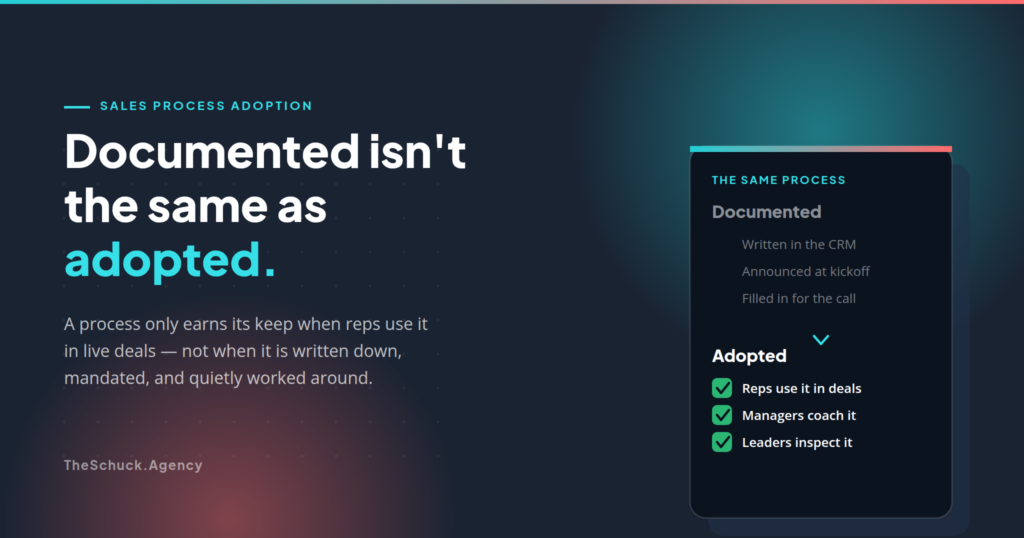
The most useful distinction I can give a leadership team wrestling with this is the difference between a process that is documented and a process that is adopted, because most teams have confused the two and are measuring the wrong one. A documented process means it exists — it is written down, it is in the CRM, it was announced at a kickoff, and there is a slide you can point to. That is genuinely necessary, and it is also where most transformations stop, which is why so many of them fail to change anything in the field. I broke that pattern down in why sales transformations fail, including the five collapse points and the leading indicator that exposes each one.
An adopted process is a different animal entirely. Adopted means the process is alive in the daily behavior of the team: managers coach it in one-on-ones and deal reviews, reps use it to run real conversations with buyers, and leaders inspect it as a matter of routine rather than in a panic at quarter-end. The test is not whether the process exists, it is whether it would still be running next week if the mandate disappeared. Documentation is a starting line that a lot of teams mistake for a finish line, and closing that gap is the entire job.
| A documented process | An adopted process |
|---|---|
| Exists on a slide and in the CRM | Shows up in how reps talk about live deals |
| Stages describe what the rep did | Stages advance on what the buyer committed to |
| Managers check that fields are filled | Managers coach the selling motion underneath the fields |
| Inspected in a scramble at quarter-end | Inspected as a routine part of the operating rhythm |
| Reps follow it to stay out of trouble | Reps follow it because it helps them win |
How to Diagnose the Adoption Gap
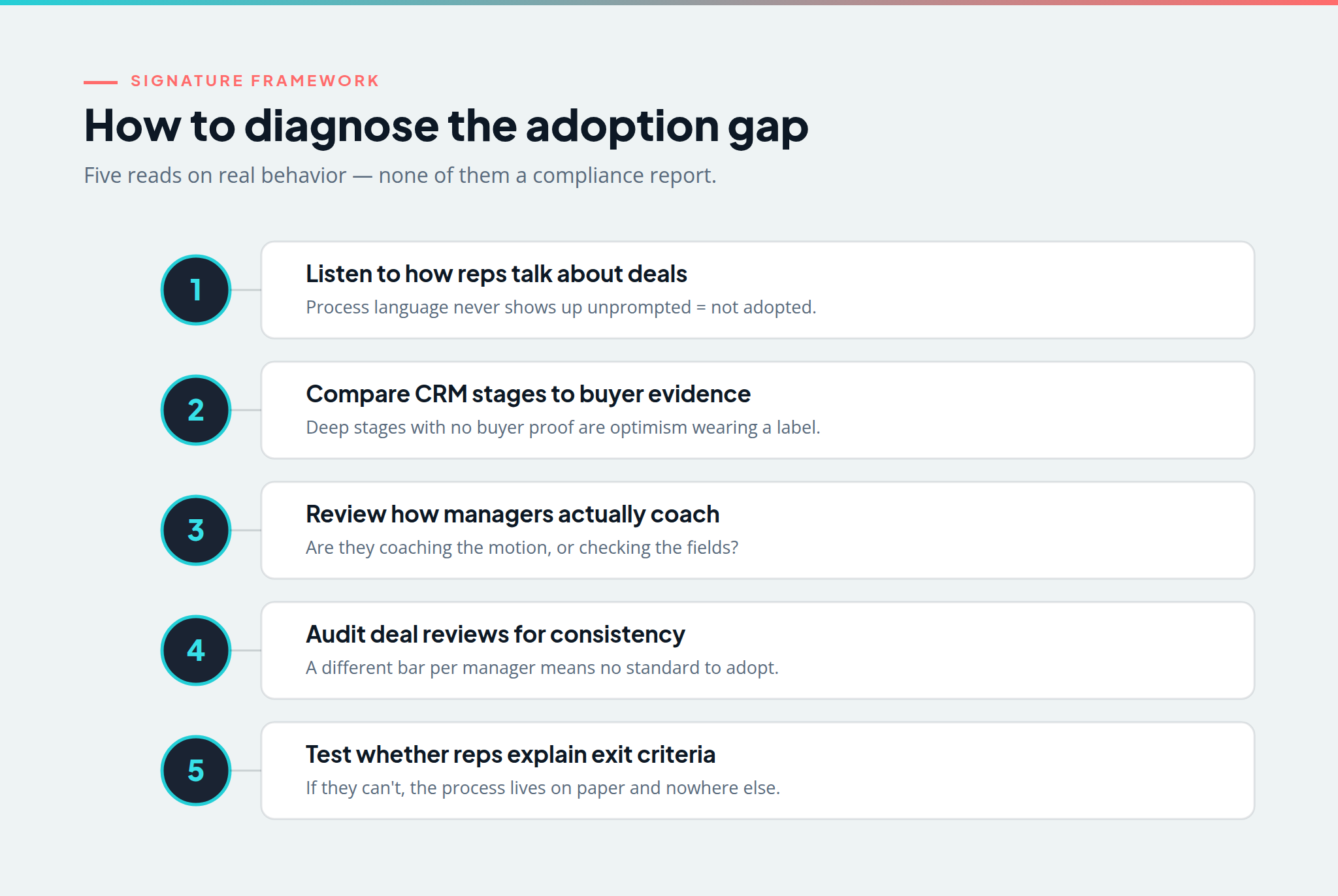
You cannot fix what you have not measured, and adoption is measured in behavior, not in a compliance percentage. The encouraging part is that the signals are easy to read once you know where to look, and none of them require a new tool — just a willingness to inspect what is actually happening instead of what the dashboard reports. Here is the diagnostic I run before I redesign anything, because the redesign is only as good as the honesty of the diagnosis.
- Listen to how reps talk about their deals
- This is the fastest tell there is. Get reps talking about live opportunities and notice the language: do they describe deals in the vocabulary of your process and its exit criteria, or in their own improvised shorthand? When the process language never shows up unprompted, the process is not adopted, no matter what the stages say. Reps reveal what they actually believe about a deal the moment they stop reciting the CRM and start talking like sellers.
- Compare CRM stage data to buyer evidence
- Pull a sample of deals sitting in mid-to-late stages and ask a blunt question of each: what did the buyer do to justify this stage? If a deal is marked deep in the funnel but there is no confirmed decision process, no engaged economic buyer, and no buyer-committed next step, the stage is a rep’s optimism wearing a label. A wide gap between where deals sit and what the buyer has actually done is the clearest quantitative signal of low adoption you will find.
- Review how managers actually coach
- Sit in on a few one-on-ones and deal reviews and watch what the manager inspects. Are they coaching the buyer evidence and the selling motion, or are they walking down the CRM checking that fields are populated? Managers set the real definition of the process through what they choose to inspect, so their coaching habits tell you more about adoption than any rep survey ever will.
- Audit your deal reviews for consistency
- If every deal review is improvised — different questions, different bar, different definition of “commit” from one manager to the next — reps have no consistent standard to adopt, and adoption fragments by team. Consistent inspection is what makes a process real, which is why how you structure deal reviews with leadership is so tightly bound up with whether the process gets used at all.
- Test whether reps can explain the exit criteria
- The single cleanest test: ask a rep what has to be true for a deal to leave its current stage. If they can explain the exit criteria in their own words and tell you why those criteria protect them from wasting time on a deal that will not close, the process is genuinely theirs. If they cannot, the process exists on paper and nowhere else — and you have just found your starting point.
The scorecard below turns these signals into a fast read you can run on your own team in a few minutes, before you spend a single hour redesigning anything.
Sales Process Adoption Scorecard
Check every statement that is true of your team right now — based on how reps and managers actually behave, not on what the process document says. The score tells you whether your process is genuinely adopted, documented in name only, or somewhere in between.

Run this with your frontline managers, not just from the CRM. The boxes you cannot check are exactly where the redesign and the coaching should start.
How to Rebuild Adoption
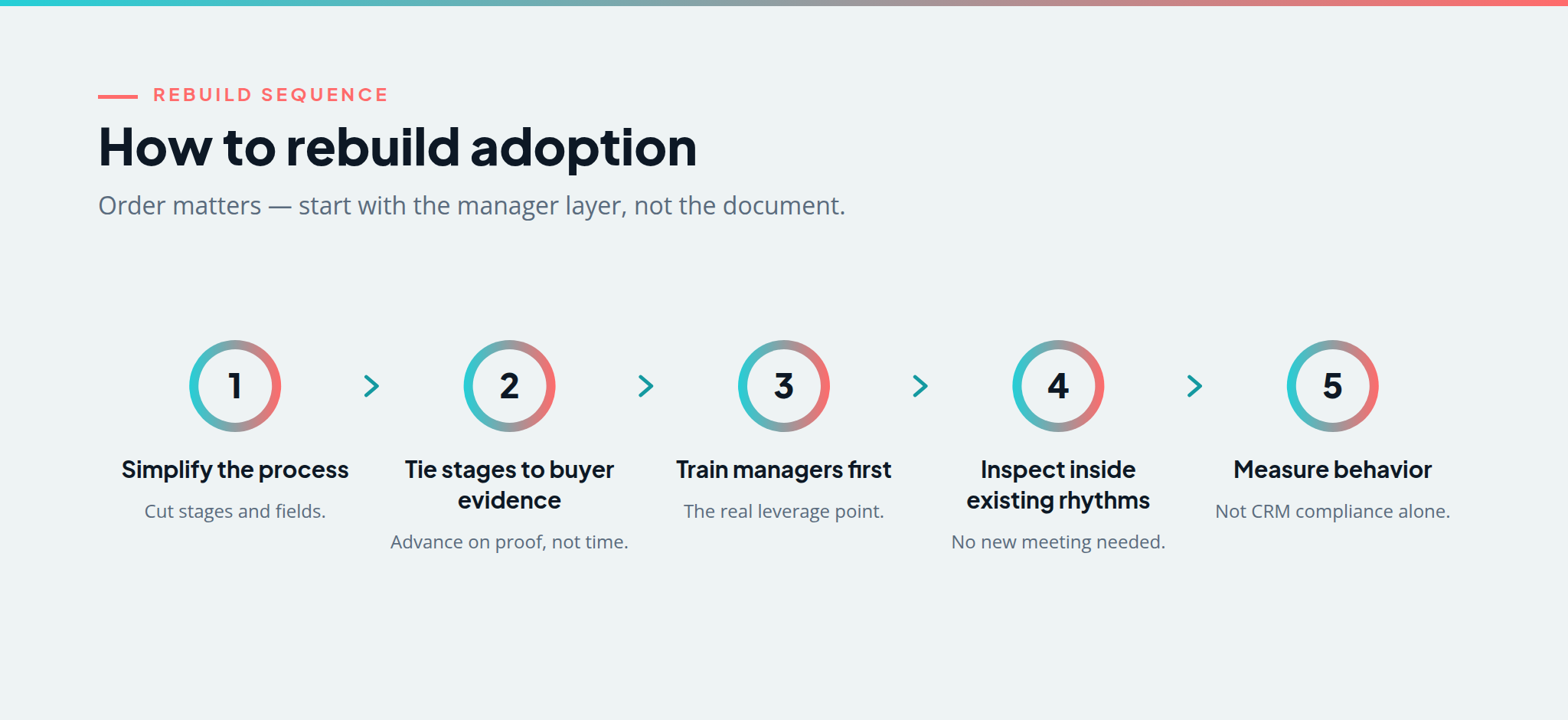
Once you know where adoption is thin, rebuilding it is less about a grand relaunch and more about a sequence of deliberate moves, done in the right order. The order matters as much as the moves — start with the manager layer instead of the process document, and you will get further in a quarter than most teams get in a year of re-templating. Here is the sequence I run.
Simplify the process first
Before you add anything, take things away. Cut the stages and fields down to the smallest set that still gives you a real read on a deal, because every element you remove is friction you remove, and friction is what adoption dies of. A process a rep can run in the flow of a real selling week — without setting aside admin time to reverse-engineer it — is a process a rep will actually run. If you cannot explain why a field earns its place in a deal, delete it.
Tie every stage to buyer evidence
Rewrite the stages so they advance on what the buyer has done, not on what the rep has sent. Each stage should have an exit criterion anchored to a specific piece of buyer evidence — a confirmed decision process, an engaged economic buyer, a buyer-committed next step — so that moving a deal forward requires proof rather than optimism. This single change does more for adoption than any training session, because it makes the process match the reality reps already live in, and reps adopt what matches their reality.
Train the managers before the reps
The frontline manager is the leverage point, so they get trained first and most. Managers need to know how to coach the buyer-evidence conversation, how to hold the line on exit criteria without turning into the CRM police, and how to inspect the selling motion rather than the field. When managers change what they coach, reps change what they do — reliably and quickly — which is why skipping this step is the most common reason a well-designed relaunch still fails to move behavior.
Add inspection into the rhythms you already have
Do not build a new meeting to inspect adoption; wire it into the operating rhythm that already exists. The weekly one-on-one, the pipeline review, the forecast call — each becomes a place where the process gets used and reinforced, so adoption is a byproduct of the cadence rather than a separate initiative competing for calendar space. A process inspected inside the rhythm the team already runs is a process that holds; one that needs its own ceremony to survive will not.
Measure adoption by behavior, not CRM compliance alone
Finally, change what you count as success. A fully populated CRM tells you fields got filled in, which is not the same as a process being used — reps can be perfectly compliant and still selling nothing like the motion you designed. Measure the behaviors that actually indicate adoption: can reps explain their exit criteria, are stages backed by buyer evidence, are managers coaching to the standard? Behavior is the real measure, and when you inspect behavior instead of hygiene, the compliance takes care of itself.
Compliance means the fields got filled in. Adoption means the process is how your team actually sells.
How TheSchuck.Agency Embeds Process Adoption
Plenty of firms will hand you a beautifully documented sales process and consider the job done. The reason adoption is our whole focus is that a process document has never once, on its own, changed how a team sells — the work is making the motion stick in the field after the templates are delivered, and that is a different discipline entirely. I run it audit first, build second, and it comes down to five things done in sequence.
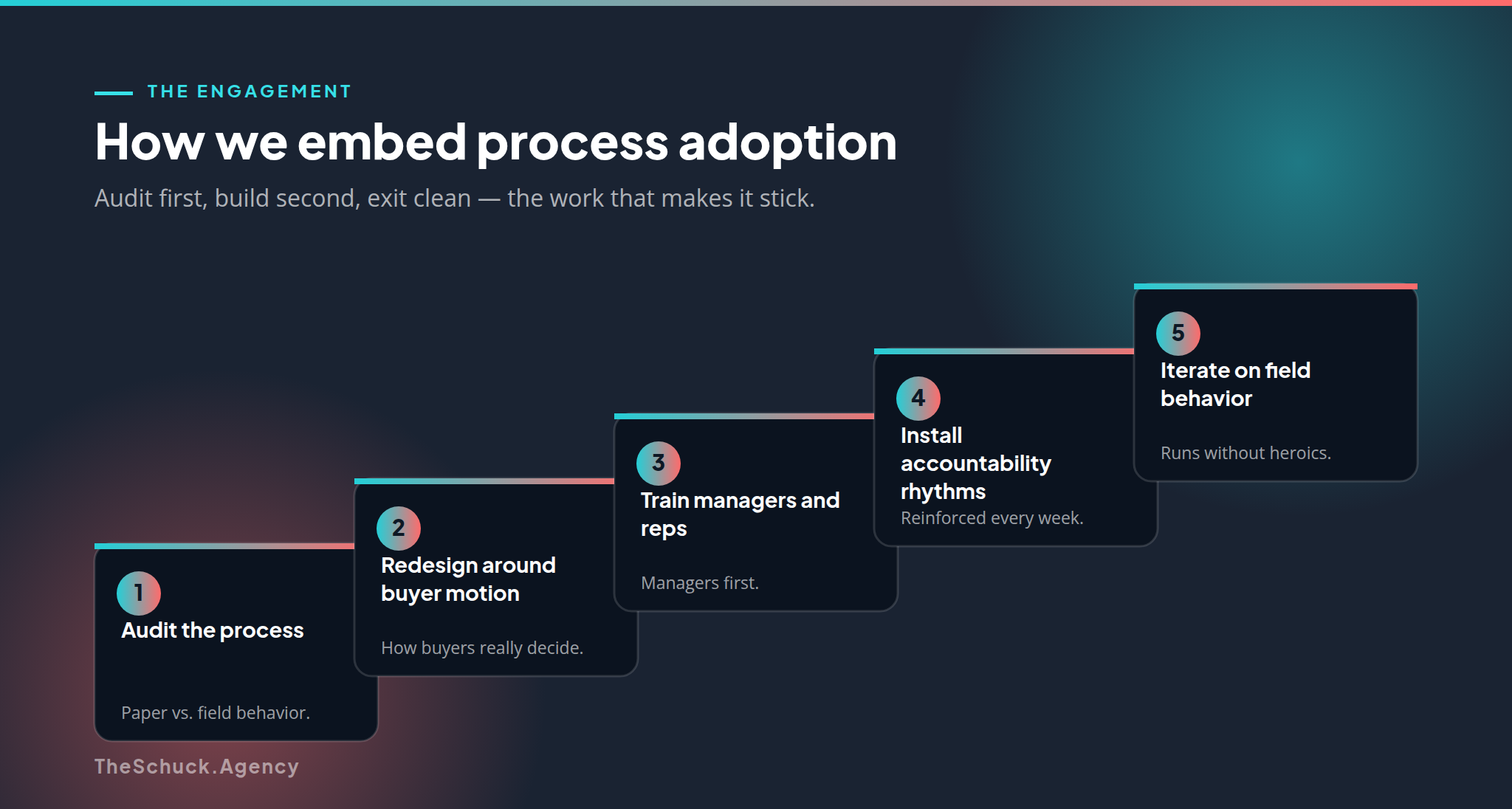
Audit the current process against real behavior
We start where the diagnosis above starts: by comparing the process on paper to the process in the field. That means listening to how reps talk about deals, testing CRM stages against buyer evidence, and watching how managers coach, so we know exactly where adoption is thin and why. Diagnose before you prescribe — a redesign built on a real read of field behavior is worth ten built on best-practice theory.
Redesign around real buyer motion
Then we rebuild the process around how your buyers actually make decisions, not around how the company wishes they did. Simpler stages, exit criteria tied to buyer evidence, and a motion that reflects the deals reps are really running — so the process stops feeling like something imposed on the field and starts feeling like a sharper version of what good reps already do.
Train managers and reps to run it
We train the managers first, because they are the ones who make or break adoption day to day, and then the reps — not on how to fill in the CRM, but on how the process helps them qualify harder and win more. When both layers understand the motion and can see what is in it for them, the process moves from mandate to habit.
Install accountability rhythms
We wire inspection into the rhythms the team already runs, so the process is reinforced every week without a new meeting to sustain it. This is the difference between a change that survives the quarter and one that drifts back to the old way the moment attention moves elsewhere — the rhythm is what makes it durable.
Iterate based on field behavior
A process is never finished on the first pass, so we watch how it behaves in real deals and tune it — tightening an exit criterion here, cutting a stage that is not earning its place there. The point is a system that runs without heroics and keeps getting sharper, so it holds long after the engagement ends. Build capability, not dependency, and then exit clean.
Anyone can deliver a template. Making it survive contact with the field is the actual work — and the whole reason we exist.
Frequently Asked Questions
How do we fix low adoption of our sales process?
Stop treating it as a documentation problem and start treating it as an execution one. Cut the process down to the smallest set of stages and fields that still gives you a real read on a deal, rewrite each stage so it advances on buyer evidence instead of rep activity, and train your frontline managers to coach that motion before you retrain a single rep. Then wire inspection into the meetings you already run and measure the behaviors that show the process is being used — whether reps can explain their exit criteria, whether stages are backed by what the buyer actually did — rather than whether the CRM fields are full. Adoption follows when the process is simple, matches how buyers really buy, and is reinforced by managers every week.
Why do sales reps not follow the sales process?
Usually because the process was built without them and does not match the deals they are actually running. When stages describe seller activity instead of buyer commitment, when there are more fields than any busy rep can maintain, and when managers inspect CRM hygiene instead of coaching the sale, reps reasonably conclude the process is for management’s visibility rather than for winning. They will always trust the deal in front of them over a stage that does not fit it. Reps follow a process when it is simple enough to run in a real week, honest about how buyers decide, and clearly connected to helping them close.
What is the difference between a documented and an adopted sales process?
A documented process exists — it is written down, sitting in the CRM, and was announced at a kickoff. An adopted process is alive in daily behavior: managers coach it, reps use it in real buyer conversations, and leaders inspect it as routine. The simplest test is whether the process would still be running next week if the mandate vanished. Most teams have a thoroughly documented process and mistake that for adoption, which is exactly why their forecasts still surprise them.
How do you measure sales process adoption?
By behavior, not by CRM compliance. A fully populated CRM only proves that fields got filled in, which reps can do while selling nothing like the motion you designed. The signals worth measuring are whether reps describe live deals in the process language, whether they can explain each stage’s exit criteria in their own words, whether stages are backed by genuine buyer evidence, and whether managers are coaching the standard consistently across teams. Those behaviors tell you the process is real; a compliance percentage only tells you it was mandated.
How long does it take to improve sales process adoption?
Faster than most leaders expect, because the highest-leverage move — retraining managers to coach buyer evidence and hold the line on exit criteria — starts changing rep behavior within a few weeks. Simplifying the process and re-anchoring stages to buyer motion can happen in parallel. The deeper work is durability: making adoption hold after attention moves on, which is why the accountability rhythms matter as much as the redesign. A focused engagement can move behavior in a quarter, but the rhythms are what keep it from drifting back.
Should we redesign the sales process or just enforce the one we have?
Enforcing a process the field is working around only produces better-looking data on top of the same broken motion, so start by diagnosing why adoption is low before you reach for either lever. If reps cannot explain the exit criteria, if stages do not match how buyers actually buy, or if the process is simply too heavy to run, the answer is redesign, not enforcement. If the design is sound and only the manager coaching and inspection rhythm are missing, you may not need a redesign at all — you need reinforcement. The audit tells you which, and guessing wrong costs you a quarter either way.
Find Out Why Your Process Isn’t Sticking
A 30-minute discovery call is enough to pinpoint where your sales process is breaking down between the slide and the field — and what it would take to make it stick. No pitch, no pressure. Just a clear read on where adoption is thin and why.
Book a Discovery Call Responds within 24 hours · No commitment required