How to Fix an Unreliable B2B Sales Forecast When Your CRM Data and Pipeline Stages Are Messy
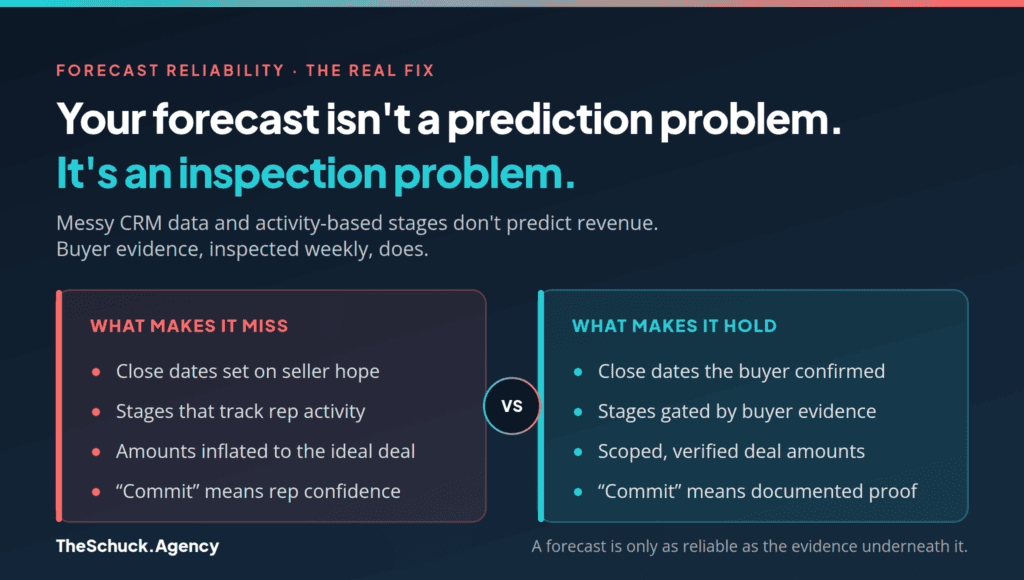
Most revenue leaders I work with do not lie awake worrying about their forecasting model. They lie awake because deals they were told were committed keep slipping into next quarter, shrinking before they close, or vanishing entirely a week before the board meeting, and because the number they carried into that meeting turned out to be wrong again. When that happens two or three quarters in a row, the instinct is to blame the spreadsheet, the CRM, or the reps who "sandbag." But the forecast is a downstream symptom, and rebuilding the model on top of the same messy inputs just produces a cleaner-looking number that misses in exactly the same way.
An unreliable forecast is almost always the visible edge of something further upstream: pipeline stages that mean five different things to five different reps, CRM fields full of optimism instead of evidence, and forecast calls that reward confidence rather than testing it. You do not fix forecast accuracy by predicting the future better; you fix it by defining the present clearly enough that the number has something real to stand on. This guide walks through exactly how to do that, in the order that actually holds.
To fix an unreliable B2B sales forecast, stop treating it as a prediction problem and start treating it as an inspection problem. Diagnose why the forecast is missing (slipped, shrunk, lost, phantom, or surprise deals), clean only the CRM fields that move the number, redefine pipeline stages around buyer evidence instead of seller activity, separate forecast categories from sales stages, and run a weekly review that inspects what changed and what the buyer actually did. Forecast accuracy improves the moment your team stops inspecting opinions and starts inspecting evidence.
Why B2B sales forecasts become unreliable
When I audit a revenue org where the forecast keeps missing, the pipeline almost always looks fine at first glance. Coverage is healthy, the stages are populated, activity is high, and the dashboard is green. The unreliability is not sitting on the surface where the reports are; it is sitting underneath, in the definitions and habits that decide what those reports are made of. Five failure points show up again and again, and because they feed each other, a company can be doing plenty right and still end up with a number nobody trusts.
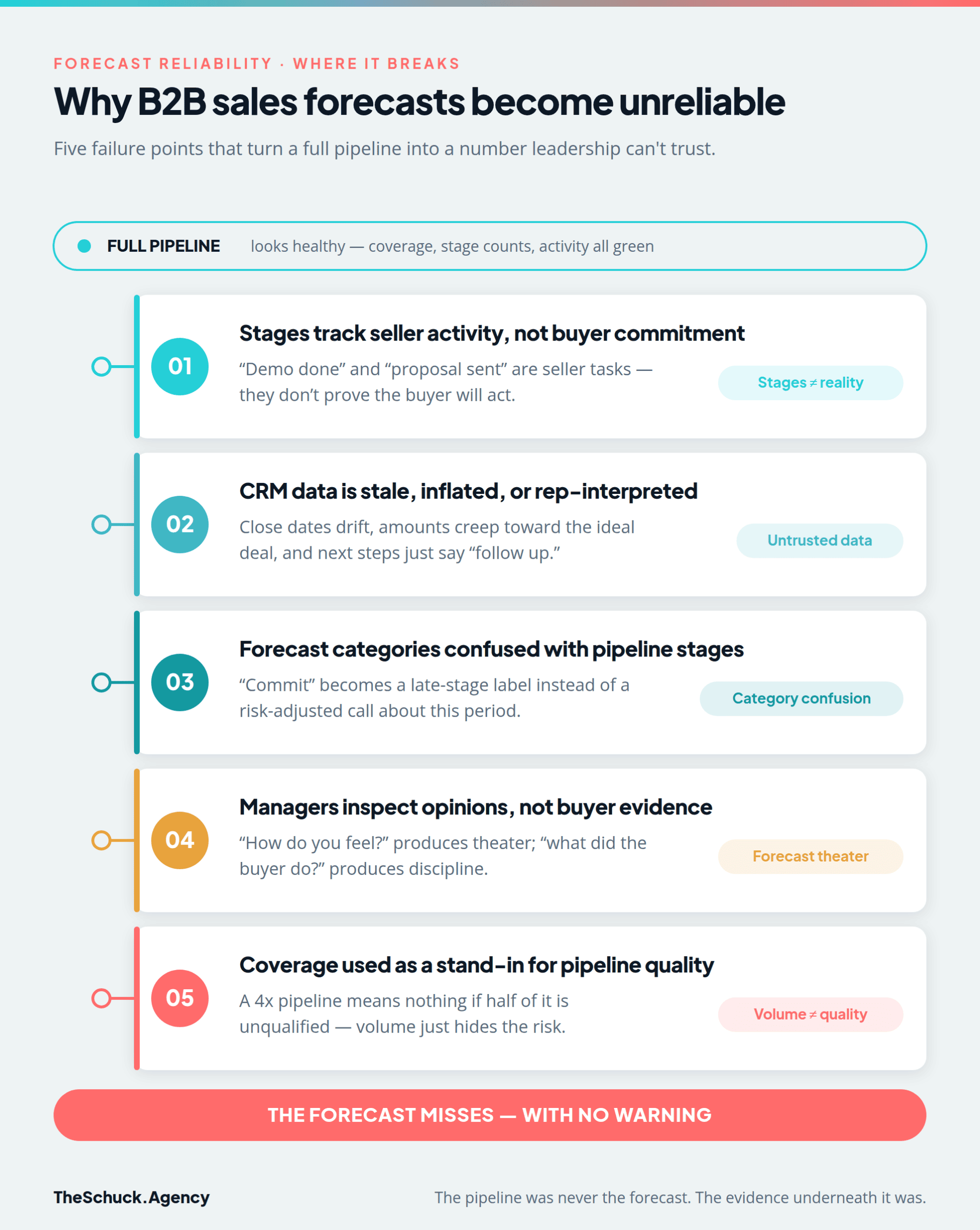
Stages track what the seller did rather than what the buyer committed to, so "demo completed" and "proposal sent" advance a deal that has no real momentum behind it. CRM data drifts quietly out of reality as close dates get pushed, amounts creep toward the deal everyone wishes they were running, and next steps read "follow up" instead of naming a buyer action. Forecast categories get treated as fancier stage labels, so "commit" becomes a place a deal sits rather than a risk-adjusted judgment about closing this period. Managers inspect sentiment instead of evidence, which turns the forecast call into theater. And pipeline coverage gets used as a proxy for pipeline quality, so a reassuring 4x number hides the fact that half of it was never real.
The real reason your forecast keeps missing
Here is the part most forecasting advice skips: your forecast is not inaccurate because your team can't see the future. It is inaccurate because your sales process does not describe the present clearly enough for anyone to reason from it. A forecast is only ever as good as the shared definitions underneath it, and when there is no agreement on what makes a deal real, what has to be true for it to advance, and what separates commit from best case, the number becomes an average of everyone's private optimism.
A forecast is not a prediction exercise. It is an inspection system — and it will only ever be as reliable as the evidence it is built to inspect.
That reframe changes what you actually work on. Instead of chasing a better formula, you go after the things that decide whether the inputs are trustworthy: how an opportunity enters the pipeline, what evidence is required to move it, how managers pressure-test a deal, which CRM fields get governed, and how leadership handles risk and slippage when the quarter starts to bend. Get those right and the forecast stops surprising you, because it starts telling you where it would break while there is still time to do something about it. The rest of this guide is that work, in sequence.
Step 1: Audit your forecast miss pattern
Before you touch the CRM, find out how the forecast is wrong, because "we keep missing" is not diagnostic enough to act on. Pull the last two to four quarters and sort every deal that hurt the number into one of five patterns. The mix tells you where the operating problem actually lives, and it keeps you from cleaning fields that were never the issue.
| Miss pattern | What it usually means |
|---|---|
| Slipped deals | Close dates were tied to seller hope, not a buyer-confirmed event — a sign of weak close-date discipline and no mutual action plan. |
| Shrunk deals | Deal value or scope was overstated going in — a discovery, budget, or procurement problem, not a closing problem. |
| Lost deals | Real risk was never surfaced early enough to fight — the deal review inspected activity instead of the decision. |
| Phantom deals | Opportunities that should never have been forecast at all — pipeline entry criteria are too easy to satisfy. |
| Surprise deals | Business that closed without being properly forecast — reps aren't updating the CRM and leading indicators aren't being inspected. |
A forecast that misses mostly through slipped deals needs close-date discipline and mutual action planning, not a data cleanup. One that misses through shrunk deals needs better discovery and qualification. A pile of phantom deals means your pipeline is too easy to enter, and a run of surprises means the CRM and the inspection cadence aren't keeping up with reality. Name the pattern first, and everything that follows gets pointed at the actual leak.
Step 2: Redefine pipeline stages around buyer evidence
This is the single highest-leverage change on the list, because it fixes the input that every other number depends on. The principle is simple to state and hard to enforce: a deal should move to the next stage only when the buyer has taken a meaningful action, never when the seller has finished a task. "Proposal sent" tells you the rep was busy; "decision criteria, timeline, and budget path confirmed by the buyer" tells you the deal is real. One of those belongs in a forecast, and the other is just motion.
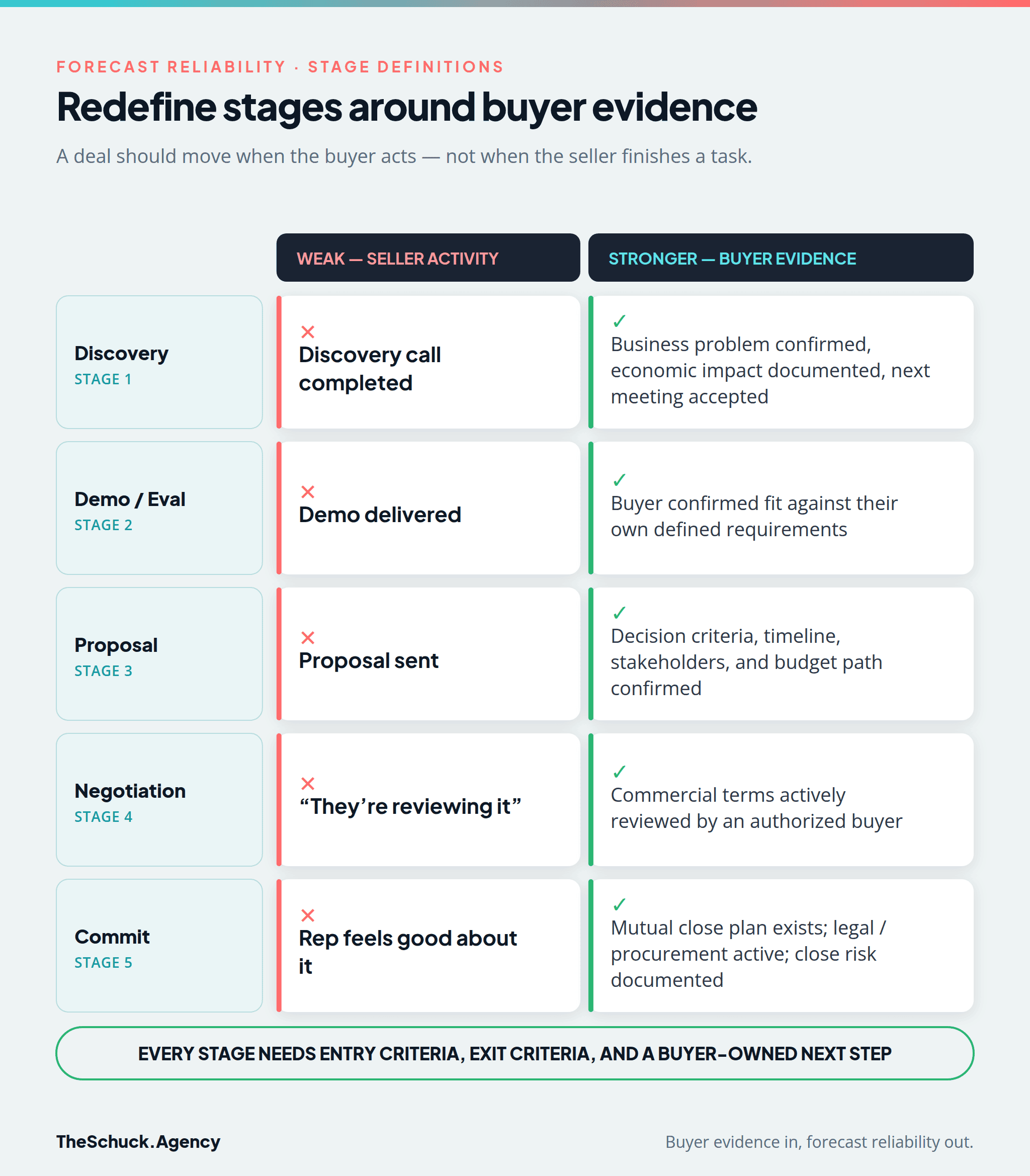
Rewriting the stage names is the easy part. The discipline is giving every stage the five things that make it inspectable, so "what stage is this in?" has a verifiable answer instead of a subjective one:
- Entry criteria
- What must be true before an opportunity is allowed into this stage — the gate that keeps phantom deals out of the pipeline.
- Exit criteria
- What buyer action proves the deal has earned the next stage, stated as evidence a manager could verify, not a feeling.
- Required CRM fields
- The specific data that must be present and current for a deal to legitimately sit here.
- Manager inspection questions
- What leadership checks every week to confirm the deal actually belongs where it is.
- Forecast risk indicators
- The signals that should pull a deal backward or drop it out of the forecast entirely.
Getting reps to a shared standard for what counts as evidence is exactly where a qualification framework earns its keep. If your team already runs one, this is where it becomes operational rather than decorative; if it doesn't, aligning stages to buyer evidence and a confirmed economic buyer is usually the fastest way to make "qualified" mean one thing across the whole team.
Step 3: Clean only the CRM fields that move the forecast
Most CRM cleanup projects fail because they try to fix everything, stall under the weight of it, and change no behavior along the way. Forecast reliability does not require a pristine CRM; it requires a trustworthy handful of fields. Start with the eight that actually decide whether leadership can believe the number, and leave the rest for later.
- Close date
- Must reflect a buyer-confirmed event or timeline, not the end of your quarter.
- Amount
- Must match the scoped, verified value — not the deal you wish you were running.
- Stage
- Must reflect buyer evidence under the definitions you set in Step 2.
- Next step
- Must be specific, dated, and buyer-owned wherever possible — "follow up" is not a next step.
- Economic buyer
- Must name who actually controls budget or strategic approval, and whether you have access.
- Decision process
- Must capture how the buyer will decide, who is involved, and what has to happen for a yes.
- Business pain
- Must explain why the buyer would act now rather than do nothing — the cost of the status quo.
- Forecast category
- Must be a risk-adjusted judgment, set against evidence, not a mirror of rep confidence.
Do not start by cleaning every field. Start with the eight fields that decide whether leadership can trust the number — the rest is housekeeping.
Step 4: Separate sales stages from forecast categories
This is a small distinction that quietly wrecks a lot of forecasts. A pipeline stage tells you where the buyer is in the process; a forecast category tells you how likely the deal is to close in this period. They are not the same axis, and collapsing them is why late-stage deals get waved into commit on momentum alone. A deal can be deep in negotiation and still be low-confidence if there is no confirmed timeline, no engaged economic buyer, and no procurement path — and a mid-stage deal can be high-confidence when the evidence is genuinely strong.
| Pipeline stage (where the buyer is) | Realistic forecast category (how likely to close) |
|---|---|
| Discovery | Pipeline |
| Evaluation | Best case |
| Proposal | Best case, or commit only with strong evidence |
| Negotiation | Commit or best case, depending on the risk that remains |
| Procurement | Commit, once the close risk is genuinely understood |
Keep the two axes separate and "commit" goes back to meaning something: a deal you would stake the quarter on because the evidence supports it, not because it happens to be far along the board.
Step 5: Inspect the forecast every week
A better set of definitions decays fast without a rhythm that enforces it, which is why the weekly review is where forecast reliability is actually won or lost. The goal is to inspect evidence and change, not to listen to a recap of everyone's week. The structure I run with revenue teams moves through five short passes:
- 1. Start with what changed
- Which deals moved forward, which stalled, which close dates or amounts shifted, and where risk went up since last week — not a recap of every deal, just the deltas.
- 2. Inspect buyer evidence
- What did the buyer actually do? Who confirmed the business problem, who owns the decision, what happens if they do nothing, and what is the next buyer-owned action?
- 3. Check stage integrity
- Does this deal genuinely belong in its stage under your exit criteria, or is it sitting a stage ahead of the evidence?
- 4. Pressure-test the forecast category
- Why is this a commit and not a best case? What could still prevent it from closing, and what proof supports the call?
- 5. End in the CRM, not in the room
- Every review closes with updated fields, not a verbal agreement everyone forgets by Thursday.
If your reviews still feel like status meetings, restructuring them is the fastest single improvement you can make, and it pairs directly with the way you structure deal reviews with leadership so the inspection is consistent from one manager to the next.
Step 6: Score every deal with the Forecast Reliability Score
Everything above gives you the standards; this gives you a fast, repeatable way to apply them deal by deal. The Forecast Reliability Score rates a single opportunity across the ten pieces of evidence that decide whether it deserves to be in your forecast at all. Score each one from one (missing) to five (strong and verified), and let the total tell you how much of the deal is real. The point is not the number itself — it's that a late-stage deal with a low score should not be sitting in commit, no matter how far along the board it looks.
Score a deal from 10 to 50
Pick one real opportunity that's currently in your forecast. Rate it on each dimension from 1 (missing or assumed) to 5 (confirmed by the buyer and current in the CRM). The score, band, and read update as you go — the dimensions you can't rate highly are exactly where the deal is fragile.
A directional read, not a probability. Two deals in the same stage can score twenty points apart — and that gap is usually the difference between a commit that holds and one that surprises you.
Common mistakes that make forecasts worse
Plenty of well-intentioned fixes make forecast reliability worse, not better, because they add process without changing what gets inspected. These are the ones I watch for:
- Adding more CRM fields without changing what managers actually inspect — more data is not more discipline.
- Treating probability percentages as a substitute for evidence, so a "70% deal" means nothing verifiable.
- Letting reps self-certify commit deals without a shred of buyer proof behind the call.
- Reading pipeline coverage as forecast confidence, when a bigger pipeline can simply hide bigger risk.
- Allowing every manager to interpret the stages differently, so "commit" drifts team by team.
- Making RevOps solely accountable for a number that only sales leadership can actually enforce.
- Only reviewing the biggest deals, and missing the pattern-level risk hiding in the rest of the book.
RevOps can build the system, design the fields, and report the risk, but forecast accuracy is an operating discipline that leadership has to enforce week after week. When those responsibilities blur, the standards quietly erode under quota pressure and the forecast drifts right back to where it started.
A 30-day plan to make the forecast trustworthy
You can't fix all of this at once, and trying to is how these efforts stall. The order matters because each step is what makes the next one hold — clean fields are useless under subjective stages, and a weekly review has nothing to inspect until the definitions exist. Here is the month I run with teams.
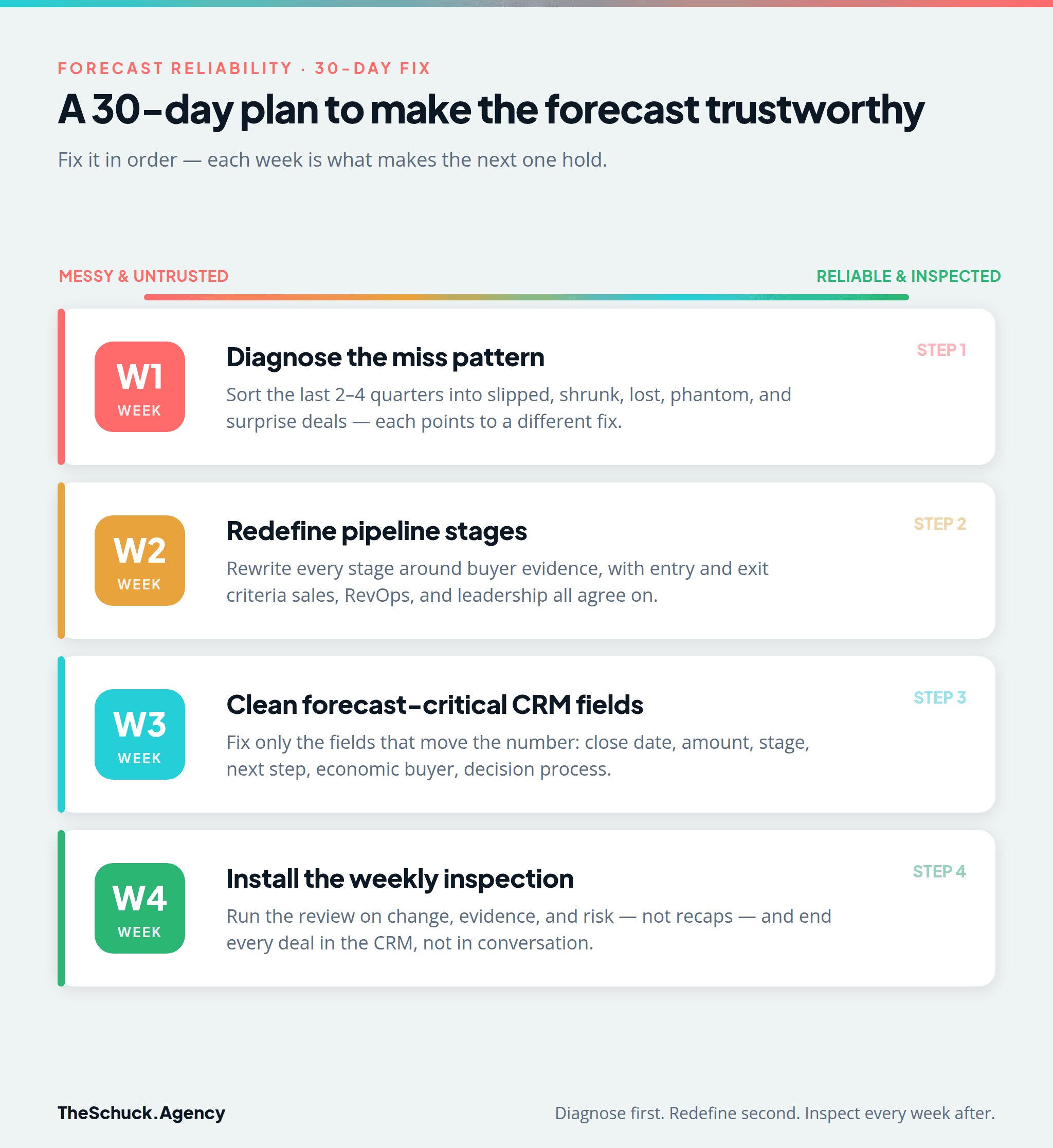
- Week 1 — Diagnose the miss pattern
- Sort the last two to four quarters into slipped, shrunk, lost, phantom, and surprise deals, and identify where trust in the number breaks down.
- Week 2 — Redefine pipeline stages
- Rewrite every stage around buyer evidence with entry and exit criteria, and get sales, RevOps, and leadership aligned on one shared definition.
- Week 3 — Clean the forecast-critical CRM fields
- Fix the eight fields that move the number and strip the noise out of your forecast review views.
- Week 4 — Install the inspection cadence
- Run the weekly review on change, evidence, and risk, and end every deal in the CRM rather than in conversation.
When to bring in outside help
Plenty of teams can run this on their own, and if that's you, take the sequence above and go. But there is a recognizable point where the issue is no longer CRM cleanup and has become a deeper problem in how the revenue engine operates — usually because the people closest to it are too far inside the machine to see where it's bending. The signs I see most often:
- The board no longer trusts the forecast, and neither, quietly, do you.
- Sales leadership and RevOps disagree on what the real number is.
- Reps constantly push close dates, and no standard has ever held.
- Managers can't explain why a commit deal is a commit beyond "they feel good about it."
- The CRM fields exist, but the data in them isn't trusted enough to decide from.
- Forecast misses are recurring and patterned, not the occasional bad quarter.
- Leadership can't tell whether the real problem is pipeline creation, deal quality, sales execution, or process design.
When several of those are true at once, the answer is rarely a new forecasting tool. TheSchuck.Agency helps B2B revenue teams diagnose and rebuild the operating system behind the forecast — pipeline stages, CRM hygiene, sales process, inspection cadence, and the executive decision frameworks that hold it all together. The approach is to diagnose before prescribing, fix the system in the right order, and build a discipline that runs without constant executive intervention. Related reading, if the symptom you recognize most is upstream of the forecast itself: why your pipeline looks healthy but revenue keeps missing, and how to build a forecast as a best, base, and worst case instead of a single fragile number.
Frequently Asked Questions
What causes inaccurate B2B sales forecasts?
Inaccurate B2B sales forecasts are usually caused by pipeline stages that track seller activity instead of buyer commitment, CRM data that is stale or inflated, forecast categories that get confused with sales stages, and managers who inspect rep sentiment rather than buyer evidence. The forecasting model is rarely the culprit — the inputs feeding it are unreliable, so a cleaner model just misses more precisely.
How do you fix messy CRM data for sales forecasting?
Don't try to clean everything at once. Focus first on the eight fields that actually move the number: close date, amount, stage, next step, economic buyer, decision process, business pain, and forecast category. Get those trustworthy and current under clear stage definitions, and the forecast becomes decision-safe long before the rest of the CRM is spotless.
What is the difference between a pipeline stage and a forecast category?
A pipeline stage describes where the buyer is in the sales process; a forecast category describes how likely the deal is to close in the current period. They measure different things. A deal can be late-stage and still low-confidence when the timeline, economic buyer, or procurement path is unconfirmed — which is exactly why late-stage deals shouldn't be waved into commit on position alone.
How should B2B pipeline stages be defined?
Define stages by buyer evidence rather than seller activity. Every stage should carry entry criteria, exit criteria tied to a verifiable buyer action, the CRM fields that must be present, the questions a manager inspects weekly, and the risk signals that would move a deal backward. That structure is what turns "what stage is this in?" from an opinion into something you can check.
Why do sales reps keep pushing close dates?
Usually because the original date was anchored to the seller's hope or the end of the quarter rather than anything the buyer confirmed. Tie close dates to a verified business event — a decision meeting, a procurement window, an implementation deadline — and they stop drifting, because the date now belongs to the buyer's calendar instead of the rep's optimism.
Is forecast accuracy a RevOps problem or a sales leadership problem?
Both, and confusing the two is a common failure. RevOps designs the CRM structure, the stage logic, and the reporting, and it should govern those definitions. But enforcing stage discipline, testing deal evidence, and holding the line on what "commit" means is an operating responsibility that only sales leadership can carry. A great system with no leadership enforcement drifts back to guesswork within a quarter.