Hitting Activity Targets but Deals Keep Slipping? Fix Qualification
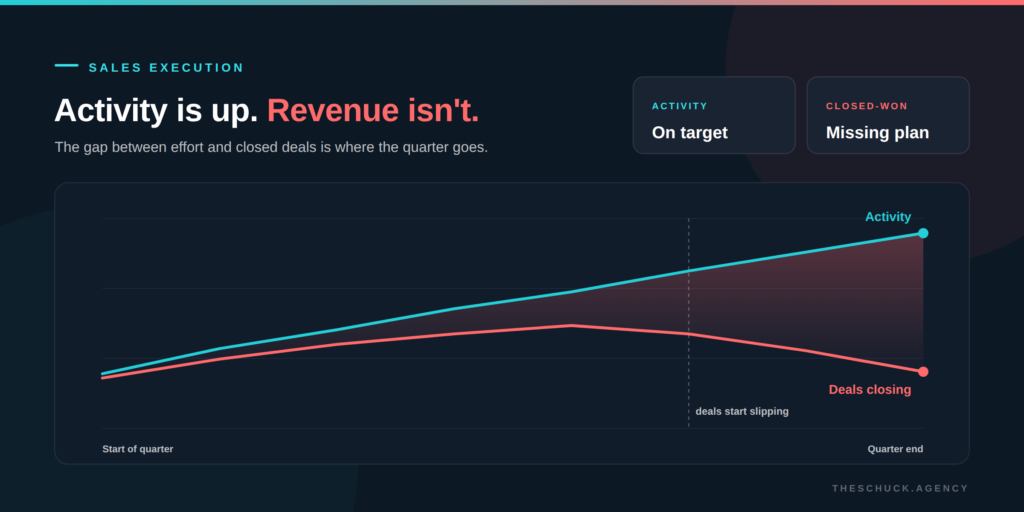
Every number on the activity dashboard is green. Calls are up, meetings are booked, demos are going out, and the team is clearly working hard. Then the last two weeks of the quarter arrive, the deals you were counting on slide or vanish, and you finish short again.
On your team's forecast calls, the same kinds of lines come up every quarter:
"They were ready to sign, but their legal said we need to do another security audit before they'll sign. Looks like it'll take us another three months to get through compliance."
"Our contact holds the budget, but his CFO killed the deal."
"The POC went well and they increased the quantity. The problem is, now we have to go through a different procurement process, and they only meet once a month."
None of those deals slipped for lack of effort. Each one slipped on something qualification is supposed to catch early: a paper process nobody mapped, an economic buyer nobody engaged, a competitor nobody accounted for. That is the pattern behind hitting activity targets while deals keep slipping, and it is worth being precise about why it happens.
In more than twenty years running and rebuilding revenue organizations, from a B2B brand I grew to 500-plus retailers to enterprise sales transformation inside a global Fortune 500, I have watched plenty of busy teams miss the number. When you are hitting activity targets and deals keep slipping, the shortfall almost always traces back to qualification rather than effort. Activity measures how much your team is doing, not whether the buyer intends to move, so a fully committed team can spend an entire quarter on deals that were never going to close. The answer is not more activity. It is making sure the effort your team already puts in lands on deals that can actually convert.
If your team is hitting activity targets but deals keep slipping, the problem is usually pipeline quality, not rep effort. Activity shows motion, but it does not prove buyer intent, economic buyer access, decision process, paper process, or competitive risk. The fix is a shared qualification standard like MEDDPICC that forces weak deals out early.
Activity Measures Effort, Not Whether Deals Will Close
Activity targets earn their place for a good reason. Motion is easy to measure, easy to coach, and a fair early sign that a team is engaged. The problem starts when leaders treat activity as the result instead of an input to it. Calls made and meetings booked tell you the team is busy, but they say nothing about whether the deals underneath that work are real. A rep can hit every activity number for a full quarter while working deals that had no path to signature the entire time, and the dashboard will keep rewarding the effort right up until the forecast falls apart.
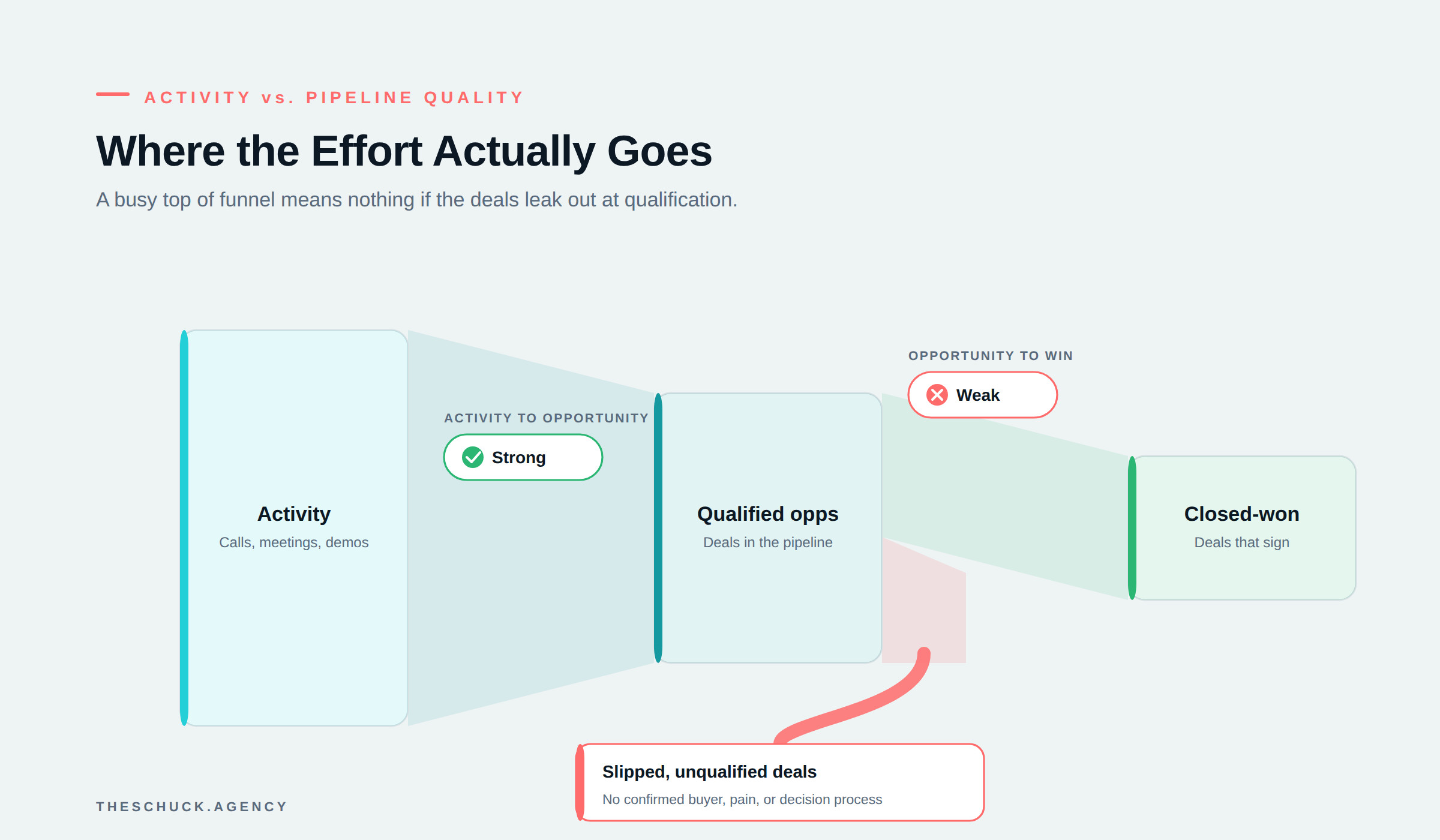
It helps to separate two conversions that most teams blur together. The first is activity-to-opportunity: are your outbound and inbound motions creating enough qualified opportunities in the first place? The second is opportunity-to-win: once a deal is in the pipeline, does it actually close? These are different problems with different fixes, and solving the wrong one is how good teams waste two or three quarters cutting the very thing that was working.
The pattern behind hitting activity targets while deals slip is almost always the second one. You are generating plenty of opportunities and the team is working them hard, but they die in the funnel. When that is the shape of the problem, the fix is never to cut pipeline generation to protect the number. The fix is to understand why qualified-looking deals keep failing to close, and then to stop that leak at the source.
Activity Metrics vs. Pipeline Quality
The two are easy to conflate. Activity metrics tell you how hard your team is working. Pipeline quality tells you whether that work is landing on deals that can actually close.
| Activity metrics measure | Pipeline quality measures |
|---|---|
| Calls made | Confirmed business pain |
| Meetings booked | Economic buyer access |
| Demos completed | Decision process clarity |
| Emails sent | Paper process risk |
| Follow-ups scheduled | Buyer-owned next steps |
| Rep effort | Deal likelihood |
What this looks like in practice
A VP of Sales came to me convinced he needed to cut his SDR team. Pipeline generation was steady, revenue had gone flat, the board was asking hard questions, and cutting the SDRs felt like the obvious move. We ran the diagnostic before he touched anything. His team was creating around 120 opportunities a month at a healthy activity-to-opportunity ratio, so the top of the funnel was genuinely working. The win rate told the real story: 12 percent against the 22 percent he needed to hit plan, with deals dying again and again at the handoff from qualified to proposal.
Had he cut the SDR team, he would have reduced pipeline by roughly a third while the actual failure point went untouched, and within six months he would have been rebuilding the team he just let go. Instead, he changed what got inspected rather than how much got done. He put a tighter, shared qualification standard on the qualified-to-proposal handoff, so a deal could not advance without a confirmed economic buyer, a quantified problem, and a decision process the rep could actually map.
Then he stood up a weekly team pipeline review where every rep walked their key deals in front of the group. That second move mattered as much as the first, because it made the real state of each deal visible instead of private and held sellers accountable to scrutiny from their peers, who tended to ask the questions a rep would rather avoid. Deals that could not stand up to that scrutiny got requalified or let go early, while there was still time to affect the quarter. Win rate climbed from 12 percent to 18 percent in a single quarter, and revenue moved with it, without adding one new activity to anyone's day.
Why Deals Slip When the Activity Looks Great
Why do deals slip even when reps hit activity targets?
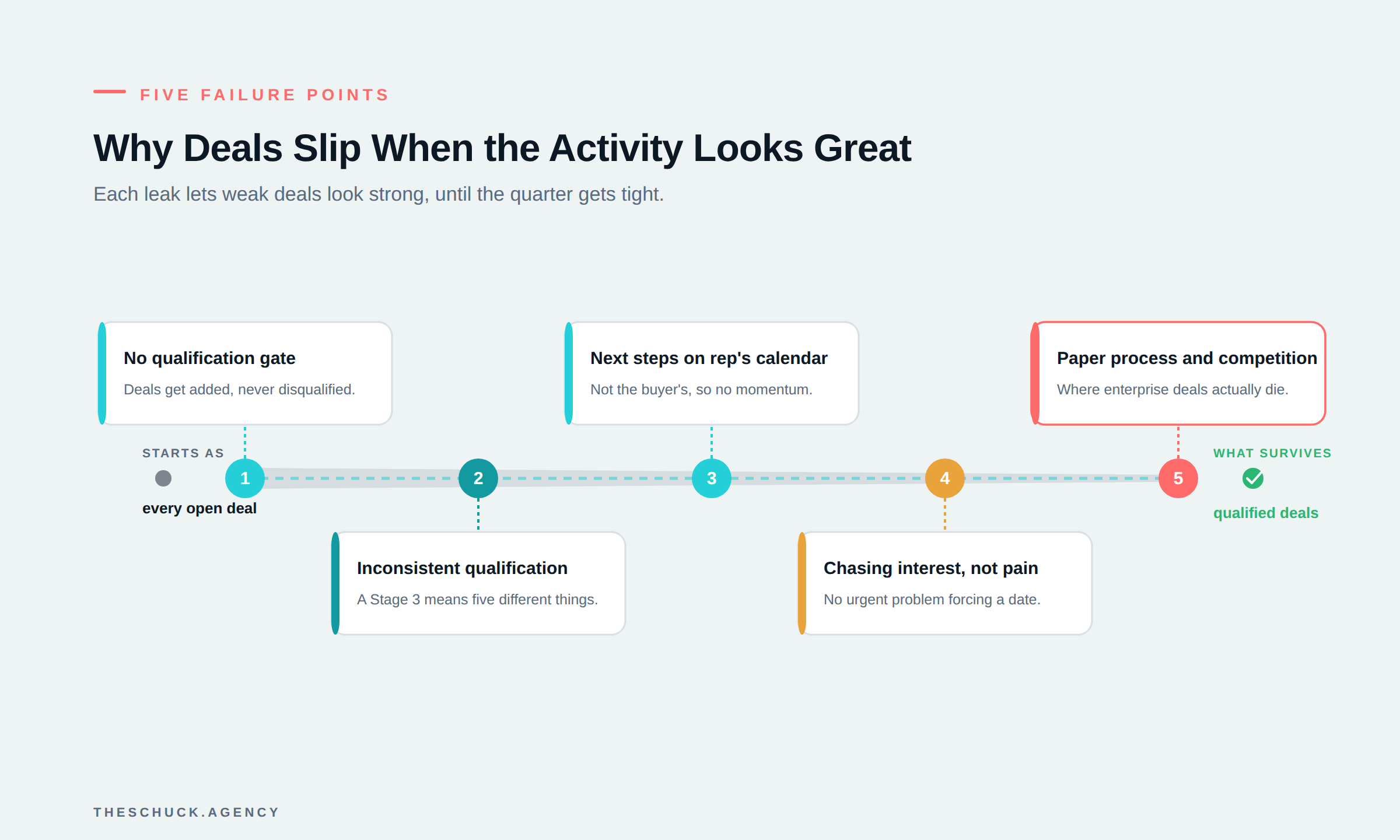
Because activity and qualification measure different things. Hitting call, meeting, and demo targets proves a team is busy. It says nothing about whether a deal has a confirmed economic buyer, a real decision and paper process, quantified pain, or a handle on the competition. When those go unconfirmed, the deal keeps advancing on effort and stalls late, which is when the slip shows up. The five failure points below are where it happens.
When I audit a team that is busy but still slipping, the causes are remarkably consistent, and none of them come down to how hard the reps are working. They come down to what reps are allowed to keep working on, and for how long, before anyone tests whether a deal is genuinely real. Five failure points show up again and again.
1. There is no qualification gate, so nothing gets disqualified
In most slipping pipelines, deals get added but almost never removed. A deal goes in on a rep's optimism and simply stays there, quarter after quarter, absorbing effort the whole way. With no shared standard for what makes a deal real, there is no honest moment where a weak deal gets killed, so time keeps flowing into opportunities that everyone half-suspects will never close. A pipeline that only ever grows usually means qualification has stopped happening.
2. Qualification means something different to every rep
When each seller qualifies to a private standard, the same stage means five different things across a team of five. One rep's Stage 3 is an evidence-backed opportunity; another's is a friendly conversation with someone who cannot sign. Managers cannot coach what they cannot compare, and the roll-up blends strong and weak deals into a number no one can reason about clearly, until the weak half fails to convert and the miss becomes obvious.
3. Next steps live on the rep's calendar, not the buyer's
A plan to follow up next week is not really a next step. A genuine next step is a specific action the buyer has agreed to and put on their own calendar. When the only forward motion sits on your team's side, the deal is moving on your energy rather than the buyer's intent, and those are exactly the deals that stall the moment the quarter tightens.
4. Reps are chasing interest instead of confirmed pain
Interest and pain are not the same thing, and only one of them closes. A buyer who finds your product interesting will happily take the meeting, sit through the demo, and generate all the activity you could want, then never spend a dollar, because nothing urgent was forcing a decision. Deals built on interest slip indefinitely, since there was never a real reason to sign by any particular date.
5. The two places enterprise deals actually die go uninspected
The later a deal is when it slips, the more it costs you, and two failure points do their damage at exactly that stage. The first is the paper process, meaning the procurement, legal, security, and approval path a deal has to clear before signature, which teams routinely discover only when it surprises them in the final weeks. The second is competition, including the alternative most forecasts ignore entirely: the status quo, the decision to do nothing, which wins more deals than any named rival. Activity will never surface either one. Only deliberate qualification does, and that is where MEDDPICC earns its place.
Wasted-Effort Reality Check
Your team is busy, but how much of that effort is landing on deals that can actually close? Enter three figures (best estimates are fine) to see how much pipeline is resting on deals that cannot currently pass a basic qualification test.
This is the effort and forecast riding on deals your team cannot yet prove are real, and the first place a qualification standard like MEDDPICC pays for itself. Directional, not a forecast. Want the full test? Run the MEDDPICC deal health scorecard.
Signs Your Activity Problem Is Really a Qualification Problem
Not every team with slipping deals has a qualification problem, but most do. Use these signals to tell the difference. If several of them describe your last few quarters, effort is not your constraint.
- Reps are hitting call, meeting, and demo targets, but win rate is flat.
- Deals repeatedly slip in the last two weeks of the quarter.
- Forecast calls focus on rep updates instead of buyer evidence.
- Opportunities move stages without confirmed economic buyer access.
- Procurement, legal, security, or competition shows up late in the deal.
- Managers inspect activity volume more than deal quality.
It is a structural problem as much as a behavioral one. Gartner finds that a typical buying group for a complex B2B solution involves six to ten decision makers, and that buyers spend only about 17 percent of the purchase journey meeting with potential vendors at all. More stakeholders and less face time mean more places for a deal to stall, which is exactly what a qualification standard is built to expose early.
What should sales leaders inspect instead of activity metrics?
Inspect evidence of buyer intent, not volume of motion. For every committed deal, look for confirmed and quantified business pain, direct access to the economic buyer, a documented decision process and paper process, buyer-owned next steps, and a clear read on the competition. A deal that cannot show these does not belong in the forecast, no matter how many calls or demos sit behind it.
How MEDDPICC Keeps Activity From Being Wasted
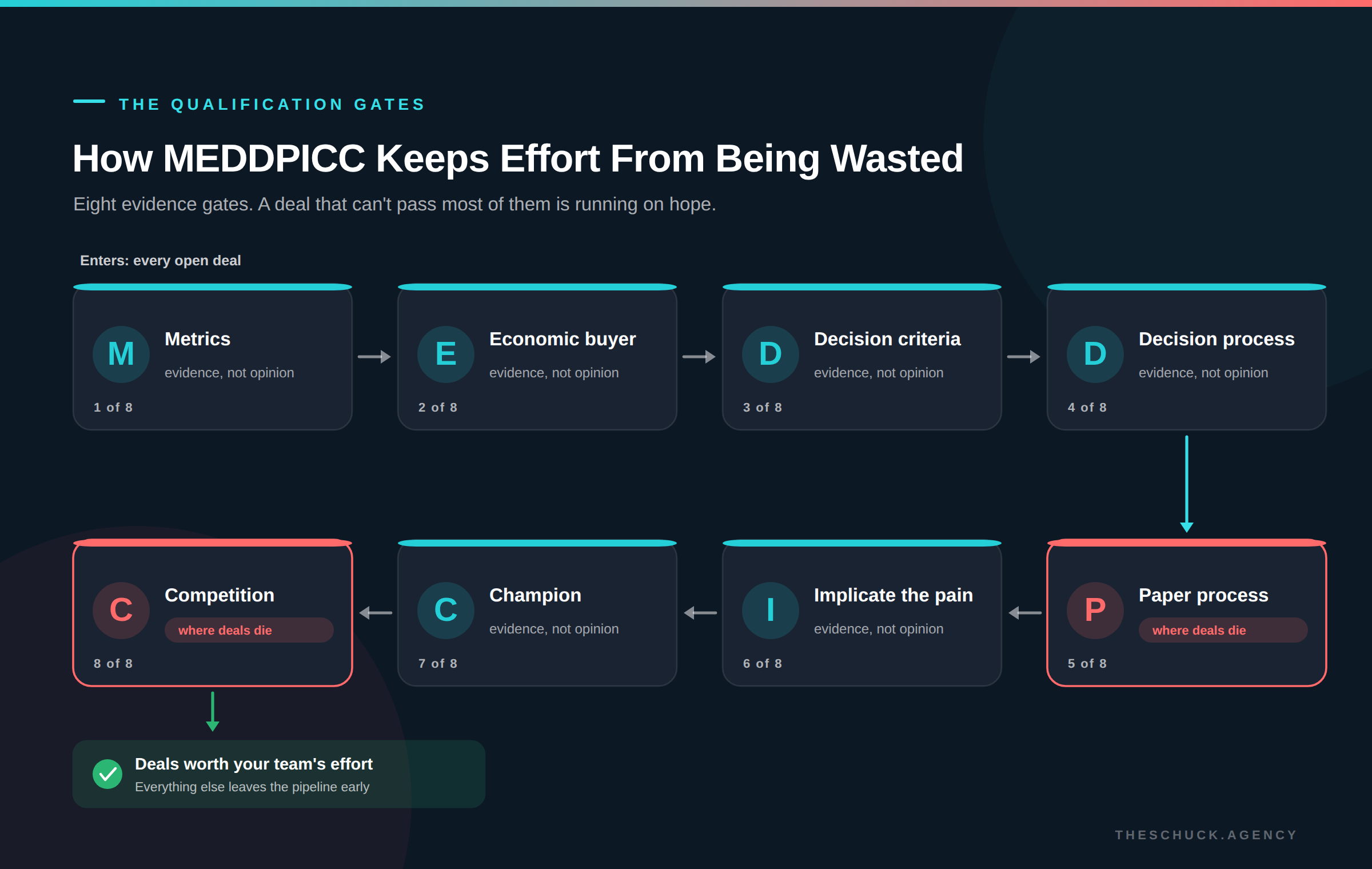
MEDDPICC is not a form to complete after a deal is already sitting in the pipeline. Used properly, it is a set of qualification gates that decide whether a deal deserves your team's effort in the first place, and when it is time to walk away. Each element names a specific piece of buyer evidence, and a deal missing several of them is a deal your reps are running on hope. The goal is not documentation. The goal is to make sure effort only flows toward opportunities that can survive real scrutiny.
- Metrics
- The quantified business impact the buyer expects to gain. Without a number the buyer owns, there is no real business case, and no reason for them to prioritize this decision over everything else competing for their attention.
- Economic buyer
- The person who actually controls the budget, engaged directly in the deal rather than referenced by a champion who plans to take it to them later. Deals that never reach the economic buyer are the ones that die in a final approval you never saw coming.
- Decision criteria
- The explicit standards the buyer will use to make the call. If you do not know the criteria, you are selling blind and hoping your strengths happen to be the ones that matter to them.
- Decision process
- The real sequence of steps, people, and dates that runs from evaluation to signature. When you cannot map the process, you are running the deal on your own assumptions about how they buy, and those assumptions are usually wrong.
- Paper process
- The procurement, legal, and security path a deal has to clear before it can close. This is where enterprise deals slip in the final weeks, and no activity metric will ever show it to you. Surfacing it early is often the single biggest lever you have on cycle time.
- Implicate the pain
- A real, quantified problem, with the cost of leaving it unsolved made explicit enough that the buyer will spend money and political capital now rather than later. Interest is not pain, and a deal whose pain has never been made to sting has no reason to close on any particular date.
- Champion
- Someone inside the account with genuine influence who advocates for you when you are not in the room, and who personally benefits from the deal getting done. A contact who simply likes you is not a champion.
- Competition
- Every alternative the buyer is weighing, including the one most teams forget: the status quo, the option to do nothing at all. Effort spent without knowing what you are truly up against is effort spent guessing.
Run any deal you are counting on against those eight, and the picture is immediate: the deals that cannot answer most of the questions are the ones about to slip. That is how you keep your team off deals with no chance of closing. Not by pushing everyone to work harder, but by making qualification honest enough that weak deals leave the pipeline early, so the time that is left compounds on the deals that can actually convert.
What this looked like at enterprise scale
Inside a global Fortune 500 sales organization, I led a transformation where this was the core problem: enormous activity across the regions, wildly inconsistent qualification underneath it, and a forecast leadership could not trust. Every region qualified differently, so "commit" meant one thing in one roll-up and something else in the next, and deals kept slipping in the paper-process and competitive stages that no dashboard was watching. We put a single qualification standard in place across the teams, rebuilt deal reviews to inspect evidence instead of activity, and made walking away from a deal a normal, expected outcome rather than a personal failure. The change was not that people worked harder, since many were already at capacity. Their effort simply stopped draining into deals that were never going to close. Forecast accuracy improved because a stage finally meant the same thing everywhere, and cycles shortened because the deals that could not clear procurement or beat the status quo were caught early instead of at quarter end.
The 8-Point Deal Qualification Test
Score any deal against the eight elements of MEDDPICC and see where the evidence is thin before it slips. A fast, self-scoring check your team can run in any deal review this week to tell a real opportunity from a busy one.
Run the ScorecardWhat to Fix First
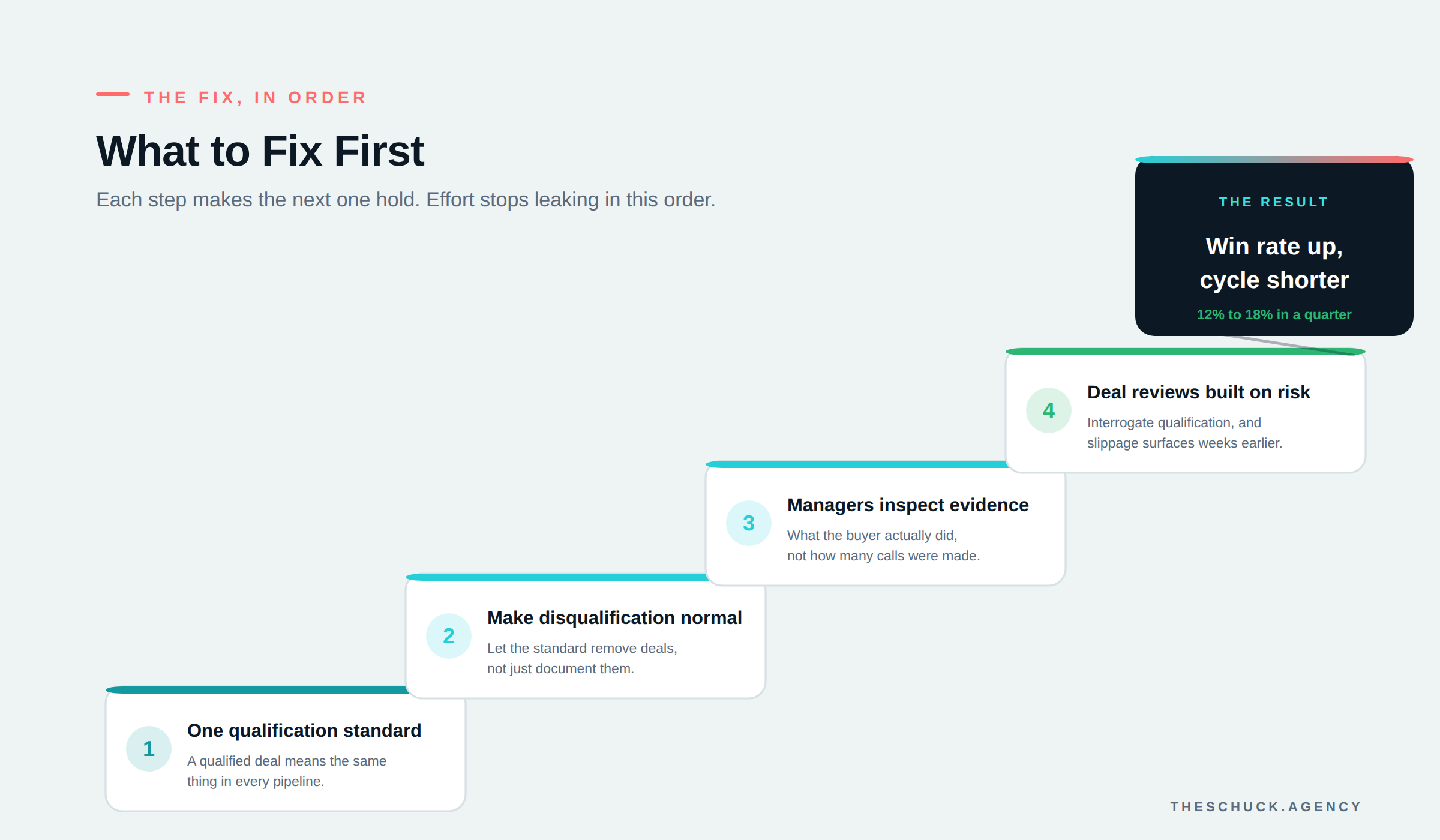
You cannot fix all of this at once, and you should not try. Effort stops leaking in a particular order, because each fix makes the next one hold. The fastest way to get this diagnosed and rebuilt with your own team in the room is a full-day intensive, but the sequence below is the priority order no matter how you approach it.
1. Adopt one shared qualification standard
Start by giving the whole team a single definition of what makes a deal real, so a qualified opportunity means the same thing in every rep's pipeline and every manager's roll-up. I use MEDDPICC because it covers the two stages where deals most often die, paper process and competition, which lighter frameworks tend to skip. A shared language is the foundation every other fix depends on.
2. Make disqualification a normal outcome
A qualification standard only works if it is allowed to remove deals, not just describe them. Set clear criteria for what gets a deal paused or killed, and treat walking away as a sound decision rather than a mark against the rep. Once disqualification is routine, effort stops pooling in dead deals and starts compounding on live ones, and win rate rises for no reason other than that the denominator finally reflects reality.
3. Retrain managers to inspect evidence, not activity
Managers are your enforcement layer, and most of them inspect activity because it is easy to count and easy to praise. Retrain them to ask what the buyer has actually done, the metrics, the economic buyer, the decision and paper process, rather than how many calls the rep logged. Adoption is won or lost in these reviews, one real deal at a time, because managers are what keep the pipeline honest between quarters.
4. Rebuild deal reviews and the forecast around risk
Finally, change what a deal review is actually for. Instead of a status update or a negotiation over commit versus best case, make it an inspection of the evidence and the risk inside each deal. When the review interrogates qualification, the forecast stops surprising you, slippage gets caught weeks earlier, and the number becomes one you can defend to your CFO and board. It is the same discipline that produces a pipeline that looks good and actually converts.
Diagnose before you prescribe. Qualify the deal before you pour the effort in.
Frequently Asked Questions
We're hitting activity targets but deals keep slipping. What's actually going on?
In almost every case it is a qualification issue rather than an effort issue. Your dashboards track motion, things like calls, meetings, and demos, which say nothing about whether a buyer truly intends to move. A hardworking team can fill the pipeline with deals that were never winnable, and those are the ones that slide at quarter end. Putting a shared qualification standard such as MEDDPICC in place lets you catch and clear those deals early, so the effort that remains goes to opportunities that can genuinely close.
Why do deals slip when our activity metrics look strong?
Because strong activity can sit on top of weak deals and hide them. A rep can hit every call and meeting goal while working opportunities built on curiosity rather than a costly, urgent problem, with follow-ups that only ever live on the rep's side. Those deals feel active but carry no real momentum of their own, so they drift until the quarter gets tight and then give way, usually in the procurement and competitive stages that activity reports never show.
How does MEDDPICC stop reps from wasting time on deals that won't close?
It turns qualification into eight concrete evidence checks: metrics, economic buyer, decision criteria, decision process, paper process, implicated pain, champion, and competition. A deal that cannot satisfy most of them is running on hope, and naming that early gives the team permission to let it go before it eats another quarter. Rather than spreading attention thinly across every open deal, reps concentrate on the ones that can pass, and that is what lifts win rates and shortens cycles together.
Is the problem my reps or my sales process?
Nearly always the process. Without a common qualification bar, without permission to disqualify, and with managers who review activity instead of evidence, even strong reps will produce a busy pipeline that slips. Coaching people to try harder inside that setup just yields a more confident version of the same miss. Durable improvement comes from the system around them: one qualification language, real criteria for walking away, and reviews built on buyer evidence.
What's the difference between activity metrics and pipeline quality?
Activity metrics describe what your team does, such as calls, meetings, demos, and emails. Pipeline quality describes whether the deals under that work are real: a confirmed and costly problem, an engaged economic buyer, a mapped decision and paper process, and a clear read on the competition. Activity is a useful early signal, but only quality predicts revenue. Manage to activity alone and you optimize how busy people look; manage to quality and you optimize what actually closes.
How fast can we improve win rates and shorten the sales cycle?
The diagnosis is quick, because the failure points repeat and a focused working session can surface them in a day. The gains come from adopting the standard, normalizing disqualification, and retraining managers to inspect evidence, which many teams feel within a quarter. The VP of Sales in the example above moved win rate from 12 to 18 percent in that window. A full-day intensive is built to compress that diagnosis into a single day and hand you the execution plan to keep the gains.
Why are my reps hitting activity goals but still missing quota?
Activity goals confirm that your reps are working, not that the deals they are working can close. When quota is missed despite green activity, the pipeline is usually full of opportunities that never had a confirmed economic buyer, a real decision process, or quantified pain. Qualify harder and the same effort lands on winnable deals, so attainment rises without adding headcount or activity.
Why does our pipeline look healthy but revenue keeps coming up short?
A pipeline can look healthy on volume and coverage while being weak on quality. If opportunities advance stages without buyer evidence, the coverage ratio is inflated by deals that will slip or die. Inspect each committed deal for economic buyer access, decision and paper process, and competition, and the real, closeable pipeline becomes visible.
What causes late-stage deal slippage?
Late-stage slippage almost always traces to two things that go uninspected earlier: the paper process (procurement, legal, security, and compliance) and competition. When those surface in the final weeks, they push deals into the next quarter. Qualifying the paper process and competitive position early is what keeps late-stage deals from sliding.
How do you improve win rate without increasing sales activity?
You improve win rate by raising the quality of the deals you pursue, not the quantity of activity. A shared qualification standard removes unwinnable deals early so reps concentrate effort where it can convert. Teams that do this usually lift win rate and shorten the cycle at the same time, because time stops leaking into deals that were never going to close.
Bring Me In for a Full-Day Intensive
One focused day on-site with your leadership and frontline team. We pressure-test live deals, pinpoint where effort is leaking and why deals are slipping, and build a concrete execution plan to raise win rates and shorten your cycle. Real deal reviews and a MEDDPICC qualification workshop run on your own pipeline, so you leave with a working plan rather than a slide deck.
On-site with your team · You leave with an execution plan, not a deck