Enterprise Sales Training: How to Diagnose and Close Your B2B Sales Talent Gap
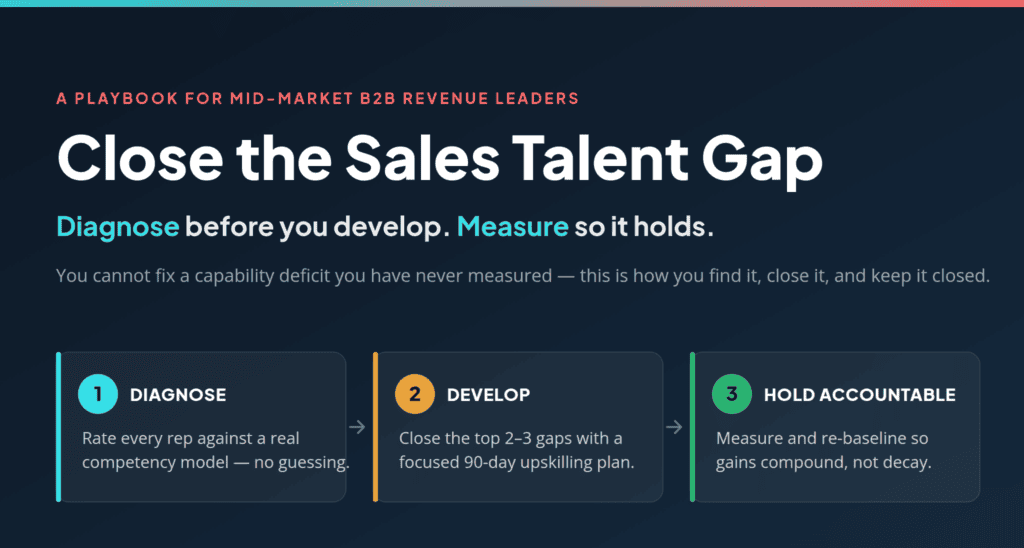
Effective enterprise sales training starts with a diagnosis, not a curriculum. Before you invest in another generic B2B sales training program, the question worth answering is whether your team’s performance gaps come from skill, from will, or from the systems around them — because each has a different fix, and training only solves the first. Getting that diagnosis right is the difference between a training budget that changes the number and one that just creates more busywork.
When a mid-market number comes in soft, the reflex is almost always the same. Leadership reaches for MORE — more activity, more pipeline coverage, more pressure, sometimes more hiring — on the assumption that the team is either not working hard enough or not big enough. It is the most expensive assumption in sales, because it treats a capability problem as an effort problem, and no amount of effort closes a skill gap. A rep who cannot build a business case for an economic buyer will not magically figure out how to build one by making forty more calls. They will just have forty more conversations that stall in exactly the same place.
I have spent twenty years inside revenue organizations, and the single most common thing I find when I audit a struggling team is not lazy reps or a broken market — it’s a set of specific, nameable capability gaps that have never been measured, so they have never been fixed. You can’t optimize what you can’t see, and gut feel is a terrible instrument for seeing it. This playbook gives you the instruments: a way to evaluate what your team can and cannot actually do, a 90-day plan to close the gaps that matter, and an accountability system so the improvement holds.
Identifying and closing a sales talent deficit is a three-part discipline. First you diagnose — rate every rep against a defined competency model, backed by evidence, and separate skill gaps from will and system problems. Then you develop — build focused 90-day plans that target the two or three competencies with the most revenue leverage, using deliberate practice on live deals rather than generic training. Then you hold it accountable — pair every competency with a leading and a lagging indicator, run a weekly-monthly-quarterly cadence, and re-baseline so gains compound instead of decaying.
What a B2B Sales Training Program Should Address for Enterprise Teams
The reason so much enterprise sales training fails to move the number is that it’s often brought in before the gap is truly understood. A generic B2B sales training program teaches the same content to everyone, whether or not it maps to how your team actually wins complex, multi-stakeholder deals. Effective enterprise sales training is built backward from the competencies that drive revenue in your specific sales motion — and for a mid-market team selling into enterprise buyers, eight of them matter most:
- Business & financial acumen — quantifying impact for the economic buyer
- Discovery & diagnosis — uncovering the real problem and cost of inaction
- Multi-threading — engaging the full buying committee
- Qualification & deal strategy — MEDDPICC-level rigor
- Value articulation — framing value against the status quo
- Negotiation & commercial command — holding margin under pressure
- Prospecting & pipeline generation — self-sourced, quality pipeline
- Forecasting & deal hygiene — evidence-based, reliable commits
Before you invest in any training, score your team against these eight — the evaluation toolkit below shows exactly how. That is what turns “sales training” from an expense into a targeted investment: you develop the two or three competencies that are actually costing you deals, not rollout a one-size-fits-all curriculum some outsider designed.
Why Sales Talent Deficits Stay Hidden
Talent gaps survive in mid-market teams because the numbers most leaders watch are lagging and aggregate — quota attainment, total pipeline, closed revenue — and by the time those move, the gap has already cost you a quarter. Worse, aggregate numbers hide as much as they reveal. Two reps can miss quota for completely different reasons: one is losing winnable deals late because they never reach the economic buyer, the other is filling the pipeline with deals that were never qualified in the first place. Same symptom, opposite disease, and a single blunt “they need to sell more” prescription makes both of them worse.
The other reason deficits hide is that we mislabel them. When a deal slips, it gets written up as a motivation or discipline issue far more often than it should, when the honest cause is that the rep genuinely did not know how to multi-thread a stalled account or quantify a cost of inaction. Before you can fix anything, you have to separate three very different things that all look identical on a dashboard: a skill gap (they don’t know how), a will gap (they know how but aren’t doing it), and a system gap (the process, tooling, or comp plan is quietly preventing the right behavior). Each one has a different remedy, and applying the wrong remedy is how leaders spend a year “developing” a team that never needed training in the first place.
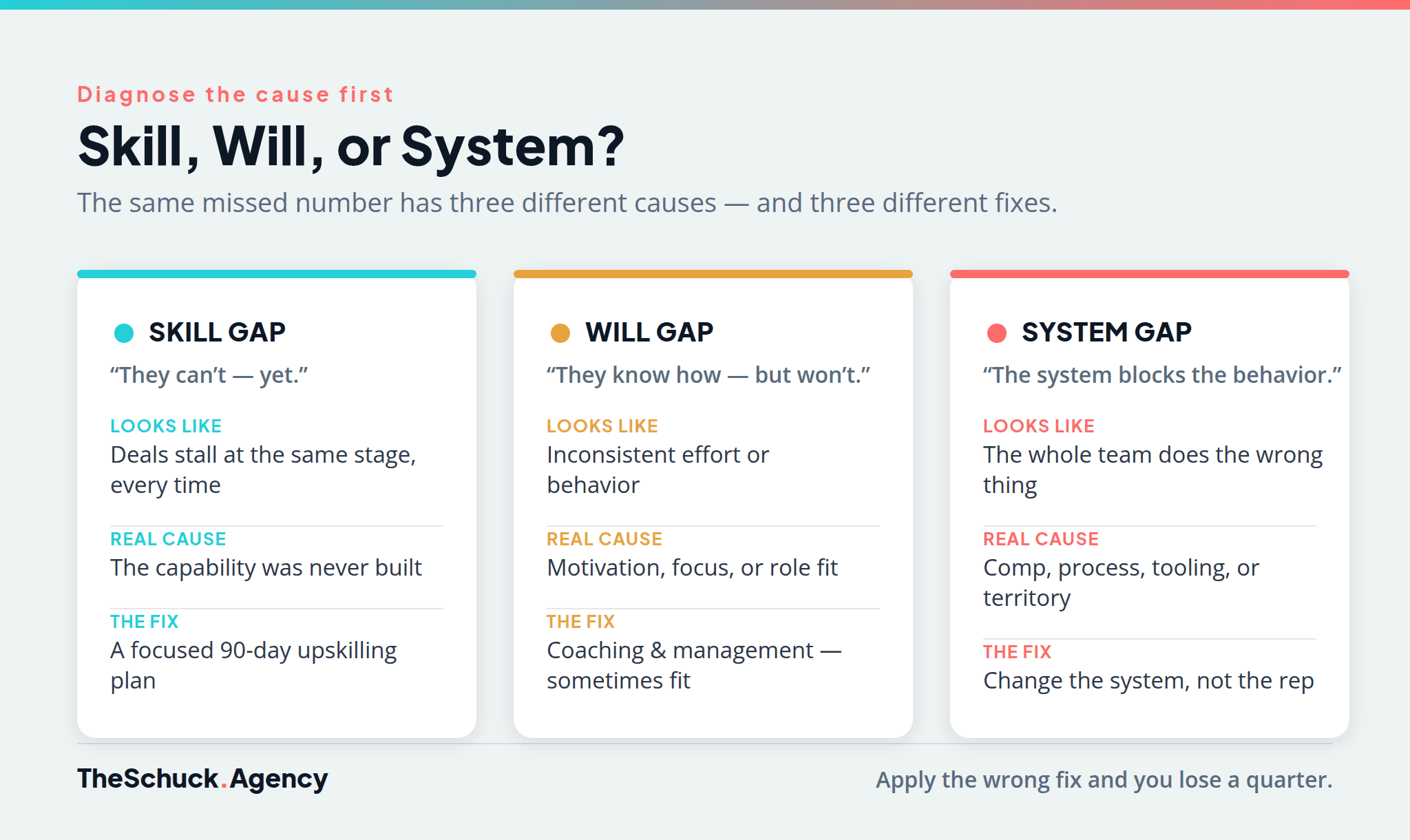
A capability problem treated as an effort problem just produces more of the wrong activity. Diagnose before you prescribe — every time.
The Sales Talent Evaluation Toolkit
A real evaluation is not a performance review and it is not a gut ranking of who you’d keep in a downturn. It is a structured read of what each rep can actually do, across the competencies that drive revenue in a complex B2B sale, backed by evidence you can point to. Done properly it takes a manager a few hours per rep, and it gives you something a quota report never will: a map of exactly where your revenue is leaking and why.
Step 1 — Rate against a competency model, not a vibe
Start with a shared definition of what “good” looks like. For a mid-market team selling complex, multi-stakeholder deals into enterprise buyers, capability lives in eight competencies that group into three domains — mastery of the buyer, execution of the deal, and the operating discipline that makes results repeatable. Rate every rep on all eight, and the aggregate becomes a heat map of your whole team.
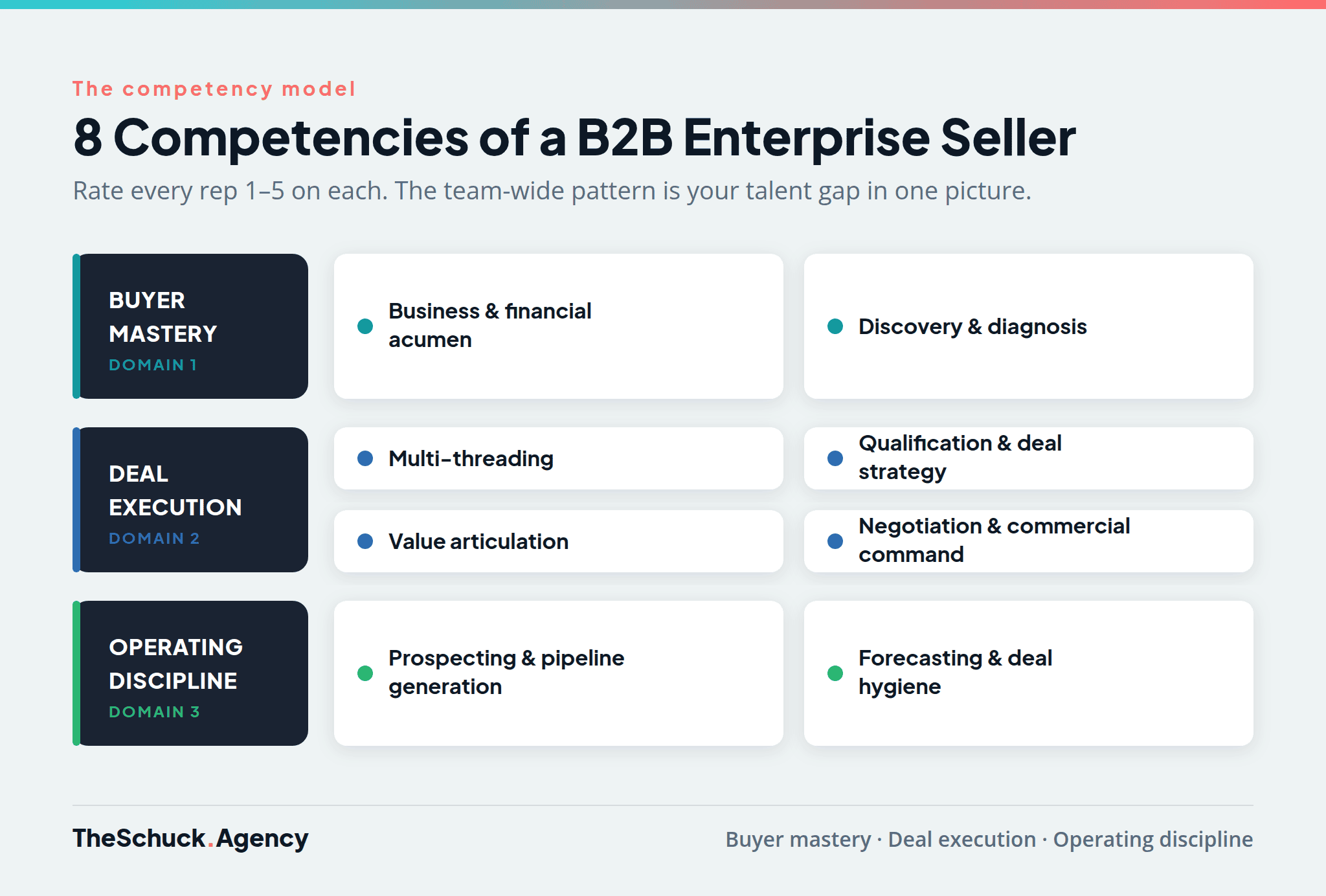
- Buyer MasteryBusiness & financial acumen
- Can the rep speak the buyer’s business — their metrics, their P&L pressure, their strategic priorities — and build a quantified business case an economic buyer will sign off on? This is the competency that separates a vendor from a peer, and its absence is why so many technically strong reps stall the moment a deal reaches finance.
- Buyer MasteryDiscovery & diagnosis
- Can they run discovery that uncovers the real problem and its cost, rather than a feature checklist? Strong discovery surfaces the cost of inaction — the buyer’s status quo is the true competitor in most complex deals — and a rep who can’t quantify “what happens if you do nothing” will lose winnable deals to no-decision.
- Deal ExecutionMulti-threading & stakeholder navigation
- Can they map a full buying committee and build relationships across it, reaching the economic buyer instead of just camping out with a single friendly champion? Single-threaded deals are the most common late-stage failure in enterprise selling, and this is the skill that prevents them.
- Deal ExecutionQualification & deal strategy
- Can they qualify with rigor — MEDDPICC-level discipline — and disqualify early so their time goes to deals that can actually close? A rep who can’t qualify fills the pipeline with “hope deals” – a rep who qualifies well creates forecasts you can count on.
- Deal ExecutionValue articulation & differentiation
- Can they frame value against the buyer’s alternatives — including doing nothing — and differentiate without leaning on a feature dump or a discount? This is what protects both win rate and price.
- Deal ExecutionNegotiation & commercial command
- Can they run a mutual close plan, hold margin under procurement pressure, and trade concessions for commitments instead of caving? Weakness here shows up as a discounting habit and quarter-end scrambles, not as a training request.
- Operating DisciplineProspecting & pipeline generation
- Can they self-source quality pipeline in their territory, not just work inbound? The question is quality, not raw volume — coverage built on unqualified activity is the thing that makes a pipeline look healthy right up until it doesn’t.
- Operating DisciplineForecasting & deal hygiene
- Do their CRM stages reflect buyer evidence, and are their commits reliable? A rep whose forecast you can trust is exercising a real competency and deal hygiene is the operating backbone that makes every other competency measurable.
Step 2 — Score 1–5 against behavioral anchors, backed by evidence
A rating is only useful if everyone means the same thing by it, so anchor the scale to observable behavior rather than impression. The point of the anchors is to force the honest question every score should answer: what’s the evidence? Pull it from call recordings, deal artifacts, CRM data, and win/loss patterns — not from how confident the rep sounds in a one-on-one.
| Score | What it means | Where you see the evidence |
|---|---|---|
| 1 · Absent | The behavior is missing; deals fail here repeatedly. | Lost/no-decision deals cluster on this competency in win/loss review. |
| 2 · Emerging | Inconsistent; works with heavy manager support. | Manager has to step into deals to supply the skill. |
| 3 · Competent | Does it reliably on standard deals, unaided. | Call reviews and deal notes show the behavior as routine. |
| 4 · Strong | Does it well on complex, non-standard deals. | Wins competitive or multi-stakeholder deals on this strength. |
| 5 · Teaches it | Sets the standard; can coach peers. | Other reps borrow their approach; a repeatable play. |
Step 3 — Separate skill, will, and system
For every low score, run it through one more filter before you decide what to do about it. Ask whether the rep can’t do it (a skill gap — the target of your 90-day plan), won’t do it consistently despite knowing how (a will or motivation gap — a coaching and management conversation, sometimes a fit conversation), or is being quietly blocked by the system (a system gap — a comp plan that rewards the wrong thing, a CRM nobody trusts, a territory that can’t support the target). Training a will problem breeds resentment; coaching a system problem burns credibility. This one filter is what makes the difference between a development plan that works and a year of wheel-spinning.
Step 4 — Roll it up into a team heat map
Individual scores tell you who to coach and the aggregate tells you what to fix systemically. Lay every rep’s eight scores into a grid and the pattern jumps out. A column that’s red across the whole team — say, business acumen or multi-threading — is not eight coaching problems, it’s an enablement, hiring-profile, or process problem, and it’s usually the highest-leverage thing you can address. A row that’s red for one rep is an individual plan. Reading the gap at both levels at once is what turns an evaluation into a strategy.
A gap that shows up for one rep is a coaching plan. A gap that shows up for the whole team is a leadership problem.
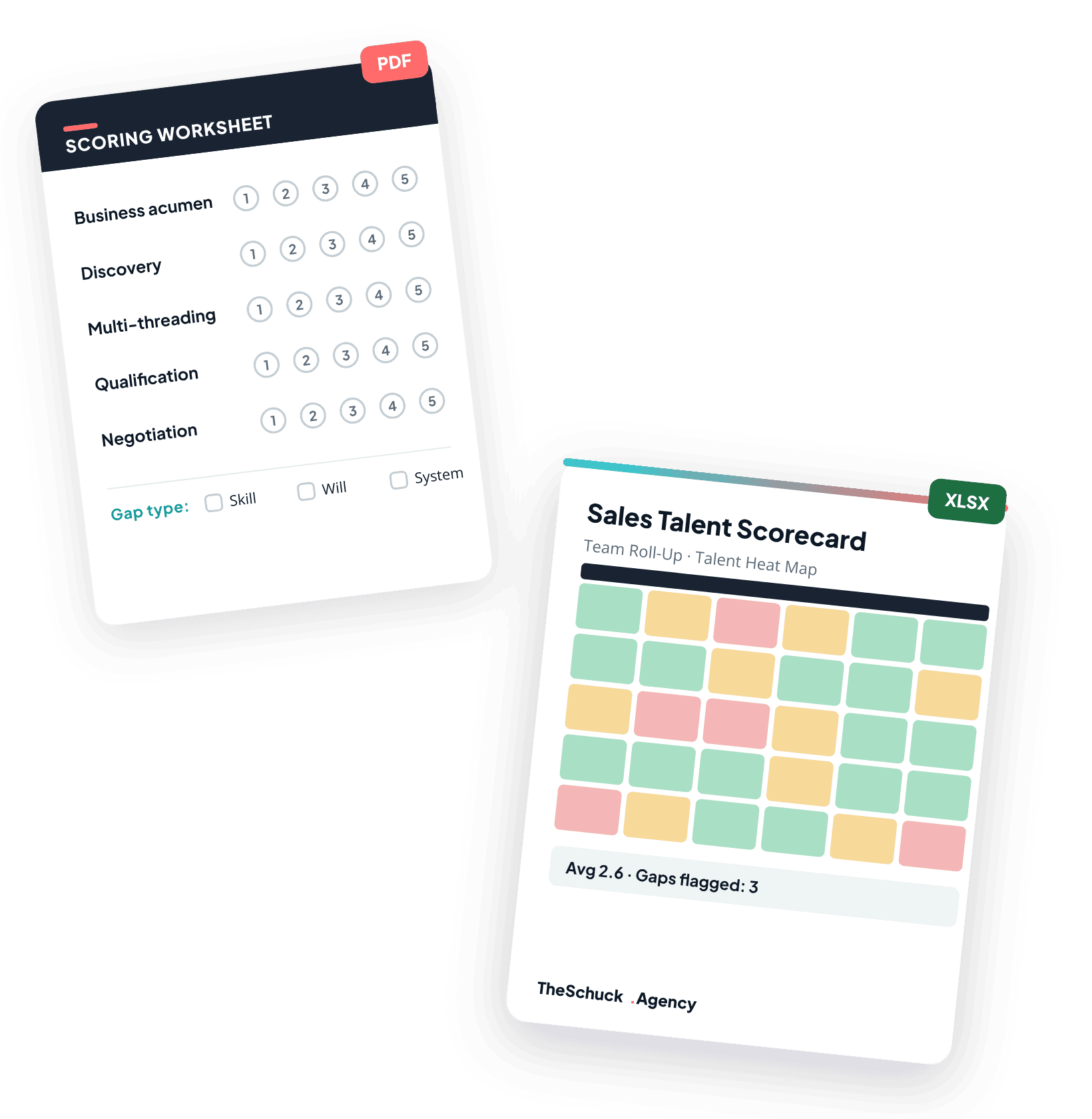
Get the Sales Talent Scorecard
Score each rep 1–5, auto-flag every gap, classify it as skill, will, or system, and spot team-wide gaps with the heat map — delivered as a fillable Excel scorecard and a printable PDF worksheet.
The 90-Day Upskilling Plan
A diagnosis you don’t act on is just an expensive spreadsheet. The 90-day window exists because it’s long enough to build real capability and short enough to hold urgency — a quarter is the natural unit of a sales team’s life. Two principles make or break these plans, and both go against instinct.
Focus beats breadth — pick two or three, not eight
The temptation, staring at a heat map full of gaps, is to fix everything. Don’t. A rep who is working on eight competencies is working on none of them. Capability is built through concentrated, deliberate practice, and that requires focus. Choose the two or three competencies with the most revenue leverage for that specific rep — usually where a gap is both large and sits on a high-value stage of your sales motion — and put everything behind those. The other gaps wait for the next cycle.
Deliberate practice on live deals, not a content binge
Skills are not transferred by watching a course or listening to lectures. They’re built by doing the thing, getting specific feedback, and doing it again. The best 90-day plans are built around a rep’s actual pipeline — the next real discovery call, the stalled deal that needs multi-threading, the negotiation coming up on Thursday — with the manager coaching against each rep before and after. Generic training has its place as an input, but the reps who improve are the ones practicing on Tuesday’s deal, not the ones who finished a video library.
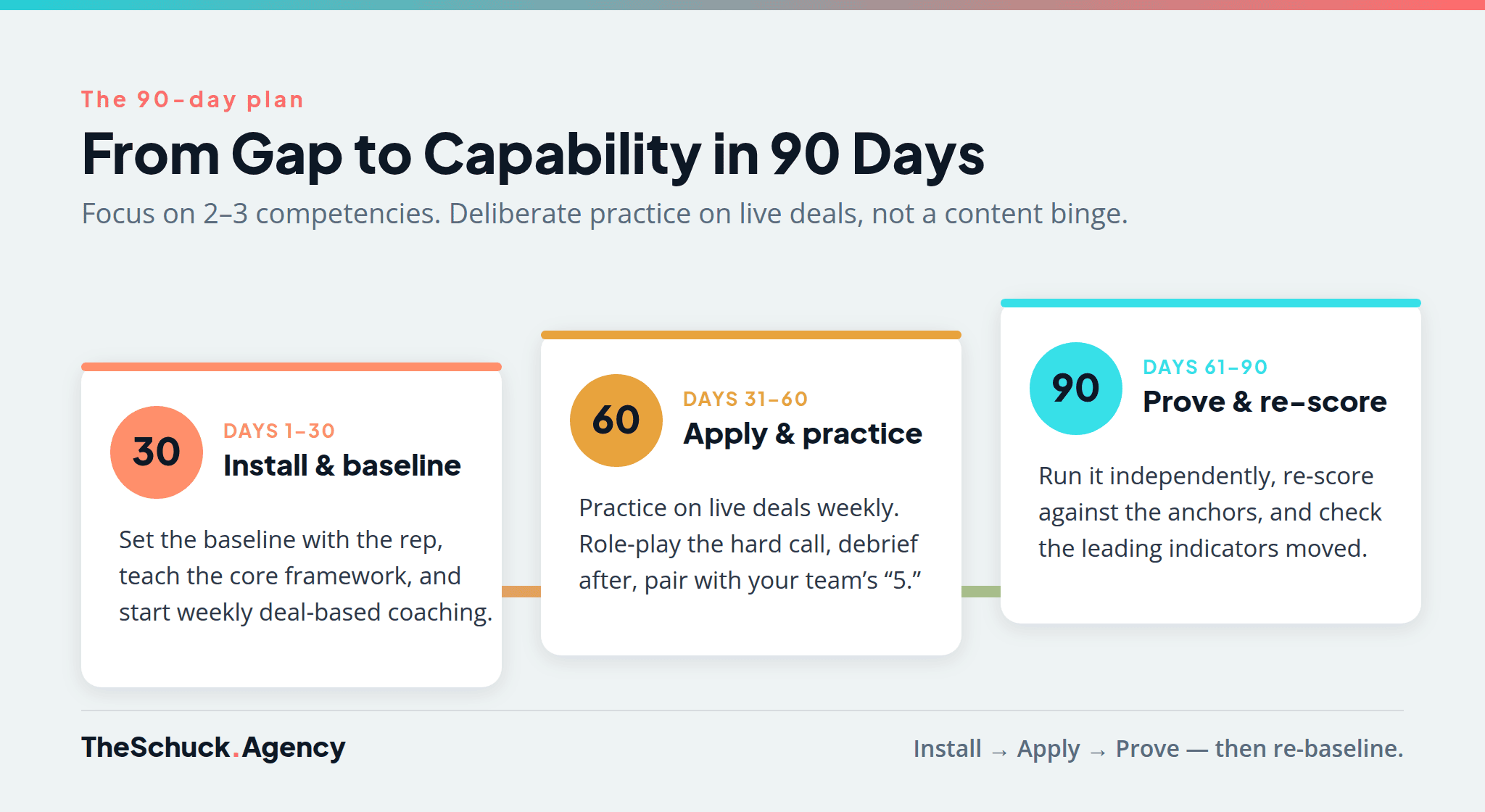
- Days 1–30Install & baseline
- Set the starting line and build the foundation. Confirm the baseline score with the rep so they own the gap, teach the core framework for each target competency, and start a weekly coaching cadence tied to their live deals. The output of month one is a rep who knows exactly what they’re working on and has done the behavior once, with support.
- Days 31–60Apply & practice
- Move from learning to reps. The competency gets applied on real deals every week — role-play the hard call beforehand, debrief it after, and use peer learning by pairing them with your “5” on that competency. This is where the skill actually gets built, and where the manager’s feedback has to be specific and frequent. The output is the behavior happening consistently on standard deals without prompting.
- Days 61–90Prove & re-baseline
- Test whether it holds under real conditions and no hand-holding. The rep runs the competency independently on live deals, you re-score them against the same anchors, and you check the leading indicators for movement. The output is a new baseline — a documented one-point gain on the target competencies — and the next cycle’s focus, chosen from what’s still red.
Use the builder below to turn your evaluation into a starting draft. Check the competencies you’re targeting and it assembles a focused 30/60/90 sequence you can adapt to each rep’s real pipeline.
90-Day Upskilling Plan Builder
Select the competency gaps you want to close this quarter. The builder assembles a focused 30/60/90 development sequence from the plays that move each one. Choose two or three for a rep — focus is what makes a plan work.
Select the gaps you want to target above.
Your 30/60/90 plan will build here as you select competencies.
Built for one rep at a time. Adapt each play to the rep’s live pipeline — deliberate practice on real deals beats generic training every time.
The Analytics & Accountability System
Capability that isn’t measured decays. Reps drift back to old habits, new hires arrive below the bar, and the gains from a great 90 days quietly erode unless the system holds them in place. Accountability isn’t about micro-managing — it’s about building the “muscle” and ensuring the improvements are visible and durable. The mistake most teams make is measuring only outcomes, which tell you what already happened when it’s too late to change it.
Pair every competency with a leading and a lagging indicator
Outcomes are lagging — win rate, deal size, quota attainment. They’re real, but they move slowly and they’re noisy. The leverage is in leading indicators: the observable behaviors that predict those outcomes, which you can see and coach in week one instead of in the QBR. For every competency you’re developing, name both — the behavior you’ll watch weekly and the outcome you expect it to move over a quarter.
| Competency | Leading indicator (watch weekly) | Lagging indicator (moves per quarter) |
|---|---|---|
| Business & financial acumen | % of deals with a quantified, buyer-validated business case | Win rate at finance/economic-buyer stage; average deal size |
| Discovery & diagnosis | % of opps with a documented cost of inaction | Discovery-to-opportunity conversion; no-decision loss rate |
| Multi-threading | Average engaged contacts per deal; economic buyer engaged (Y/N) | Late-stage slippage rate; win rate on competitive deals |
| Qualification & deal strategy | % of pipeline meeting the qualification bar (e.g. MEDDPICC) | Stage-to-stage conversion; forecast accuracy |
| Negotiation & commercial command | % of deals with a mutual close plan; average discount given | Realized margin; quarter-end discount concentration |
| Pipeline generation | Self-sourced qualified pipeline created (quality-screened) | Pipeline coverage that actually converts; ramp time |
| Forecasting & deal hygiene | % of stages backed by buyer evidence; CRM freshness | Commit accuracy vs. actual; forecast reliability |
Run the cadence — weekly, monthly, quarterly
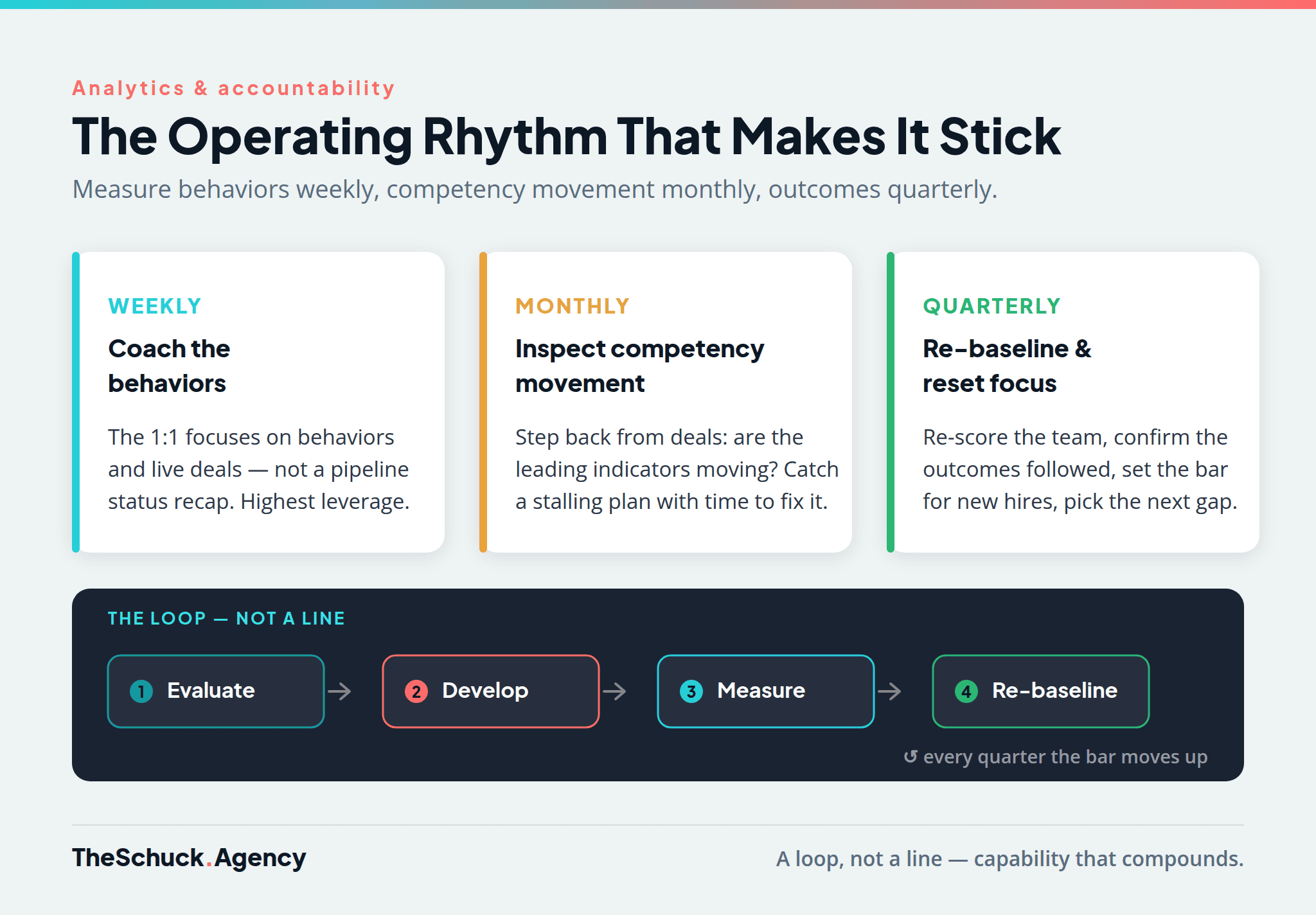
Accountability isn’t one and done, you need a documented cadence to keep momentum.
- WeeklyCoach the leading indicators
- The frontline manager’s one-on-one is where capability is actually built or lost. Spend it on the behaviors and the live deals where the target competency shows up — not a pipeline status recap. This is the highest-leverage hour in the whole system, and protecting it is non-negotiable.
- MonthlyInspect competency movement
- Once a month, step back from individual deals and look at whether the leading indicators are actually moving for each rep on plan. Are the behaviors becoming routine? Is the heat map shifting? This is where you catch a plan that isn’t working while there are still two months to adjust it.
- QuarterlyRe-baseline and reset focus
- Re-score the team against the competency model, confirm the outcome (lagging) indicators followed the behaviors, and choose the next cycle’s focus. This is also where you catch drift and set the bar for new hires. The quarterly re-baseline is what turns a one-time fix into a compounding system.
Putting It to Work
The frameworks here are enough to start on your own, and most of the value comes from simply doing the diagnosis honestly — most teams have never once rated themselves against a real competency model, and the first heat map is usually a revelation. This is also what separates enterprise sales training that works from the kind that gets forgotten by the next quarter: it is targeted at measured gaps, not bought off the shelf. Where I help revenue teams is turning this from a document into an operating system that holds: building the competency model to fit your actual sales motion, calibrating managers so the scoring is trustworthy, and wiring the cadence into your existing rhythm so it survives a busy quarter. Diagnose before you prescribe, build capability instead of dependency, and design it around your reality rather than a best-practice template — that’s the whole approach.
The goal isn’t a team that performs when you’re in the room. It’s a team whose capability compounds whether you’re there or not.
When to Bring in an Enterprise Sales Training Partner
You can run the first cycle of this yourself, and most teams should — the diagnosis alone changes how you think about the number. But there are three signals that it is time to bring in outside help rather than push through another quarter on instinct:
- The same capability gap shows up across multiple reps
- A weakness that repeats down a whole column of the heat map is not a coaching problem you can fix rep by rep — it is a hiring-profile, enablement, or process problem, and it usually needs a program, not a pep talk.
- Your managers can’t consistently coach the required behaviors
- The cadence is only ever as good as the managers running it. If your frontline can’t reliably coach discovery, multi-threading, or a business case, the plan stalls the moment you step away — and building that coaching muscle is its own piece of work.
- The 90-day plan needs to be embedded into your operating cadence
- Turning a framework into an operating system that survives a busy quarter — wired into one-on-ones, deal reviews, and the QBR — is the hardest part to do while also carrying the number yourself.
That is exactly the work of a 90-Day B2B Sales Audit and Analysis: diagnose the real capability gaps, build the focused development plan, and embed it into the way your team already runs — so the improvement holds after the engagement ends.
Frequently Asked Questions
What should an enterprise B2B sales training program include?
An enterprise B2B sales training program should be built on the competencies that actually drive complex, multi-stakeholder deals — not a generic curriculum. At minimum it should develop business and financial acumen, discovery and diagnosis, multi-threading, qualification and deal strategy, value articulation, negotiation, pipeline generation, and forecasting discipline. The most effective programs start with a skills assessment, target the two or three competencies with the most revenue leverage for each rep, and build capability through deliberate practice on live deals rather than one-off workshops.
How do you assess sales skills on an enterprise sales team?
Rate every rep against a defined competency model — the eight competencies that drive enterprise B2B deals — on a 1–5 scale anchored to observable behavior, backed by evidence from call recordings, deal artifacts, CRM data, and win/loss patterns. A structured sales skills assessment separates skill gaps (they can’t yet) from will and system problems, and rolls each rep’s scores into a team heat map so you can see whether a weakness is one person’s coaching need or a systemic gap. The scorecard in this guide runs exactly that assessment.
How do you build a 90-day sales training plan?
Focus beats breadth: pick the two or three competencies with the most revenue leverage for each rep instead of trying to fix everything. Structure the 90 days in three phases — install the framework and set a baseline in the first 30 days, apply it on live deals with weekly coaching in days 31–60, then prove it holds independently and re-score in days 61–90. Build the plan around the rep’s real pipeline, because deliberate practice on live deals beats generic sales training every time.
How do I know if it’s a sales talent problem or a market problem?
Look at the spread inside your own team before you blame the market. If a couple of reps are hitting their number while most miss, the market is closing for someone — the gap is capability, not conditions. A genuine market problem shows up as a uniform decline across nearly everyone, alongside external signals like lengthening cycles and rising no-decision rates industry-wide. The competency heat map settles it quickly: a market problem looks like flat performance everywhere, while a talent problem shows a clear pattern of specific competencies failing on specific people.
What’s the difference between a skill gap and a will gap, and why does it matter?
A skill gap means the rep doesn’t yet know how to do something — that’s what a development plan fixes. A will gap means they know how but aren’t doing it consistently, which is a coaching, management, and sometimes fit conversation, not a training one. The distinction matters because the wrong remedy backfires: putting a motivated-but-unskilled rep through pressure feels like punishment for something they can’t control, and putting an unmotivated-but-skilled rep through training wastes everyone’s time and insults their competence. Every low score should be run through this filter before you decide what to do about it.
Should I build my own competency model or use a standard one like MEDDPICC?
They do different jobs, so use both. A qualification methodology like MEDDPICC is one competency inside the broader model — it governs how rigorously your team qualifies and strategizes deals. The full competency model spans everything from business acumen to negotiation to pipeline generation. Start from a proven model like the eight competencies here, then tailor it to your actual sales motion; a transactional mid-market deal and a two-year enterprise pursuit weight these competencies very differently, and the model should reflect how you actually win.
Why 90 days — is that enough time to change anything?
Ninety days is enough to build real capability in two or three focused competencies, and it’s short enough to hold urgency and prove movement before conditions change. It is not enough to overhaul a rep across all eight competencies at once, which is exactly why the plan forces focus. Think of it as one turn of a repeating cycle rather than a finish line: you close the highest-leverage gaps this quarter, re-baseline, and target the next ones. Capability is built in concentrated cycles, not in a single all-at-once transformation.
How do I hold reps accountable without killing morale?
Accountability damages morale when it’s built on lagging outcomes people can’t directly control and surfaced only after they’ve already failed. It builds morale when it’s built on leading indicators — specific behaviors a rep can act on this week — and paired with real coaching support. The message shifts from “you missed your number” to “here’s the specific capability we’re building and here’s how I’ll help.” Reps rarely resent a clear bar with visible support; what they resent is being judged on fuzzy outcomes with no path to improve. Measure the behaviors, coach them weekly, and accountability becomes something the team wants rather than fears.
What if the gap is the same across my whole team?
Then you’ve found the single most valuable thing on the heat map, because a gap shared across the whole team is rarely eight coaching problems — it’s a systemic one. It usually points to your hiring profile, your onboarding and enablement, your sales process, or a comp plan quietly rewarding the wrong behavior. Fixing the system that produces the gap has far more leverage than coaching each rep individually against it. That’s the payoff of reading the evaluation at both the individual and the team level at once: the columns tell you what to fix in the system, the rows tell you who to coach.