Why Your GTM Strategy Looks Right but Revenue Still Misses
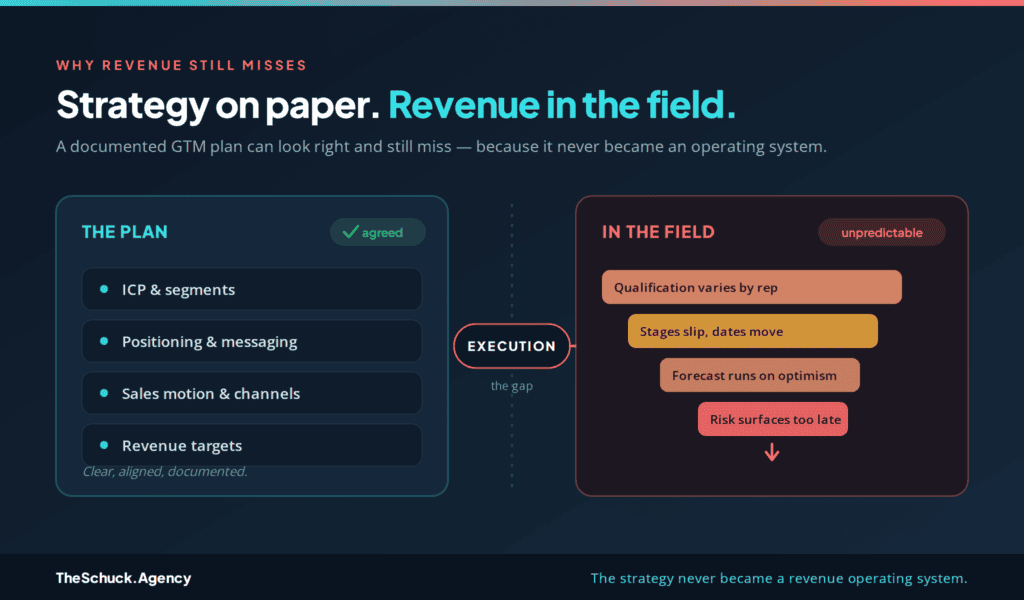
Most B2B leadership teams I work with do not have a strategy problem on paper. They have an execution problem in the field. The ICP is defined, the positioning is documented, the sales motion has been agreed to, and the dashboard is live — and yet the pipeline still does not convert the way leadership expected, the forecast keeps moving underneath everyone, and every missed quarter kicks off another round of blame between sales, marketing, and operations. On the surface it looks like the plan was wrong, but the plan is usually fine.
What is actually happening is that the strategy never became a way of operating. It stayed a document — clear in the board deck, invisible in the day-to-day — and a document does not produce predictable revenue. When a go-to-market strategy looks right and revenue still misses, it is almost always a sign that the strategy never became a revenue operating system. That gap between the plan and the operating rhythm is where predictable revenue quietly leaks out, and it is the thing this article is about.
A GTM strategy fails to create predictable revenue when it does not translate into consistent execution. Common causes include unclear qualification standards, weak pipeline governance, inconsistent sales stages, poor CRM adoption, disconnected sales and marketing handoffs, and leadership reviews that inspect activity instead of buyer evidence. The strategy can be sound; what is missing is the operating system that makes it repeatable week after week.
The strategy is not always the problem
It is tempting, after a couple of missed quarters, to reopen the strategy and start rewriting. Sometimes that is warranted. But far more often the strategy is directionally right — the market is real, the ICP is reasonable, the positioning holds up — and rewriting it just produces a fresh document that fails in exactly the same place the last one did. If you want the full breakdown of the pieces a sound strategy should include, start with my guide to what a GTM strategy is; this article picks up where that one leaves off.
Because what I want to talk about here is not what belongs in the plan. It is what happens after the plan exists, when the strategy is documented and agreed to and revenue still will not behave. That is a different problem, and it does not get solved with a better deck.
A GTM strategy has to become an operating system
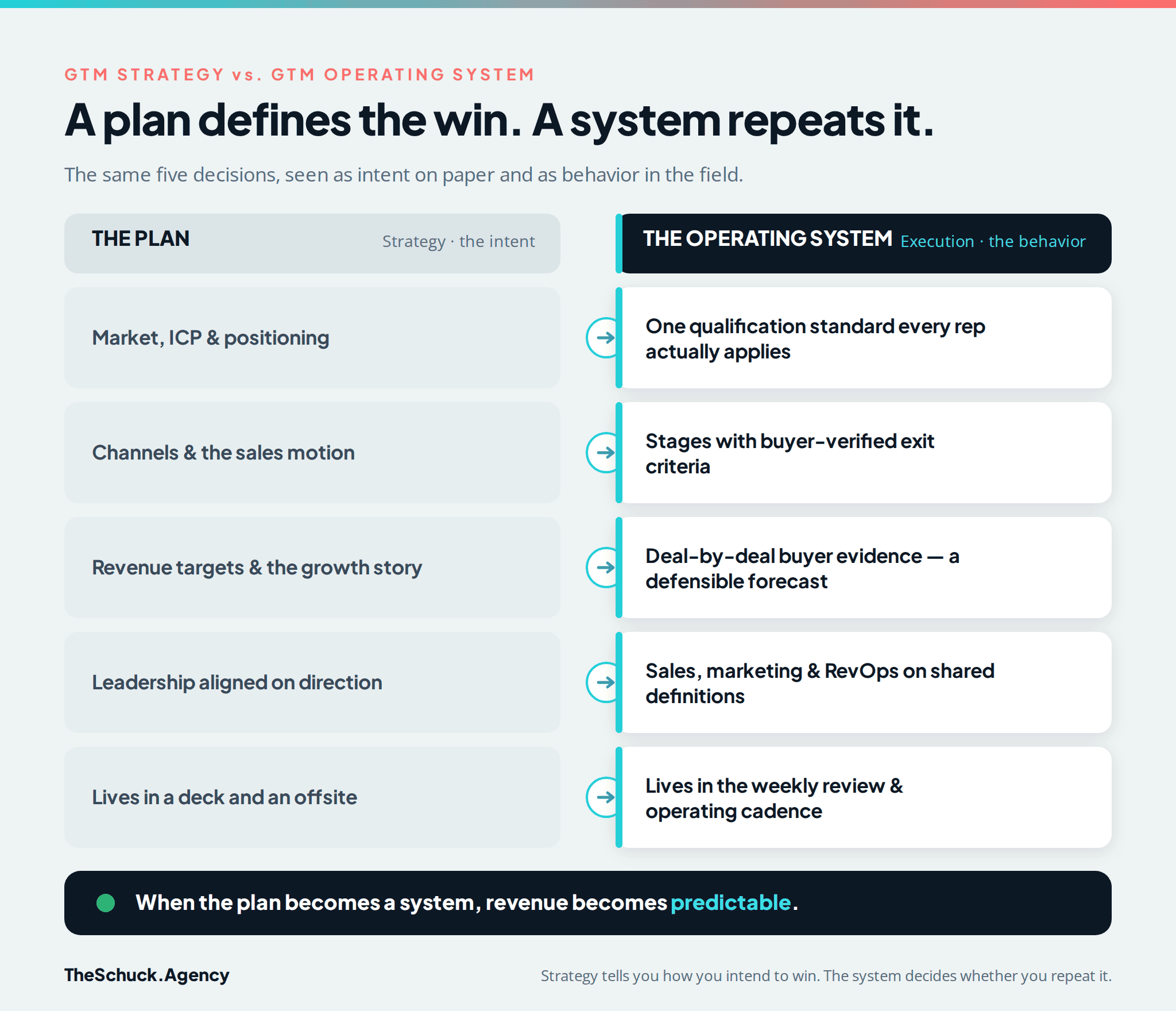
A strategy and an operating system are two different things, and most companies have invested heavily in the first and barely at all in the second. Strategy defines the market you are going after, the customer you are built for, how you position against the alternatives, the channels you will use, and the motion you will sell through. It is the intent. An operating system is what turns that intent into behavior — the qualification standards reps actually apply, the inspection leadership actually runs, the handoffs between functions, the data you can actually trust, the coaching that reinforces the standard, and the decision rhythms that catch risk before the quarter is gone.
Predictable revenue does not come from the intent. It comes from the system running the same way every week, so that a good quarter is repeatable rather than lucky and a bad one is diagnosable rather than mysterious. Strategy tells you where you are trying to go; the operating system determines whether the team can actually get there together, over and over, without a founder or a CRO personally dragging every deal across the line.
A GTM strategy tells the company how it intends to win. A GTM operating system determines whether the team can repeat that win.
Five reasons GTM strategies fail in execution
When I audit a revenue org where the strategy looks fine but the number keeps missing, the breakdown almost always sits in one of five places. They tend to travel together and reinforce each other, which is why a company can be doing a lot of things right and still not get predictability out of the system.
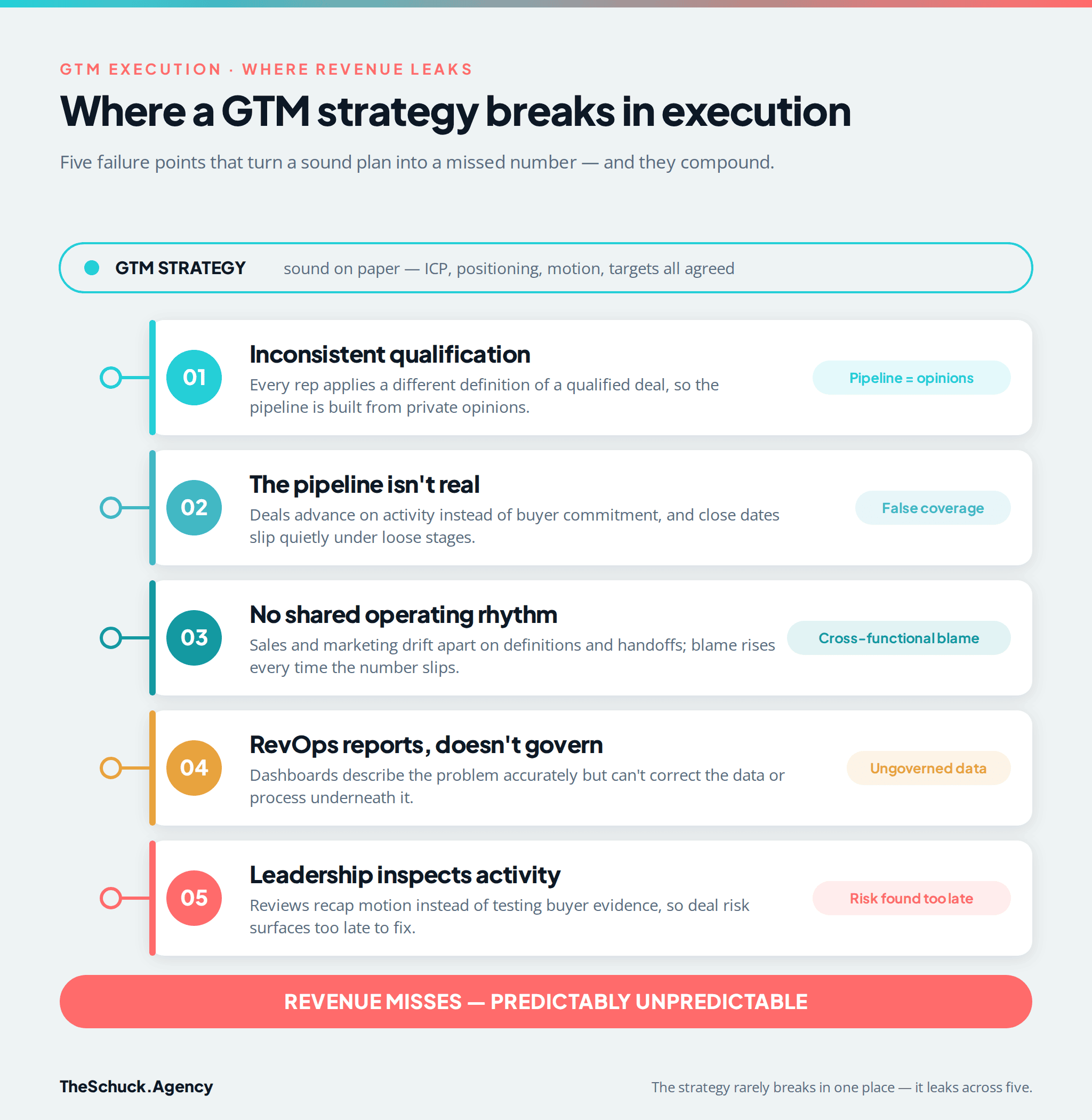
1. The ICP is defined, but qualification is inconsistent
You can write the sharpest ICP in the category and still watch it dissolve the moment deals enter the pipeline, because a definition on a slide is not the same as a standard the team applies. One rep qualifies on budget, another on interest, a third on whoever replied fastest. Managers coach to different evidence, the CRM captures activity rather than proof, and even when a methodology exists it is present on the wall without being operationalized in the deal. The result is a pipeline built out of a dozen private definitions of “qualified,” which is a very different thing from a forecast. Getting reps to a shared standard for buyer evidence in qualification is usually the first place I look.
If every rep has a different version of a qualified deal, the pipeline is not a forecast. It is a collection of opinions.
2. The pipeline looks full, but the revenue is not real
A healthy-looking pipeline is one of the most expensive illusions in B2B, because it buys confidence that the number does not deserve. Stage progression is too loose, so deals advance on activity instead of buyer commitment. Close dates are subjective and slip quietly. Deals sit in commit long after the evidence has gone cold because nobody wants to be the one to pull them. And leadership reviews pipeline totals — coverage ratios, stage counts — instead of the quality of the deals underneath, so the gap between what the pipeline says and what will actually close does not surface until the quarter is nearly over. I wrote about this failure mode in depth in why your pipeline looks healthy but revenue keeps missing, because it is that common.
Pipeline can look healthy while revenue misses when opportunities advance based on rep activity instead of buyer evidence. Coverage ratios, stage counts, and close dates may look strong in the CRM, but if qualification is inconsistent, sales stages lack clear exit criteria, and deal reviews do not inspect buyer commitment, the pipeline becomes a confidence signal instead of a forecast.
3. Sales and marketing agree in theory, but not in operating rhythm
Almost every leadership team will tell you sales and marketing are aligned, and almost none of them mean it operationally. Shared goals are not the same as shared definitions, and the two functions quietly optimize for different things — marketing for lead volume, sales for deal quality — while the definitions of MQL, SQL, pipeline, and revenue drift apart underneath them. Handoffs are not inspected, feedback loops run too slowly to correct anything, and RevOps rarely has the authority to govern the lifecycle definitions that would settle the argument. When the funnel lacks a shared source of truth, the blame between teams goes up every time the number goes down.
4. RevOps is reporting the system instead of governing it
In a lot of orgs RevOps has been positioned as a reporting function, and reporting describes reality without changing it. A beautiful dashboard on top of unreliable data just gives you a faster route to the wrong decision. CRM hygiene problems become leadership confidence problems; lifecycle stages, attribution, source tracking, and conversion reporting drift because no one owns the definitions; and tooling grows faster than the process clarity underneath it. RevOps should own the definitions, the fields, the process logic, and the inspection standards — not just publish what happened after it is too late to act on it. Real revenue operations governance is the difference between a system you can steer and one you can only describe.
RevOps should not just report the revenue motion. It should make the motion measurable, governable, and repeatable.
5. Leadership reviews activity instead of buyer evidence
This is the one that quietly undoes all the others. Forecast calls turn into status meetings, where managers ask “what changed?” instead of “what evidence do we have that this is real?” Deal reviews skip the questions that matter — the decision process, access to the economic buyer, the cost of the buyer doing nothing, the next action the buyer has actually committed to — in favor of a recap of rep activity. And because forecast accuracy is only ever as good as the inspection behind it, risk stays hidden until it is too late in the quarter to do anything about it. When leadership inspects motion instead of evidence, everyone downstream learns that motion is what gets rewarded, and a reliable sales forecast becomes impossible to build.
Symptom → root cause: a fast self-diagnosis
The five failure points show up as recognizable symptoms. If the one on the left sounds like your org, the execution failure on the right is usually where to look first.
| Symptom | Likely execution failure |
|---|---|
| Pipeline looks full but revenue misses | Stage progression is based on activity instead of buyer evidence |
| Reps qualify deals differently | ICP exists on paper but has not become an operating standard |
| Forecast keeps slipping late in the quarter | Deal reviews are not inspecting buyer commitment early enough |
| Sales and marketing blame each other | Funnel definitions and handoff standards are not governed |
| CRM data is complete but not trusted | RevOps is reporting the system instead of governing it |
| Leadership lacks confidence in pipeline reviews | The operating cadence rewards motion instead of evidence |
How to tell whether your GTM strategy is breaking in execution
Most leaders can feel that something is off long before they can name it. The signs below are the ones I use to separate a genuine strategy problem from an execution problem — and if more than two or three of them sound like your org, the issue is almost certainly the operating system, not the plan.
- Reps cannot explain qualification the same way when you ask them one at a time.
- Sales stages mean different things across teams, so “commit” is not a shared standard.
- Forecast calls depend on optimism and rep sentiment instead of buyer evidence.
- Marketing and sales disagree, often quietly, about what counts as a quality lead.
- CRM data is technically complete but not trusted enough to decide from.
- RevOps can report the problem clearly but cannot correct the underlying process.
- Leaders discover the deals at risk too late in the quarter to influence them.
- Pipeline coverage looks healthy, yet conversion stays stubbornly inconsistent.
Run the quick diagnostic below to see where your execution system is solid and where it is leaking. Check every statement you can honestly say is true today — the gaps are where predictable revenue is going.
GTM Execution Diagnostic
Check the statements that are genuinely true of your revenue org today — not what the strategy intends, but what actually happens in the field. The score tells you whether your strategy has become an operating system, or is still living in the deck.
This is a directional read, not a diagnosis — but the boxes you cannot check are usually exactly where revenue is leaking out of the plan.
What to fix first
You cannot fix all five failure points at once, and trying to is how these efforts stall. The order matters, because each fix makes the next one possible — and because starting downstream, with a new dashboard or a new comp plan, just decorates a system that is broken further up. This is the sequence I run with revenue teams.
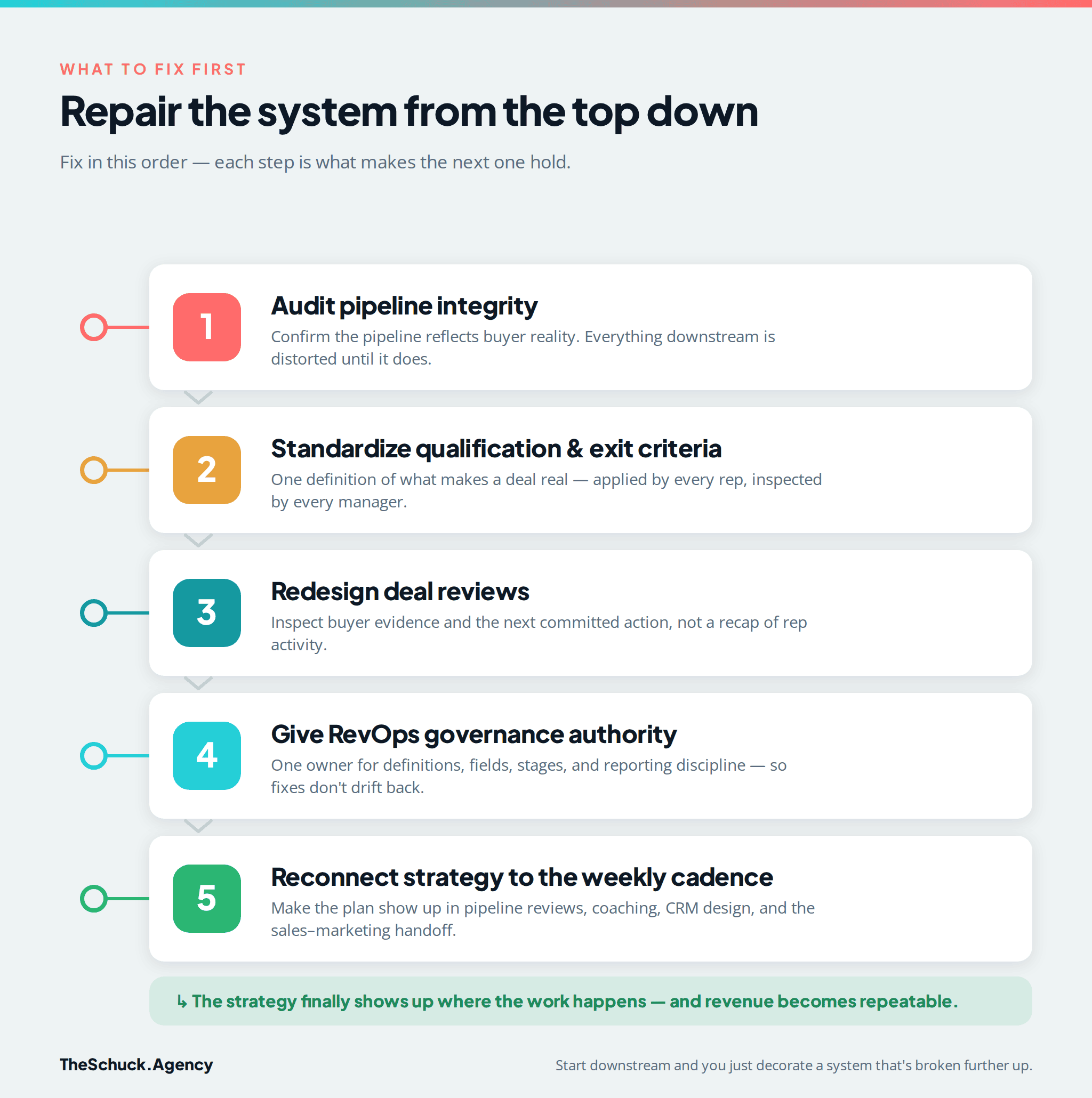
- 1. Audit pipeline integrity
- Start with whether the current pipeline reflects buyer reality, because everything downstream is distorted if it does not. Until you know which deals are real, every forecast, capacity plan, and hiring decision is built on sand.
- 2. Standardize qualification and exit criteria
- Define what must be true before an opportunity enters, advances, and reaches commit — one standard, applied by every rep and inspected by every manager. This is what turns a pile of opinions back into a forecast.
- 3. Redesign deal reviews
- Move the review from status update to evidence-based inspection. Leadership should be testing the decision process, economic buyer access, risk, and the next committed buyer action — not listening to a recap of activity.
- 4. Give RevOps governance authority
- Put one owner over definitions, lifecycle logic, CRM structure, and reporting discipline, so the system can actually be corrected instead of just described. Governance is what keeps steps one through three from drifting back out of alignment.
- 5. Reconnect strategy to the weekly operating cadence
- Finally, make the strategy show up where the work happens — in pipeline reviews, coaching, CRM design, the sales-and-marketing handoff, and leadership decisions. A strategy that never appears in the weekly cadence was never really adopted; this is what closes the loop between the plan and predictable revenue.
If you need to quantify the gap before auditing the operating system, start with the GTM Revenue Toolkit to model required pipeline, projected revenue from current lead flow, closed-won patterns, and ad-spend ROI — then use the audit to pressure-test the system that has to deliver it.
How TheSchuck.Agency approaches GTM transformation
GTM transformation does not start with a new strategy deck. It starts by inspecting whether the current strategy has become a repeatable operating system.
TheSchuck.Agency helps B2B leadership teams diagnose the gap between GTM intent and revenue execution by examining pipeline quality, qualification standards, sales stage integrity, forecast inspection, RevOps governance, CRM adoption, and the weekly leadership cadence. The goal is not to create more motion — it is to find where the system is leaking revenue and rebuild the operating rhythm that makes growth more predictable.
When to audit your GTM execution system
Not every rough quarter calls for outside help, and plenty of these fixes are ones a strong internal team can run on its own. But there is a recognizable pattern where the execution system itself needs an honest, outside look — usually because the people closest to it are too inside the machine to see where it is bending. The triggers I see most often:
- Revenue keeps missing despite a pipeline that looks more than healthy.
- Forecast accuracy is unreliable enough that you have stopped fully trusting it.
- Sales process adoption is low, and the methodology lives on the wall, not in the deals.
- Different reps qualify deals differently, and no one standard has held.
- Sales and marketing are back to blaming each other every time the number slips.
- CRM data is not trusted enough to make real decisions from.
- Leadership lacks confidence walking into its own pipeline reviews.
- Growth depends on hiring more reps instead of improving conversion.
When several of those are true at once, the answer is rarely another strategy deck. TheSchuck.Agency helps B2B leadership teams audit the execution system underneath the GTM strategy — pipeline quality, sales process adoption, RevOps alignment, CRM usage, deal inspection, and forecast reliability — and then rebuild the operating cadence that makes revenue predictable. The work is to diagnose before prescribing, fix the system in the right order, and build capability that runs without constant executive intervention. If you want to see where yours is actually breaking, that starts with a focused effort to audit the revenue execution system.
Frequently Asked Questions
Why does a GTM strategy fail?
A GTM strategy fails when it is not translated into consistent execution. The plan can be sound while revenue still misses, because the common causes sit downstream of strategy: unclear qualification standards, weak pipeline governance, poor CRM adoption, disconnected sales and marketing handoffs, and leadership reviews that do not inspect deal quality. In other words, the strategy stayed a document instead of becoming an operating system, and a document does not close deals.
Why does revenue miss when the pipeline looks healthy?
Revenue misses with a healthy-looking pipeline when opportunities are not qualified consistently, sales stages lack clear exit criteria, close dates are subjective, and leadership reviews pipeline volume instead of buyer evidence. Coverage ratios and stage counts create confidence the underlying deals have not earned, so the gap between what the pipeline says and what will actually close stays hidden until late in the quarter, when it is too late to fix.
What is the difference between GTM strategy and GTM execution?
GTM strategy defines who the company sells to, how it positions the offer, and how it plans to reach and convert the market — the intent. GTM execution is how that strategy becomes daily behavior: sales process, pipeline management, qualification, RevOps governance, CRM discipline, deal reviews, and the leadership cadence that inspects all of it. Strategy tells you where to go; execution determines whether the team can actually get there repeatably.
What is a GTM operating system?
A GTM operating system is the set of standards, definitions, and rhythms that turn a go-to-market strategy into repeatable revenue. It includes one shared qualification standard, sales stages with buyer-verified exit criteria, CRM fields that capture decision evidence, a deal review and forecast inspection cadence, RevOps governance over definitions and process, and a leadership accountability rhythm. Where a strategy is written once, an operating system runs every week — which is what makes revenue predictable rather than lucky.
How do you make a GTM strategy produce predictable revenue?
A GTM strategy produces predictable revenue when it is connected to a repeatable operating system. That means clear qualification standards, reliable pipeline data, consistent evidence-based deal reviews, RevOps governance over definitions and fields, and leadership routines that inspect execution risk before the quarter is over. The fastest path is usually to audit pipeline integrity first, standardize qualification, then rebuild deal reviews around buyer evidence — in that order, because each step makes the next one hold.
When should a company audit its GTM execution system?
A company should audit its GTM execution system when revenue is unpredictable despite pipeline volume, forecast accuracy keeps missing, pipeline quality is unclear, sales process adoption is low, CRM data is not trusted, or sales and marketing are no longer aligned around the same revenue definitions. Those are signs the breakdown is in execution rather than in the plan — and an execution problem does not get solved by rewriting the strategy.
