Fractional Chief Revenue Officer vs Chief Marketing Officer – Which to Hire?
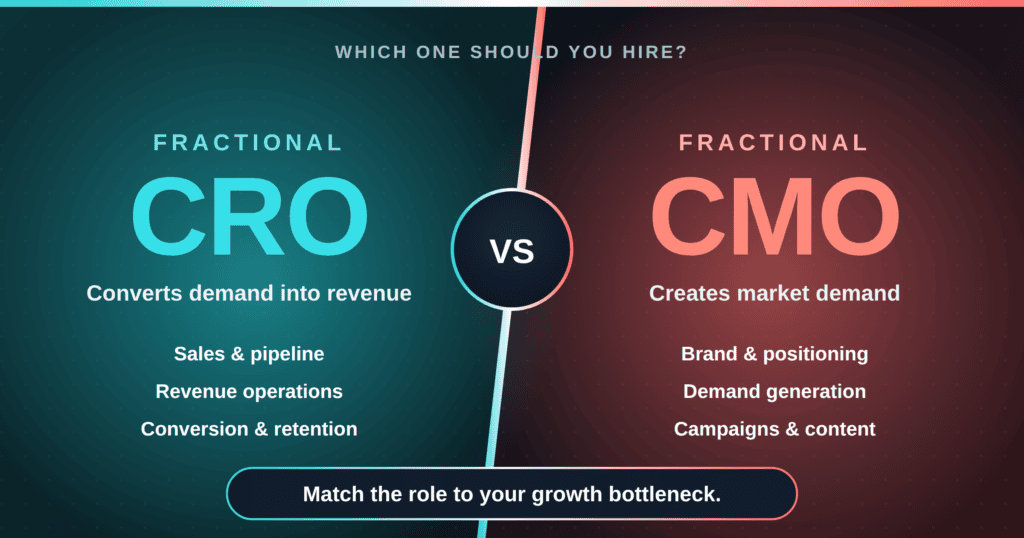
If you are scaling a B2B company, sooner or later you need senior growth leadership — but not always full-time, and not always in the same function. Two roles come up most often: a fractional Chief Revenue Officer (CRO) and a fractional Chief Marketing Officer (CMO).
They sound similar. They are not. A fractional CRO and a fractional CMO solve different bottlenecks, and hiring the wrong one wastes months of runway and budget you cannot get back.
This guide gives you a fast way to decide which one your business actually needs right now.
Hire a fractional CRO when your bottleneck is revenue execution: sales process, pipeline conversion, deal velocity, customer success, or revenue operations. Hire a fractional CMO when your bottleneck is market demand: positioning, brand clarity, lead generation, campaigns, or marketing infrastructure. If you have weak demand and weak conversion, start with the function creating the biggest near-term revenue constraint.
- The core difference (side by side)
- What a fractional CRO does
- What a fractional CMO does
- When to hire a fractional CRO
- When to hire a fractional CMO
- Quick diagnosis: which do you need?
- Can one leader cover both?
- Cost and engagement models
- Getting the most from fractional leadership
- Frequently asked questions
Fractional CRO vs CMO: The Core Difference
The simplest way to think about it: a CMO is responsible for creating demand, and a CRO is responsible for converting demand into revenue across the entire customer lifecycle. A CMO owns the top of the funnel. A CRO owns the whole revenue motion — sales, marketing alignment, customer success, and revenue operations.
| Question | Fractional CRO | Fractional CMO |
|---|---|---|
| Primary focus | Revenue growth across sales, marketing, customer success, and RevOps | Brand, positioning, demand generation, and marketing strategy |
| Best for | Companies with pipeline, conversion, pricing, sales process, or retention problems | Companies with unclear messaging, weak demand, poor awareness, or scattered campaigns |
| Core metrics | Revenue, pipeline, close rate, sales cycle, deal velocity, retention | Leads, CAC, conversion rates, awareness, marketing-sourced pipeline |
| Works across | Sales, marketing, RevOps, customer success | Marketing, brand, content, demand gen, campaigns |
| Hire when | You have demand but revenue is not converting predictably | You need more qualified demand or clearer market positioning |
In my work with B2B teams, the CRO vs CMO decision usually comes down to one question: is the company struggling to create demand, or struggling to convert the demand it already has?— Heather Schuck, GTM Strategy Consultant
What a Fractional CRO Does
A fractional CRO owns the full revenue motion on a part-time or interim basis. The job is to make revenue more predictable by aligning the functions that produce it — not to run marketing campaigns or sit inside a single department.
In practice, a fractional CRO typically works on:
- Sales process and pipeline — stage definitions, qualification, deal inspection, and forecast discipline.
- Conversion and velocity — why deals stall, where they leak, and how to shorten the sales cycle.
- Cross-functional alignment — making sure marketing, sales, and customer success operate as one revenue system instead of three silos.
- Revenue operations — CRM hygiene, reporting, and the data behind the forecast.
- Pricing, packaging, and retention — the levers that protect and expand revenue after the first sale.
The CRO lens is always the same: where is revenue getting stuck, and what change removes that constraint fastest?
What a Fractional CMO Does
A fractional CMO owns marketing strategy and demand. The job is to make sure the right buyers know you exist, understand what you do, and arrive with intent.
In practice, a fractional CMO typically works on:
- Positioning and messaging — who you are for, and why you are the obvious choice.
- Demand generation — the channels and campaigns that create qualified pipeline.
- Brand and awareness — standing out in a crowded category.
- Content and marketing infrastructure — the systems, team, and tooling that make marketing repeatable.
- Marketing measurement — CAC, channel performance, and marketing-sourced pipeline.
The CMO lens is about the market: are enough of the right buyers aware, interested, and coming to you?
When to Hire a Fractional CRO
A fractional CRO is the right call when demand exists but revenue is not converting predictably. The leads are coming in, but something between interest and closed revenue is broken.
Common signals it is time for a CRO:
- You have leads and pipeline, but deals stall or close inconsistently.
- Forecasting is unreliable and every quarter feels like a surprise.
- Sales, marketing, and customer success are misaligned or pointing fingers.
- Your sales process lacks structure, or handoffs and pricing are hurting growth.
- Retention or expansion is leaking revenue you already earned.
When to Hire a Fractional CMO
A fractional CMO is the right call when the core problem is demand. You may have a capable sales team, but not enough qualified opportunities reaching them — or the market does not clearly understand what you do.
Common signals it is time for a CMO:
- Your positioning is unclear, and prospects struggle to describe what you do.
- You are not generating enough qualified leads to hit growth targets.
- Your brand does not stand out in the category.
- Marketing activity is inconsistent, reactive, or hard to measure.
- You need campaigns, messaging, or a demand engine built from the ground up.
Quick Diagnosis: Do You Need a Fractional CRO or CMO?
If you are still unsure, run through both lists. Whichever side describes more of your reality is usually where your biggest near-term revenue constraint lives.
Choose a fractional CRO
if most of these are true- You have leads, but deals are not closing.
- Sales cycles are inconsistent or too long.
- Revenue forecasting is unreliable.
- Sales, marketing, and CS are misaligned.
- Pricing, packaging, or handoffs are hurting growth.
Choose a fractional CMO
if most of these are true- Your positioning is unclear.
- You are not generating enough qualified leads.
- Your brand does not stand out.
- Marketing is inconsistent or hard to measure.
- You need demand generation built from scratch.
Can One Leader Cover Both Roles?
Sometimes, yes — but with a caveat. Early-stage companies often benefit from a single senior growth leader who can see the whole picture: demand and conversion, marketing and sales, brand and revenue. A strong fractional CRO with marketing fluency (or a CMO with real revenue-side depth) can bridge both for a while.
The caveat is scale. As demand generation and revenue execution each become full, complex jobs, one person can no longer do both well. At that point, the hybrid leader's real value is knowing which function to build out first — and hiring into the gap deliberately rather than by default.
If you are early and resource-constrained, a hybrid growth leader is often the most efficient starting point. If you are scaling fast, be honest about when one role needs to become two.
Cost and Engagement Models
Fractional leadership is priced by the depth of involvement, not by title. Most engagements fall into one of three models. The right one depends on how much of the work your team can execute versus how much needs to be built or led.
| Engagement type | Typical use case | Best fit |
|---|---|---|
| Advisory | Founder needs strategic guidance and decision support | Early-stage teams with execution capacity |
| Part-time leadership | Company needs weekly leadership, planning, and accountability | Scaling teams without a full-time executive |
| Intensive transformation | Company needs GTM, sales, or marketing systems rebuilt | Teams with urgent growth or alignment issues |
Rather than anchoring on a monthly number, think in terms of investment level relative to the constraint. Advisory is the lightest touch; intensive transformation is the deepest. A good fractional executive will help you match the model to the problem instead of overselling the engagement.
Getting the Most From Fractional Leadership
A fractional executive is not a magic hire. The companies that get the most value do a few things well:
- Name the constraint first. Be clear about whether the problem is demand or conversion before you hire. A clear go-to-market view makes the choice obvious.
- Give real authority. A fractional leader needs the mandate to change process, not just advise from the sidelines.
- Align on outcomes, not hours. Define what success looks like — pipeline, forecast confidence, conversion, demand — and measure against it.
- Use their systems thinking. The lasting value of fractional leadership is the operating system they leave behind, not just the results during the engagement. The GTM Toolkit is a good starting point for that structure.
Frequently Asked Questions
A fractional CMO owns marketing and demand creation — positioning, brand, campaigns, and lead generation. A fractional CRO owns the full revenue motion — converting demand into revenue across sales, marketing alignment, customer success, and revenue operations. The CMO fills the top of the funnel; the CRO makes the whole funnel convert predictably.
Start with your biggest near-term revenue constraint. If you do not have enough qualified demand, hire a CMO first. If demand exists but is not converting into predictable revenue, hire a CRO first. If both are weak, choose the function that is costing you the most revenue right now rather than trying to fix everything at once.
At early stages, often yes — a senior growth leader with both marketing and revenue depth can bridge the two roles. As demand generation and revenue execution each become full, complex jobs, one person can no longer do both well, and the roles should split. The hybrid leader's most valuable contribution is knowing when that split needs to happen.
Fractional leadership is priced by depth of involvement rather than title. Engagements usually fall into three models: advisory (strategic guidance), part-time leadership (weekly leadership and accountability), and intensive transformation (rebuilding GTM, sales, or marketing systems). The right investment level depends on how much your team can execute versus how much needs to be built or led.
Companies that already have demand and a product buyers want, but where revenue is not converting predictably — typically post-product-market-fit teams scaling from early traction toward repeatable growth. That is the stage where sales process, forecasting, alignment, and revenue operations start to matter more than raw effort.
Companies whose main constraint is demand or positioning — often earlier-stage teams that need to clarify who they are for, stand out in the category, and build a repeatable demand engine before they can scale revenue. If the sales team is capable but starved of qualified pipeline, a CMO is usually the higher-leverage first hire.
It depends on the engagement model. Advisory relationships can run indefinitely at a light touch. Part-time leadership often lasts through a defined growth phase. Intensive transformation is usually time-boxed around a specific rebuild — long enough to install the systems and hand them off, not so long that the company becomes dependent on an outside leader.
Not sure where your growth is getting stuck?
Still unsure whether your bottleneck is marketing, sales, or revenue operations? Diagnose where revenue is getting stuck before you hire the wrong executive function.
Start With a Sales Audit Or begin with the GTM Decision Brief · Work with me