Sales Transformation: Why Most Initiatives Fail and How to Build One That Sticks
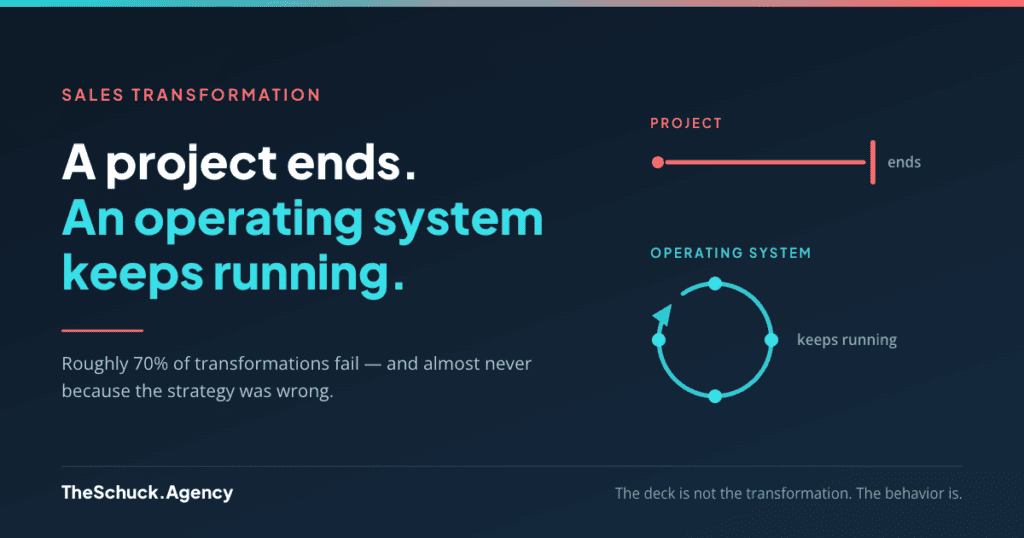
Most sales transformation programs are designed by people who will be gone before the results arrive. You have probably sat through the version I am describing — a phased roadmap, a maturity model, a timeline that made the board nod — and then watched twelve months go by with the pipeline looking more or less the way it always did, the CRM still half-filled, and reps still selling however they were selling before anyone presented anything. The deck was delivered, the retainer ended, and your team was left holding a framework nobody ever embedded into the way they actually work.
That experience is close to universal and it is not a reflection on your team. Writing in Harvard Business Review, citing McKinsey’s research, the failure rate for transformation efforts sits at roughly 70% — and the failures are rarely traced back to a flawed strategy or the wrong technology. They come from leadership that cannot read resistance, behavior that never actually changed, measurement that arrived too late to steer by, and organizations that were simply tired of being changed. For a CRO or a VP of Sales that distinction is the whole thing, because it means the work that decides the outcome is not the design of the program. It is what happens in the ninety days after the design is finished.
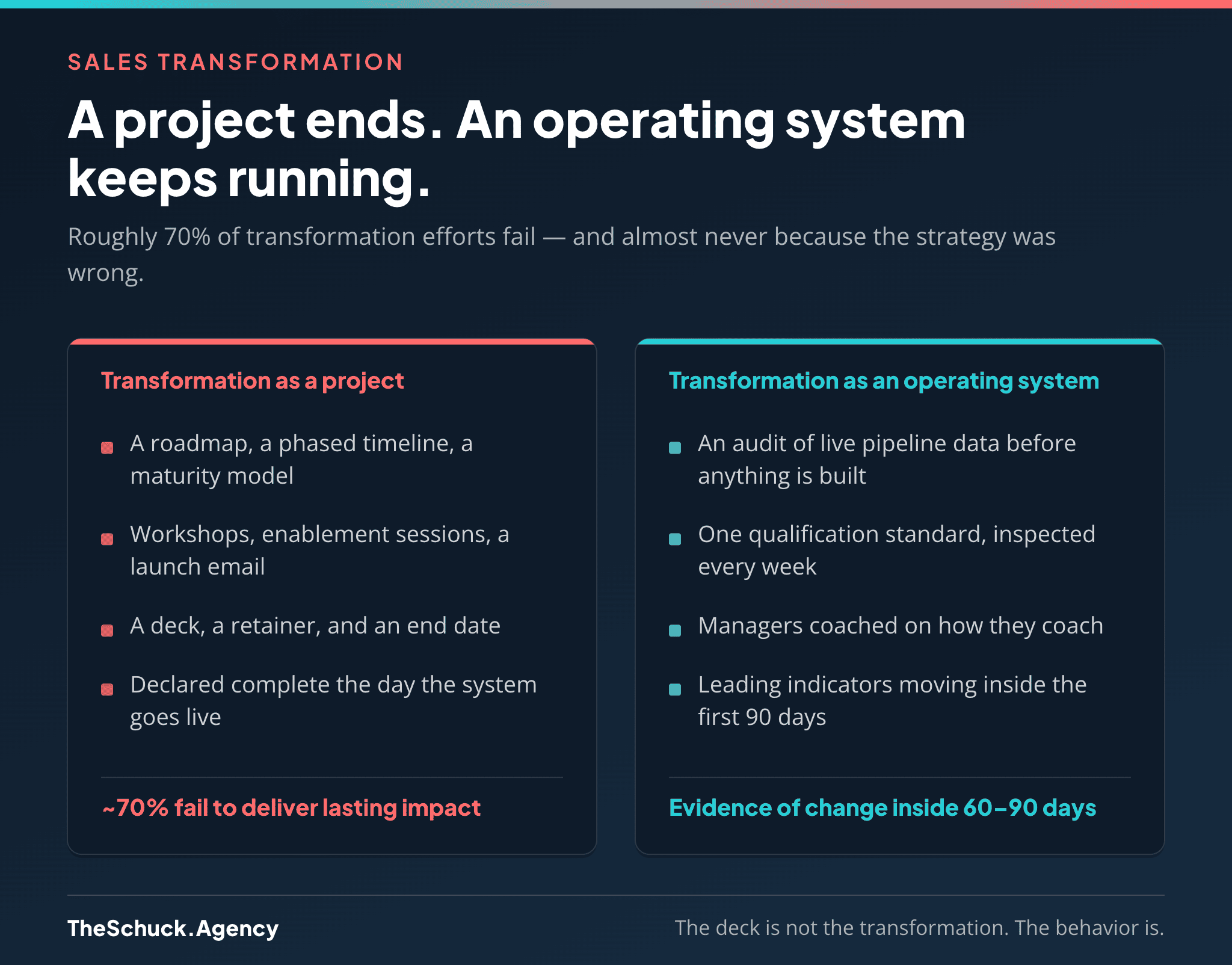
Sales transformation is the deliberate restructuring of the people, process, technology, and data systems that produce revenue. Most initiatives fail — roughly 70%, by HBR’s accounting — not because the strategy is wrong, but because the change never reaches the first-line manager layer, adoption is treated as a communications problem, and success is measured on lagging indicators that move long after the window to correct has closed. The ones that hold start with an audit of live pipeline data, sequence fixes by leverage instead of doing everything at once, and prove progress on 30, 60, and 90-day leading indicators.
Who this is for: CROs, VPs of Sales, and CEOs at B2B companies roughly between $10M and $100M in revenue who are living with a forecast they cannot trust, pipeline quality that swings from rep to rep, CRM data nobody makes decisions from, or a sales process that no longer matches how their buyers actually buy. If you are about to start a transformation, or have inherited one already in motion, it is written for that seat.
What sales transformation actually means
Sales transformation is one of the most overused phrases in revenue leadership, applied to everything from a CRM rollout to a complete go-to-market redesign, and that vagueness is part of why so many programs wander. The working definition I use with leadership teams is narrow on purpose: sales transformation is the deliberate restructuring of the people, process, technology, and data systems that drive revenue, with the goal of producing measurably better and more predictable outcomes over time.
Four components sit inside that definition, and they are load-bearing in a way that a single initiative rarely is.
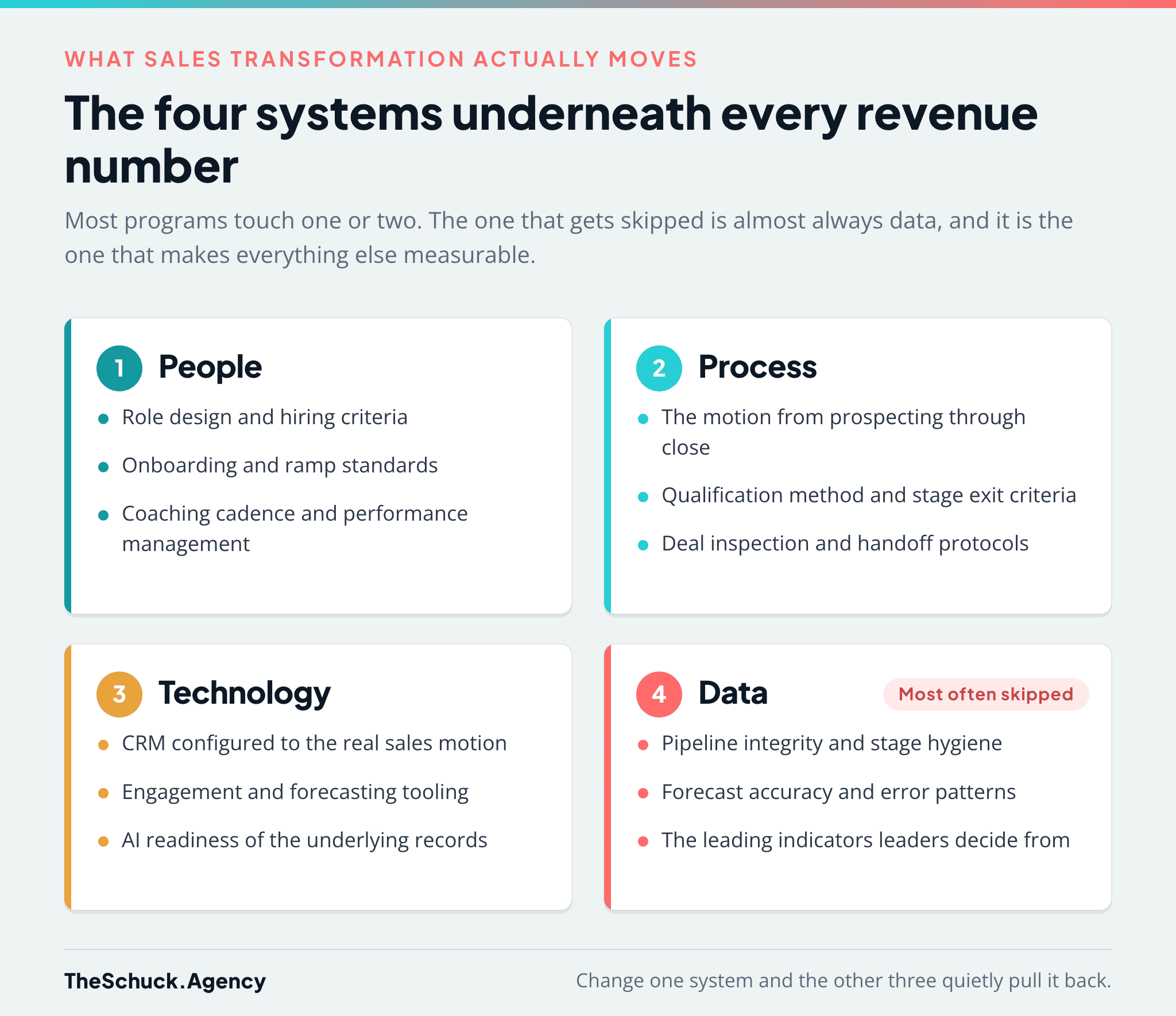
- People
- Role design, hiring criteria, onboarding and ramp standards, coaching cadence, and how performance actually gets managed rather than how the handbook says it does.
- Process
- The end-to-end motion from prospecting through close, including the qualification methodology, the exit criteria on each stage, deal inspection, and the handoff protocols between functions.
- Technology
- CRM configuration that matches how the team really sells, sales engagement tooling, forecasting systems, and whether the underlying records are clean enough for AI to do anything useful with them.
- Data
- Pipeline integrity, forecast accuracy, leading indicators, and the handful of metrics your team genuinely makes decisions from. This is the one that gets skipped, and without it every other change is something you can announce but not measure.
What sales transformation is not
Each of the following can be a component of a transformation. None of them is a transformation on its own, and conflating the part with the whole is how leaders end up declaring victory in month three and wondering in month nine why nothing moved.
- A methodology rollout — MEDDPICC, Challenger, SPIN — without the process redesign that would let it hold.
- A CRM migration with no adoption infrastructure underneath it.
- A new sales deck, a messaging refresh, or a repositioned pitch.
- A training event, however well designed and however good the facilitator was.
Why most sales transformations fail
The failure rate is not a mystery, and after enough audits the pattern stops being interesting and starts being predictable. The same five collapse points show up across company sizes, industries, and maturity levels, and they arrive roughly in this order.
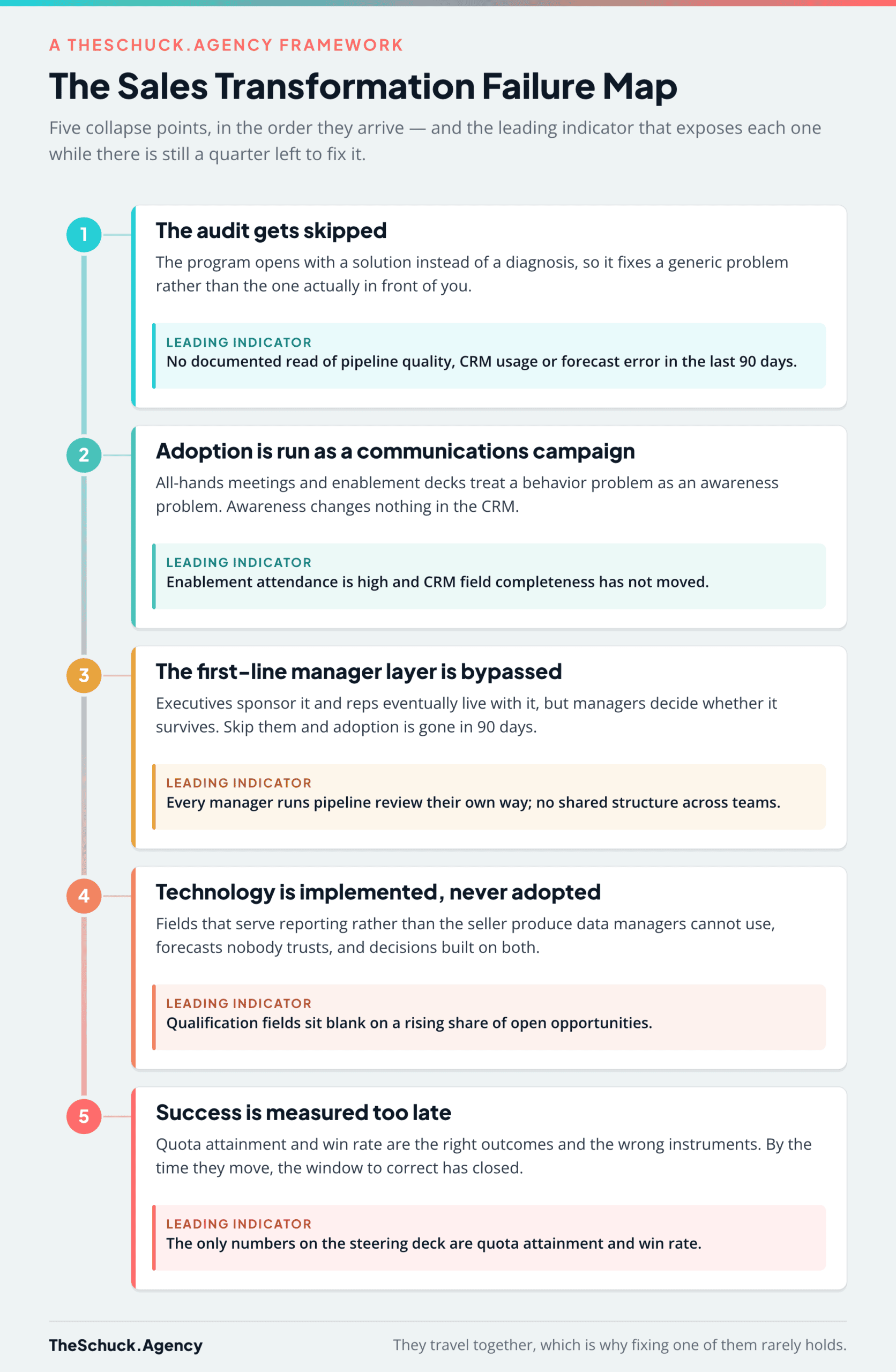
1. The audit gets skipped
Most transformation programs open with a solution rather than a diagnosis. A new CRO arrives carrying a preferred methodology, a board mandates the CRM overhaul it read about, or a firm proposes the framework it has delivered nine times before. What you get is a fix designed for a generic problem instead of the specific one sitting in your pipeline, and a broken forecasting process inside a product-led company looks nothing like the same symptom inside a field-sales organization even though the symptom reads identically on a dashboard. Diagnose before you prescribe. That means real access to live pipeline data, CRM usage patterns, and current-state process — not a round of leadership interviews that confirm what leadership already believes.
2. Adoption is treated as a communications problem
Gartner data reported in Harvard Business Review puts employee willingness to support enterprise change at 43% in 2022, down from 74% in 2016. That is not a morale problem and it is not a generational one. It is a rational response from people who have watched initiative after initiative launch loudly and die quietly, and who have learned that waiting out a change usually works. Most organizations answer that resistance with more communication — the all-hands, the enablement session, the launch email, the Slack announcement — which treats a behavior problem as though it were an awareness problem. Behavior moves when the new way is genuinely easier than the old way, when managers reinforce it in the room every week, and when the data starts proving it works. None of those three conditions is created by an announcement.
Reps do not resist change because they misunderstood the memo. They resist because they have seen how this usually ends.
3. The first-line manager layer is bypassed
CROs and VPs of Sales sponsor transformations and individual contributors eventually live inside them, but the people who decide whether any of it survives are the first-line managers running the weekly one-on-ones, leading the pipeline reviews, and coaching deals while they are still winnable. When a program treats that layer as a passive recipient of change rather than as the mechanism of it, adoption collapses inside ninety days with a predictability you could set a calendar by. The executive mandate fades, reps revert to what worked for them before, and managers quietly go back to running the cadence they already knew how to run. Investing disproportionately in managers is the single highest-return decision in most transformation programs, and it is the one most consistently underfunded — which is worth thinking about alongside the broader B2B sales talent gap that makes strong managers harder to find in the first place.
4. Technology gets implemented, never adopted
Analyst estimates of CRM failure vary widely — Johnny Grow’s CRM research puts it at 55%, and notes Gartner at 50% and Forrester at 47% — but they agree on the shape of the problem, and it is almost never the software. It is CRM fields that do not match the sales motion, data entry that creates friction for the seller while delivering value only to the reporting layer, and no consequence attached to non-compliance. The downstream sequence is mechanical: a CRM reps do not trust produces data managers cannot use, managers produce forecasts leadership cannot rely on, leadership makes decisions on those forecasts, and the credibility of the whole system degrades one quarter at a time. If your forecast keeps surprising you, the cause is usually sitting in the fields nobody wanted to fill in.
5. Success is measured too late
Most programs define success at twelve or eighteen months on quota attainment, pipeline coverage, and win rate. Those are the right outcomes and exactly the wrong instruments, because by the time a win rate moves the window to course-correct closed two quarters ago. The indicators that actually predict whether a transformation is going to hold move far earlier, and they are unglamorous enough that most programs do not bother tracking them at all.
- CRM data completeness and stage hygiene, inside 60 days.
- Manager coaching cadence adoption, inside 30 days.
- Rep methodology adherence scores, inside 45 days.
- The forecast accuracy trend — the direction, not the number — inside 90 days.
If those four are not improving in the first quarter, the transformation is already failing, whatever the steering committee slide says.
Why this is urgent now
The case for getting this right has rarely been stronger, because the current B2B selling environment is not a soft patch that waits out. Buying groups have grown, deal scrutiny has tightened, and individual seller productivity has been sliding for long enough that it now reads as structural rather than cyclical.
| What the benchmarks show | The reading | Source |
|---|---|---|
| Average B2B win rate | 29% in 2024, down to 19% in 2025 | Ebsta x Pavilion GTM Benchmarks |
| Sellers missing quota | 78% in 2024; 76% through H1 2025 | Ebsta x Pavilion GTM Benchmarks |
| Share of sellers producing 80%+ of new revenue | 14% | Ebsta x Pavilion GTM Benchmarks |
| Employee willingness to support change | 74% in 2016, down to 43% in 2022 | Gartner, via Harvard Business Review |
| Transformation efforts that fail | Roughly 70% | McKinsey, via Harvard Business Review |
Sources: Ebsta x Pavilion 2025 GTM Benchmarks; Harvard Business Review.
Those numbers tell a specific story, and it is not the one most boards are being told. Revenue at the company level has held up reasonably well across B2B, but it is being carried by a shrinking group of sellers while the average rep falls further behind — a decoupling that lets an organization keep hitting a number for a while on the strength of a handful of people and a favorable renewal base. That gap between company performance and seller performance is the transformation opportunity, because it means the revenue is arriving despite the execution system rather than because of it. When conditions tighten, the organizations without reliable execution infrastructure underneath them are the first to miss, and the window to build that infrastructure is well before the board asks for an explanation.
How durable sales transformations get built
The minority that succeed share a structure, and there is nothing proprietary about it. It is disciplined sequencing plus an embedded presence, which is the part most external programs are not designed to deliver. Audit first. Build second. Exit clean. What follows is the shape of the first ninety days; if you are running this inside a mid-market organization, my sales transformation framework for mid-market B2B companies walks the same sequence out at the company level.
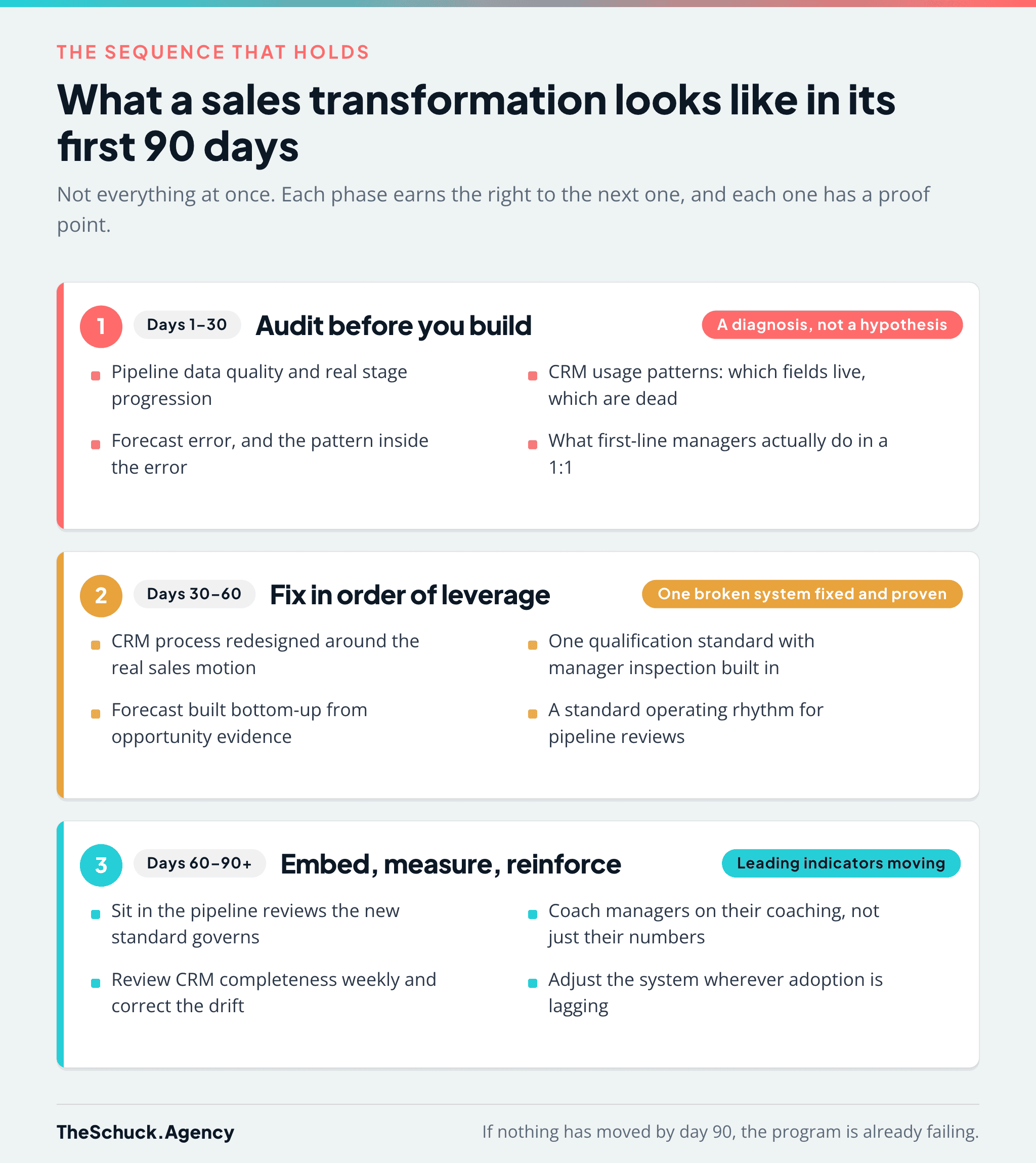
Phase 1: Audit before you build (Days 1–30)
The starting point is always a current-state assessment, and it is an audit rather than a survey. What you are looking for is the gap between the documented process and the one running in the field, which is only visible in the data itself.
- Pipeline data quality
- What share of open opportunities carry complete qualification data, and what does stage progression actually look like against what the playbook claims? This is usually where a pipeline that looks healthy starts telling on itself.
- CRM usage patterns
- Which fields are populated, which are dead, and what that pattern says about where process compliance is real and where it is theater.
- Forecast accuracy
- How far manager-submitted forecasts land from actual close, and more usefully, the shape of the error — whether it is consistent optimism, late-quarter slippage, or noise.
- Coaching infrastructure
- What first-line managers actually do inside a one-on-one, and whether there is any shared standard for what a deal review with leadership is supposed to test.
- GTM alignment
- Whether marketing, sales, and customer success are operating from the same ICP definition and the same handoff protocol, or three versions that have quietly drifted apart. The underlying GTM strategy is often sound; the operating definitions underneath it are where the drift lives.
The audit almost always surfaces a different problem than the one that prompted the conversation, which is exactly why skipping it is expensive. Organizations that go straight to the build spend real money solving the wrong thing well.
Phase 2: Fix in order of leverage (Days 30–60)
With a clear diagnosis the build becomes specific, and this is where most programs lose the plot by trying to move everything at once. Sequence by leverage instead: fix the highest-impact broken system first, prove it works with data, then expand from a position of credibility rather than a position of mandate. The starting points that earn their place most often:
- CRM process redesign aligned to the sales motion that actually exists, with field requirements that create value for the seller and not only for the reporting layer.
- Qualification methodology implemented with manager-level inspection built around it from day one — MEDDPICC, SPICED, or a custom framework, as long as one standard applies to everyone and gets tested weekly.
- Forecast infrastructure that produces a reliable weekly number from the opportunity level up, rather than a top-down figure reverse-engineered to the target.
- A manager operating rhythm that standardizes what happens inside pipeline reviews, deal coaching, and team meetings, so the standard survives a change of manager.
If process adoption has failed here before, that history matters more than the design of the new process. Teams remember what happened last time, and a second failed rollout costs more credibility than the first one did.
Phase 3: Embed, measure, reinforce (Days 60–90 and beyond)
The build is not the transformation. The transformation is what happens when the new systems become the way the team operates without anyone naming them, and getting there takes presence rather than documentation — sitting inside pipeline reviews, coaching managers on their coaching, reviewing CRM data weekly, and adjusting the system wherever adoption is dragging instead of adding another training session on top of it. The signals that tell you it is taking hold:
- Forecast accuracy improving week over week, and the error pattern getting narrower.
- CRM data completeness above 85% on active opportunities.
- Managers running structured pipeline reviews to a consistent standard across teams.
- Win rate trending up in the 90 to 120-day window, after the leading indicators moved.
What separates an embedded operator from an external consultant: an external program delivers a plan and leaves. An embedded operator stays inside the system long enough to see where the plan breaks against reality, and fixes it before the quarter is gone.
How to diagnose where your transformation stands today
Whether you are opening a transformation or inheriting one already in motion, the same questions apply, and they are worth answering honestly before committing to a direction. Ten of them, grouped by where the answer lives.
- On diagnosis
- 1. Do you have a documented audit of current-state pipeline quality, CRM usage, and forecast accuracy from the last 90 days? 2. Can you explain, with data rather than anecdote, why deals are being lost?
- On process
- 3. Is there a written sales process that maps to how reps actually sell, rather than how leadership wishes they would? 4. Do all reps use the same qualification methodology consistently, and how would you know if they did not?
- On technology
- 5. What percentage of active opportunities in your CRM carry complete qualification data? 6. Is your forecast built from opportunity-level evidence or from manager intuition?
- On people
- 7. Do your first-line managers have a standard operating rhythm for pipeline reviews and deal coaching? 8. When did you last sit in on a manager’s one-on-one with a rep?
- On measurement
- 9. What are the three leading indicators you track weekly that tell you whether you will hit the number? 10. Has your forecast accuracy improved, held flat, or declined across the last two quarters?
If you cannot answer five or more of those with specifics, the transformation has not started yet regardless of what has been announced or spent. That is not a criticism of anyone. It is the most useful piece of information available to you right now, and it is cheaper to learn in September than in January.
The diagnostic below turns the same questions into a live read. Check every statement you can honestly say is true of your organization today — not what the program intends, but what happens in the field this week.
Sales Transformation Readiness Diagnostic
Eight conditions that separate a transformation that embeds from one that gets announced. Check the ones that are genuinely true today. The score is a directional read on whether your program is changing behavior or changing slides.
A directional read, not a diagnosis. The boxes you cannot check are the ones that decide whether any of this survives the next busy quarter.
Take it with you
The Sales Transformation Readiness Scorecard
The same eight conditions, on one printable page — built to score independently with your VP of Sales and a first-line manager, then compare. The gaps between your three sheets usually say more than the total does.
You’ll also get the GTM Decision Brief. Unsubscribe any time.
What to look for in a transformation partner
If you are bringing in outside help, the selection criteria matter at least as much as the program design, because most firms sell transformation and far fewer are willing to operate inside one. Five questions separate them quickly, and the answers are usually given away in the first conversation.
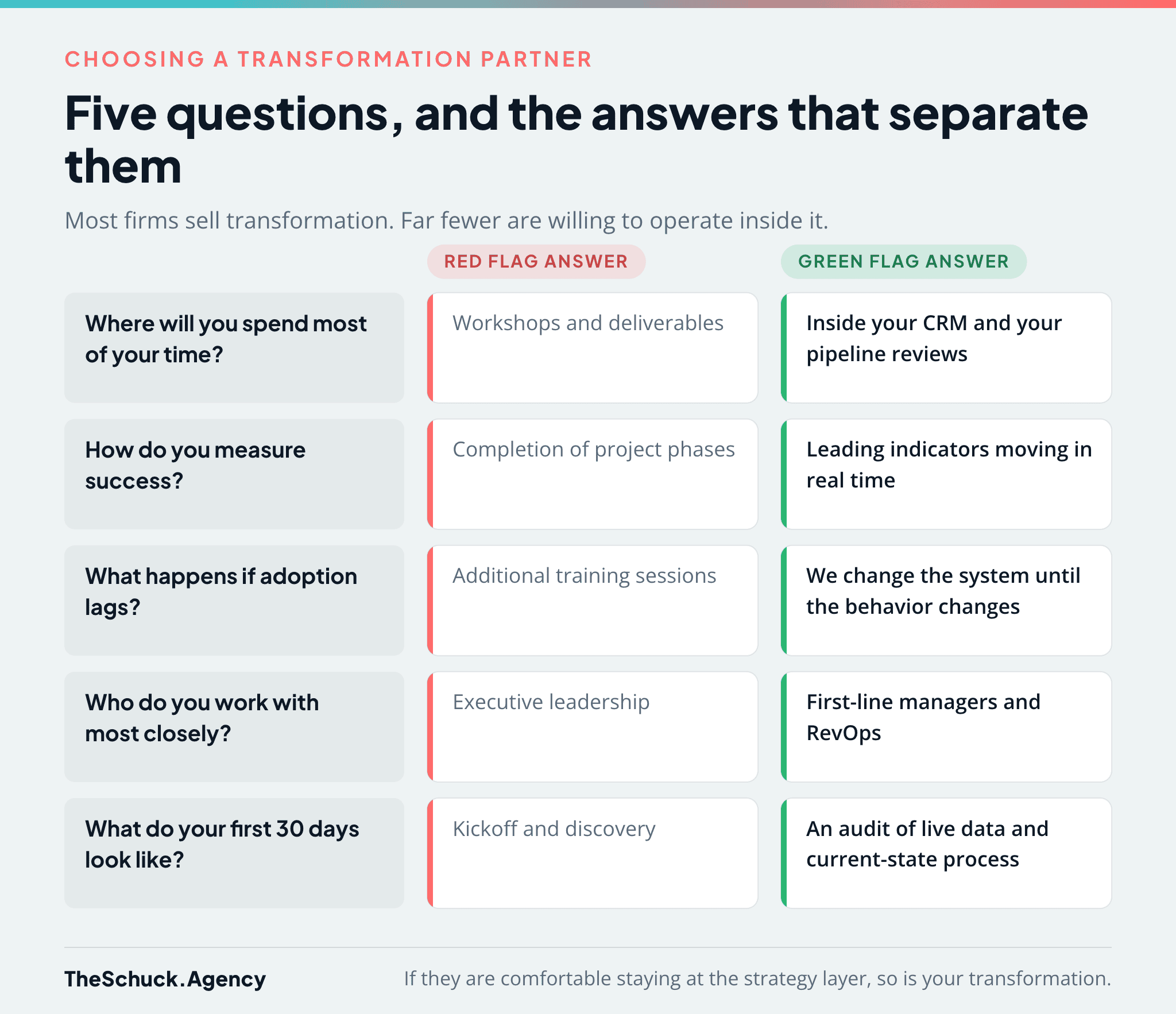
The right partner treats the engagement as an operating problem rather than a consulting project, which shows up as discomfort with any scope that excludes access to your CRM, your pipeline data, and your manager meetings. If a firm is comfortable staying at the strategy layer, your transformation will stay there too, and it will fail in the way strategy-layer transformations reliably fail.
One note on timeline. Meaningful evidence appears inside 60 to 90 days when the work is genuinely embedded, and a partner who cannot show you leading-indicator movement in that window is telling you something — either the approach is wrong or the engagement is not going deep enough to change anything. Ask at the outset which indicators they expect to move and by when, and hold the answer.
The bottom line for CROs and VPs of Sales
With average B2B win rates near 19% and roughly three in four sellers missing quota, sales transformation has stopped being a strategic option and become the difference between organizations that can explain their number and organizations that can only report it. The path forward is straightforward even where it is not easy.
- Audit first. Do not build on assumptions. Get into the live data before designing anything, because the problem you find is rarely the problem you were sold.
- Fund the middle layer. Your first-line managers are the transformation. Invest there disproportionately and the rest holds; skip them and nothing does.
- Measure leading indicators. Define what success looks like at 30, 60, and 90 days, not only at year-end, so you can still steer while steering is possible.
- Embed rather than consult. The plan is not the transformation. The behavior change is, and behavior only changes where someone is standing.
If you are not sure where your organization sits, start with the ten questions above. The answers will tell you more about your odds than any framework slide ever will, and they cost nothing but an honest hour.
TheSchuck.Agency works inside revenue teams as an embedded operator rather than alongside them as an advisor — starting with a rigorous audit of pipeline, process, and technology before recommending a single change, then staying in the operating rhythm long enough for the change to hold. That work begins with the 90-day B2B sales audit, and for teams that need the broader motion rebuilt alongside it, the go-to-market strategy consulting engagement picks up from there.
Frequently Asked Questions
What is sales transformation?
Sales transformation is a deliberate restructuring of the four systems that produce revenue: people, process, technology, and data. It goes beyond a single initiative such as a methodology rollout or a CRM migration, because the goal is measurably better and more predictable outcomes sustained over time rather than a one-off improvement. A useful test is whether the change survives a manager leaving. If it does not, what happened was a project rather than a transformation.
Why do most sales transformations fail?
Roughly 70% fail, and research summarized by Harvard Business Review attributes that to human and organizational causes rather than to flawed strategy or the wrong technology. In practice the collapse points are consistent: no diagnostic audit at the start, adoption handled as a communications exercise, first-line managers left out of the design, technology deployed without the process to make it usable, and success defined on lagging indicators that move long after the chance to intervene has passed.
How long does a sales transformation take?
Real evidence of change should appear within 60 to 90 days when the work is embedded in the operating rhythm, though full maturity across all four systems typically runs twelve to eighteen months. The distinction matters because leading indicators such as CRM data completeness, coaching cadence adoption, and forecast accuracy trend move inside the first quarter. If none of them has shifted by day 90, waiting longer rarely helps.
What metrics show a sales transformation is working?
Track leading indicators early and outcome metrics later. In the first quarter, watch CRM data completeness and stage hygiene at 60 days, manager coaching cadence adoption at 30 days, rep methodology adherence at 45 days, and the direction of forecast accuracy at 90 days. Outcome metrics such as win rate, quota attainment, and pipeline coverage confirm the result in the 90 to 180-day window, but they arrive too late to steer by.
Who owns a sales transformation?
Executive sponsorship usually sits with the CRO or VP of Sales, and it is necessary without being sufficient. The people who determine whether the change survives are the first-line sales managers, because they run the weekly one-on-ones, the pipeline reviews, and the coaching conversations where behavior is either reinforced or quietly abandoned. RevOps owns the definitions, fields, and reporting discipline that keep the new standard from drifting once attention moves on.
Should we run a sales transformation internally or bring in a partner?
Plenty of transformation work can be run internally by a strong team with the bandwidth to do it, and doing so builds capability that stays. Outside help earns its keep when the organization is too close to its own system to see where it bends, when a previous attempt has already failed and credibility is thin, or when nobody internally has the time to sit inside pipeline reviews every week for a quarter. If you do bring someone in, choose the partner by where they will spend their hours rather than by the framework on their website.